Tag Archives: #art

James Jean: Eternal Spiral IV

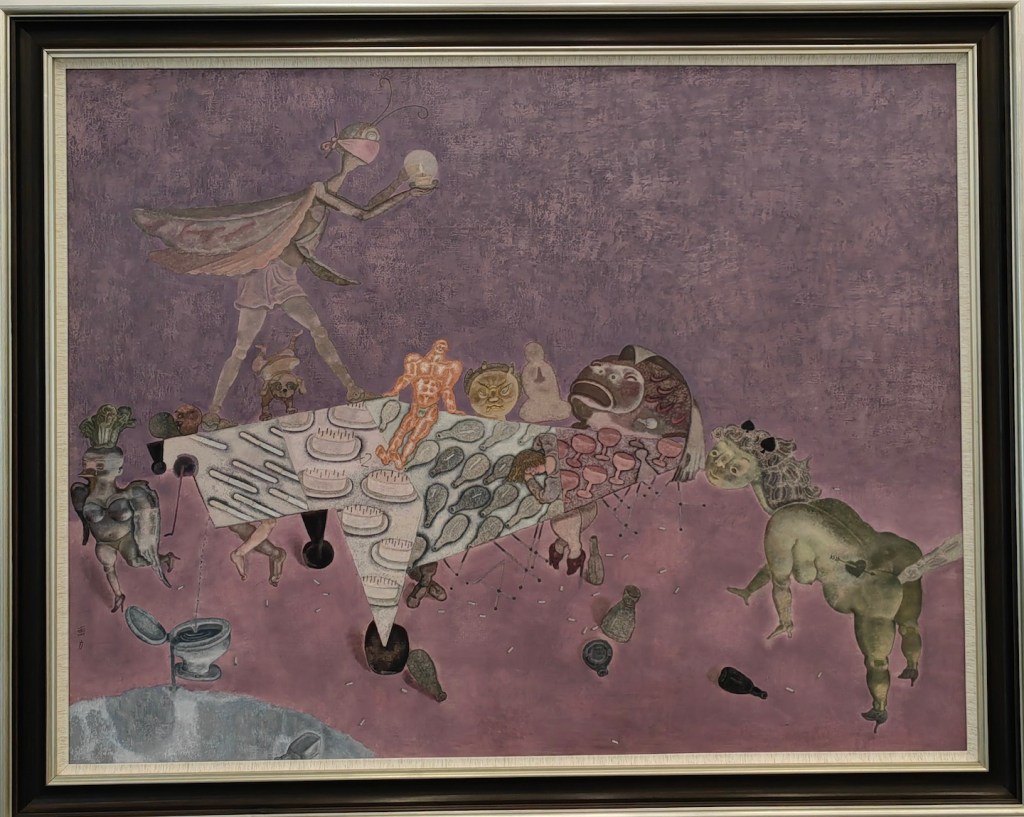
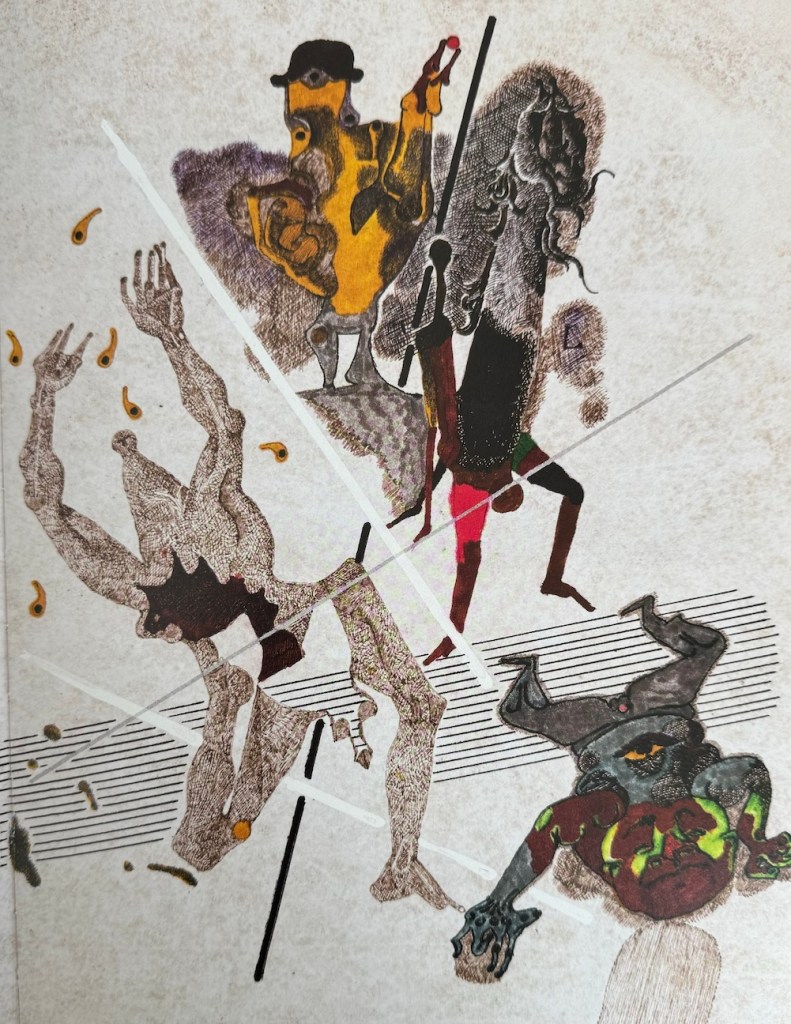
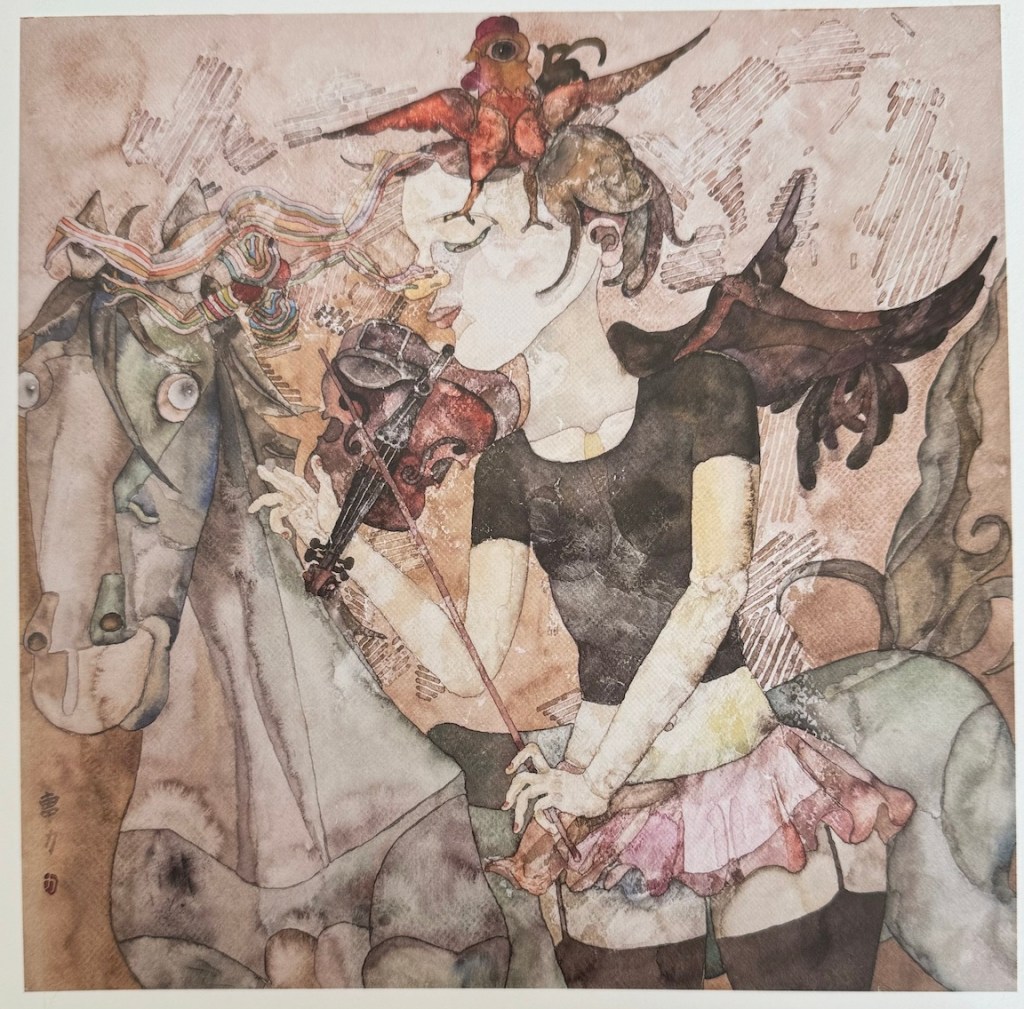
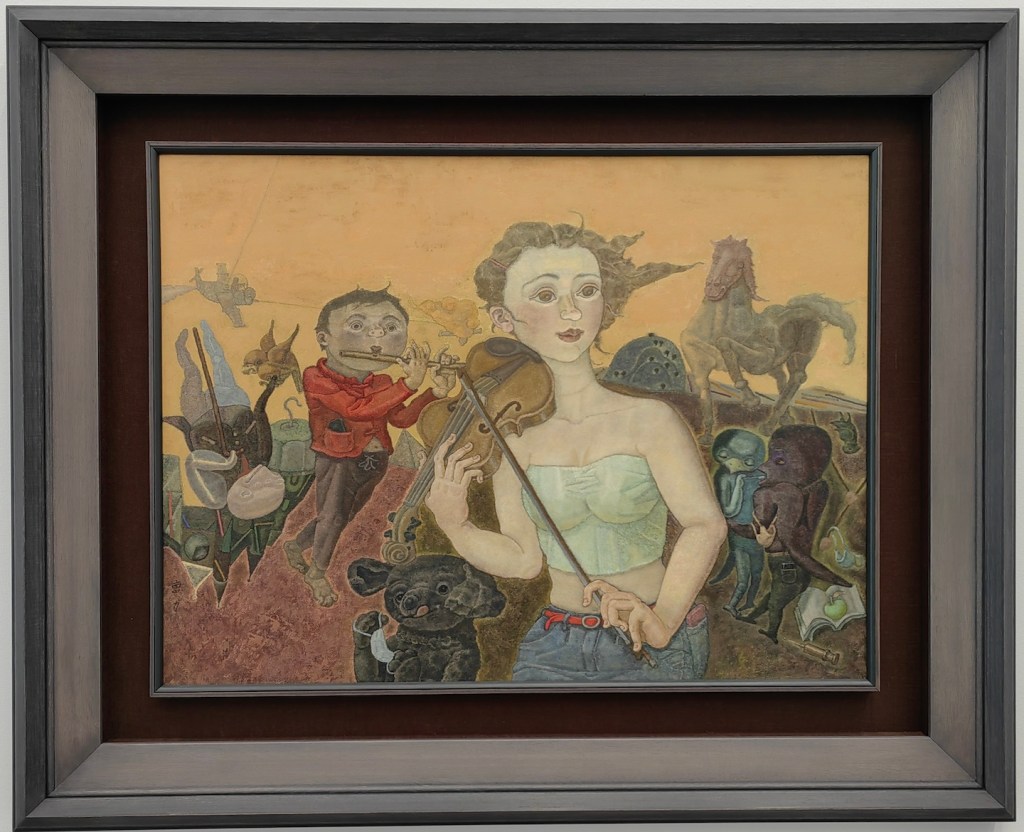
Recently in Beijing, I had the chance to visit Eternal Spiral IV, an exhibition by Taiwanese-American artist James Jean. It was a revelation. Jean began his career working for DC and Marvel, before transitioning fully to fine art in 2008. This exhibition showcases more than 200 pieces spanning over two decades of his creative journey, including paintings, sculptures, animations, installations, and even tapestries—a true multimedia experience.

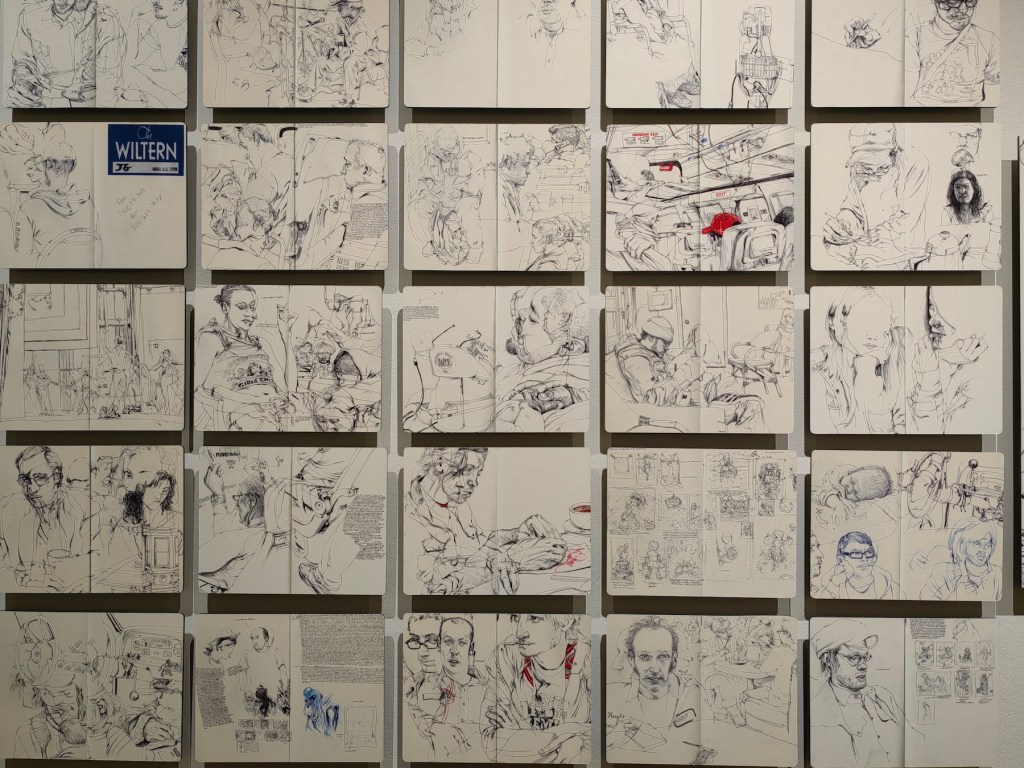
The exhibition begins with Jean’s sketchbooks and drafts. These aren’t just technical studies; they offer a rare glimpse into his process. His lines are filled with energy, precision, and constant revision. As someone who has always been afraid to sketch freely, seeing how even a master like Jean frequently changes his mind, makes mistakes, and abandons ideas was oddly reassuring.  It made me realize that sketching is a form of exploration, a space to make mistakes and grow, not something to shy away from due to fear of imperfection.

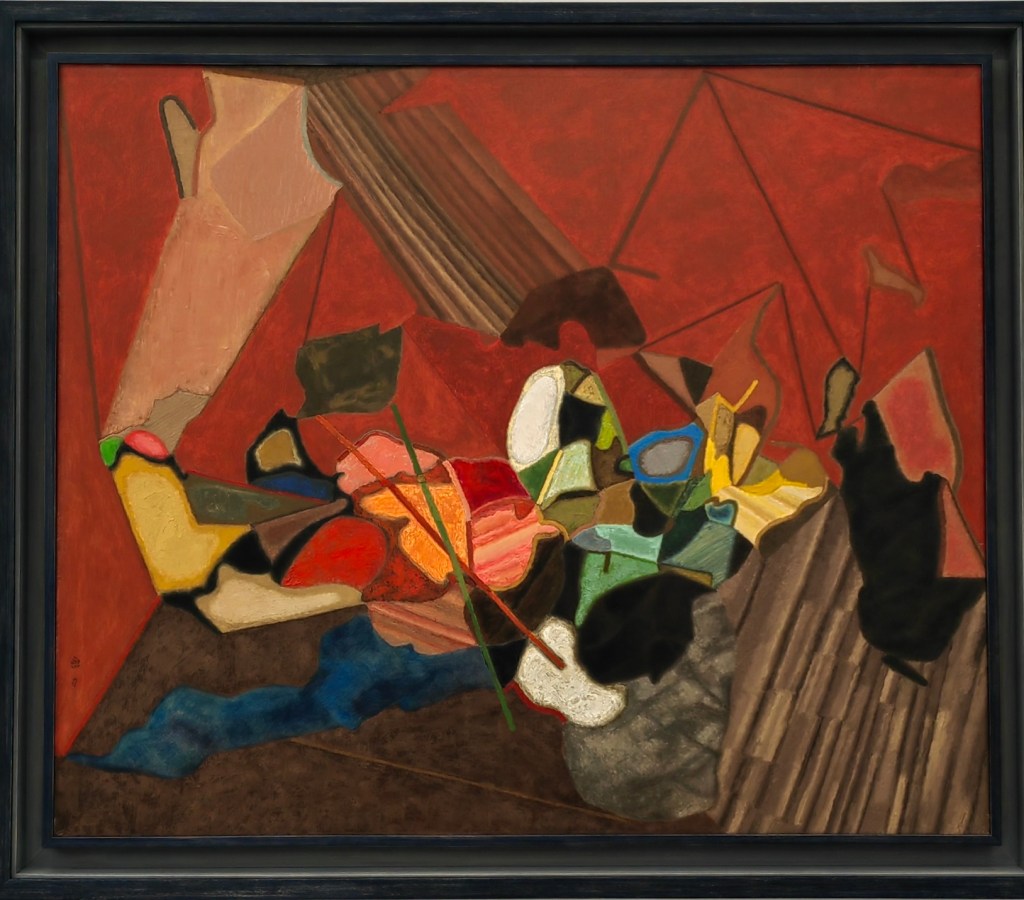
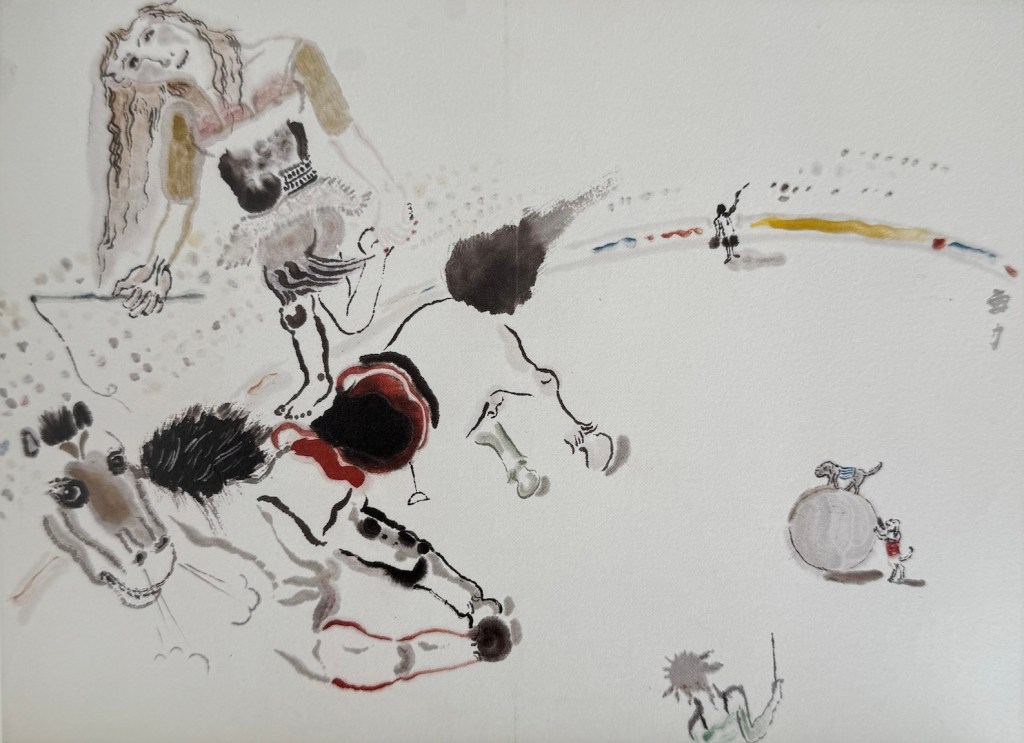
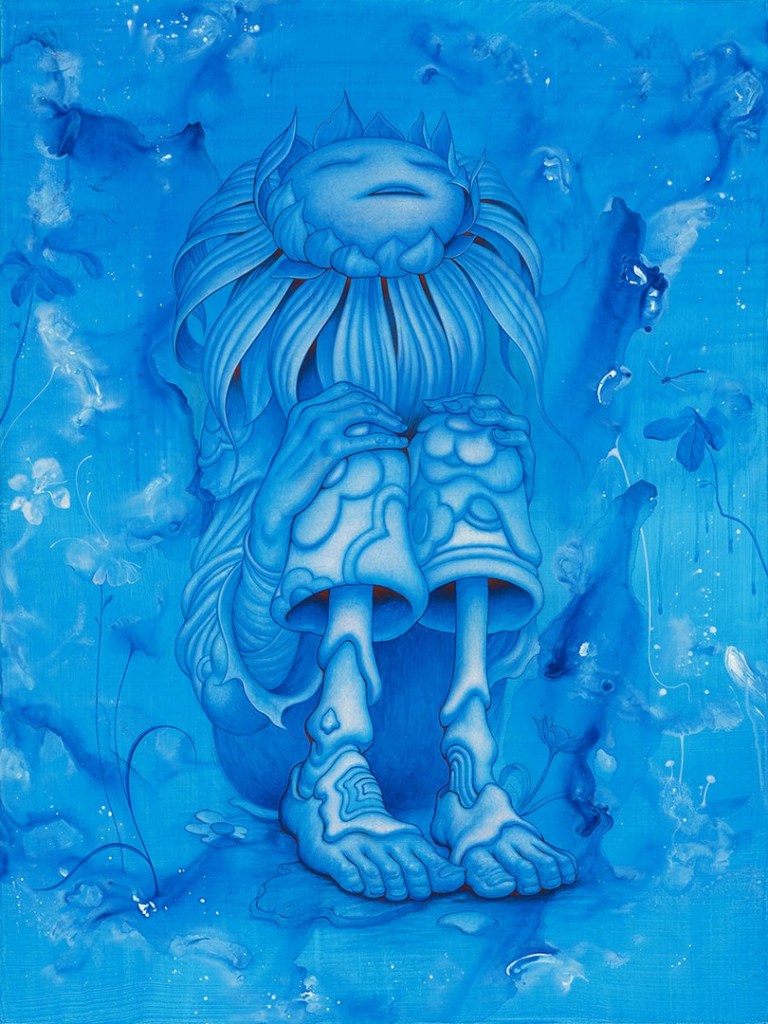
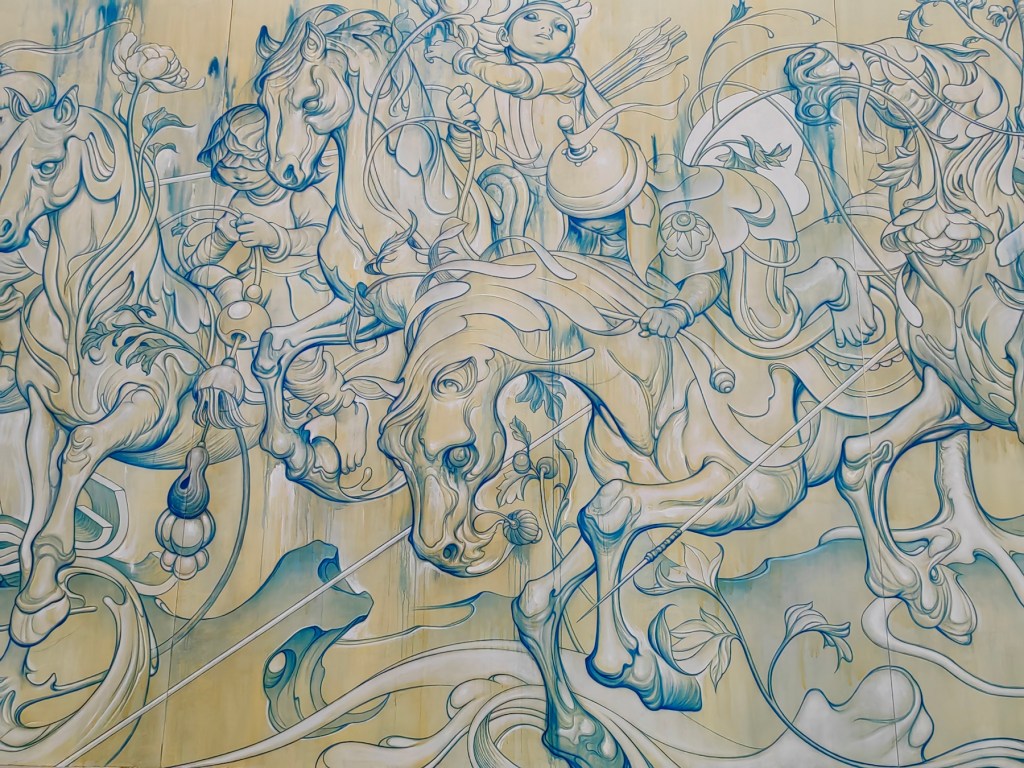
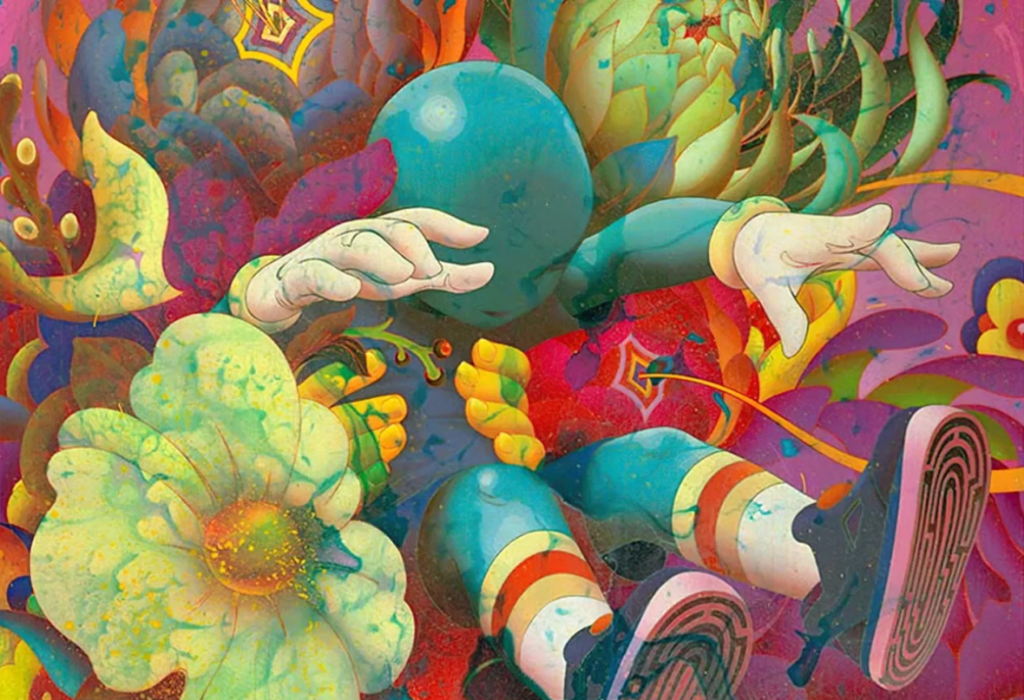
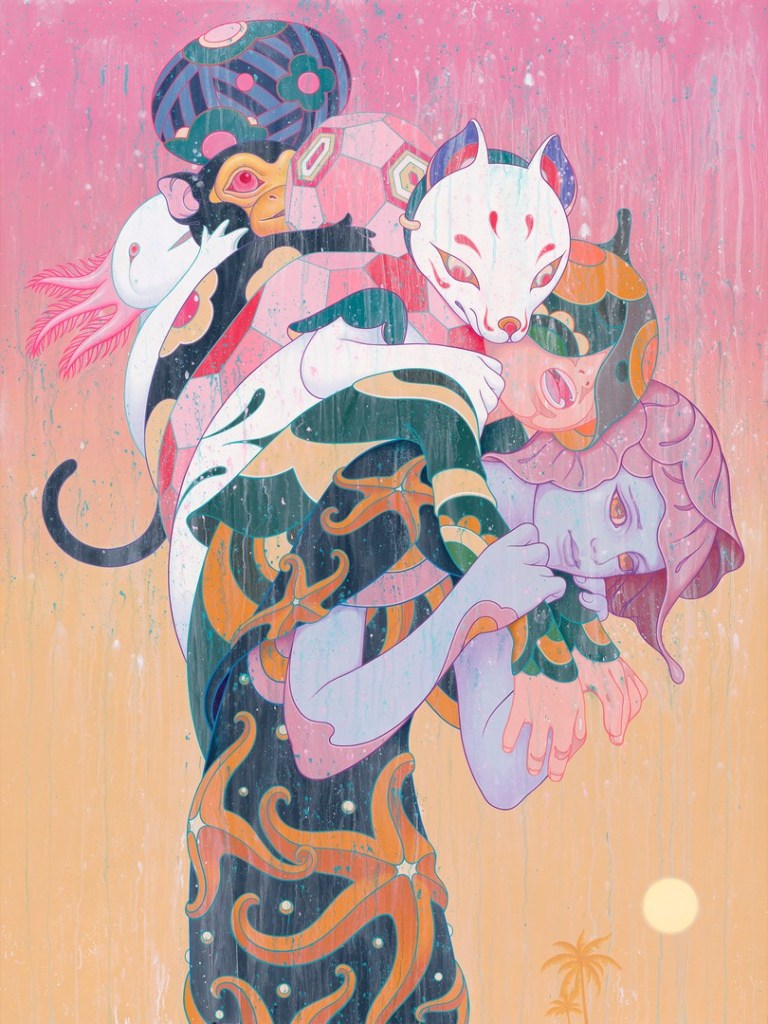
From sketches, the exhibition moves into Jean’s paintings, mostly done in acrylic. His style is a fusion of cultural influences that reflects his identity as a “cultural nomad.” He draws from sources as varied as Chinese scroll paintings, Japanese woodblock prints, and Baroque art, blending them seamlessly with contemporary culture and digital techniques. The result is a layered, intricate narrative that feels at once both timeless and modern. His dream-like compositions often depict creatures and plants spilling out of the canvas, creating fantastical worlds where reality and fantasy blur together. These hallucinatory landscapes are vibrant yet tranquil, chaotic yet serene—like stepping into someone else’s dream. He plays with delicate lines and bold colors, using vibrant pinks, blues, oranges, and golds to make his worlds feel alive. “I enjoy making colors vibrate against each other to create sparks in the eye,” Jean said. 

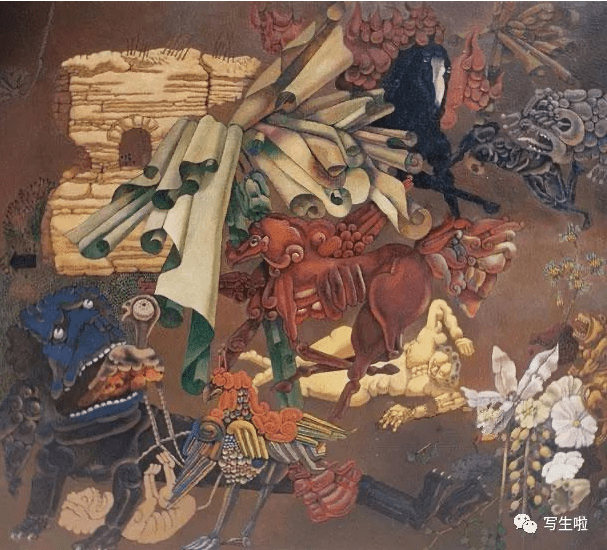
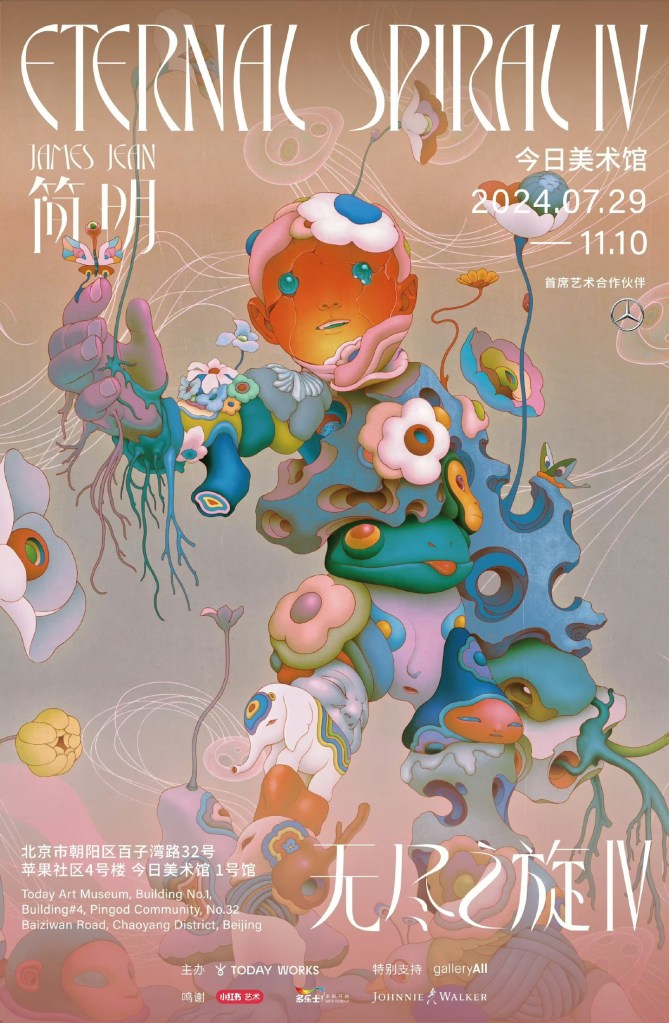
The keynote painting of the show was Jean’s newest piece, Chimera, inspired by a visit to the Kaiyuan 开元 Temple in Quanzhou 泉州, Fujian 福建. The temple’s “Kirin Wall” and the tangled banyan roots influenced the composition, which also weaves in Jean’s personal family history. His ancestors were from Fujian, but much of that history was lost when his grandparents moved to Taiwan. In Chimera, the roots reach out, searching for something to grasp, much like Jean’s own search for his heritage. Quanzhou happened to be my ancestral home too, and I have visited Kaiyuan Temple as a child. To some extent, I resonate with the tension between the desire to search for one’s root and the acute sense of disconnection. Jean has talked about the creation of this painting on his Instagram

Chimera as the poster of Eternal Spiral IV

One particularly unique aspect of this exhibition is how it integrates social media. Jean, who has over a million followers on platforms like Instagram and Xiaohongshu 小红书, included 11 time-lapse videos of his creative process.  I’d never seen social media incorporated into a gallery setting like this before, and it added an intriguing link between the fantasy world create by the artist and the mundane modern life. 

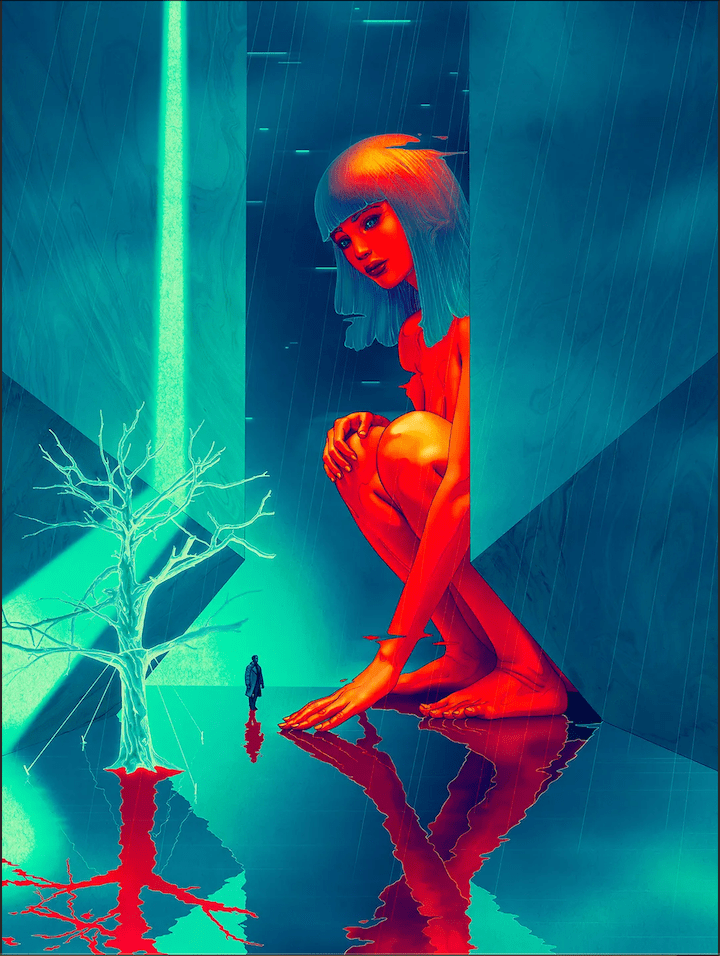
The show includes prints of Jean’s series “Seven Phases,” a collection of 7 paintings representing each member of the beloved K-pop group BTS in the “spirits of flowers”. There are also prints of posters he designed for films like Everything Everywhere All at Once and The Shape of Water. Guillermo del Toro personally asked him to create the poster for the latter, which he rendered in vivid charcoal. My favorite is his poster for Blade Runner 2049— romantic and surreal. Jean’s ability to move between fine art and pop culture, and across different media, speaks to his versatility and boundless creativity.

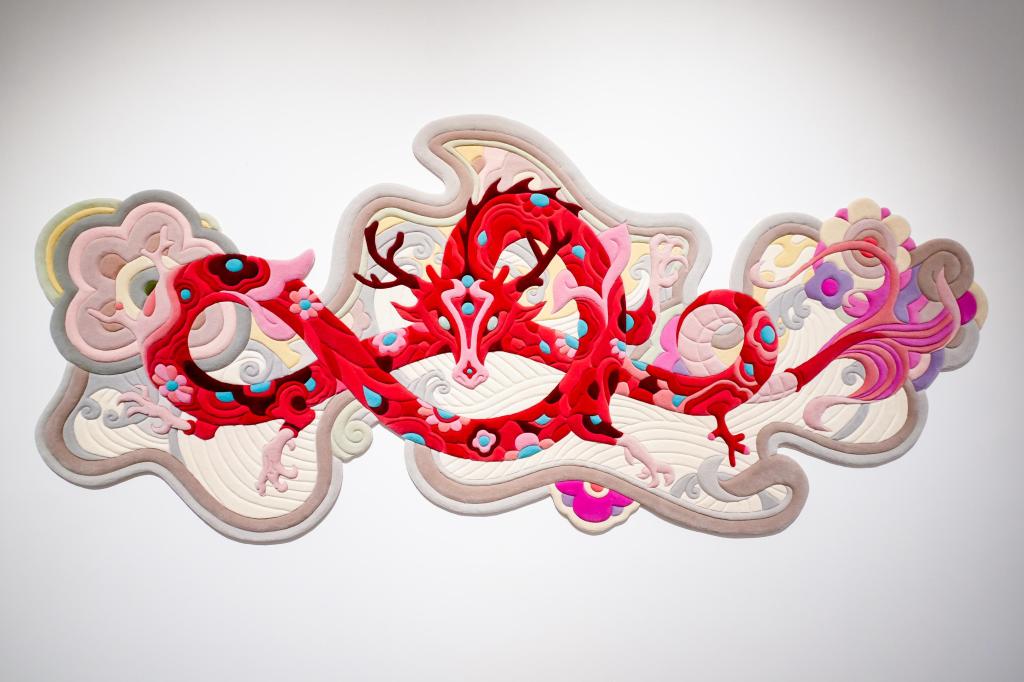
A surprise for me was Jean’s love for tapestries. He has engaged with this unconventional medium for a while and his 2024 piece Year of the Dragon made its debut here. It features a dragon—one of the most powerful figures in the Chinese zodiac—woven from a mix of flowers and plants. The dragon symbolizes strength, but Jean reinterprets it in his signature style, making it feel both traditional and personal. This reimagining of cultural symbols is a recurring theme in his work.

Jean’s versatility doesn’t stop with tapestries. His sculptures, some standing over three meters tall, bring characters from his paintings into the physical world. They blend European myths, Asian folklore, and fairy tale elements. Some sculptures are based on the artist’s painting, and shown with large-scale animation, completing the cycle from 2D to 3D to “4D.”

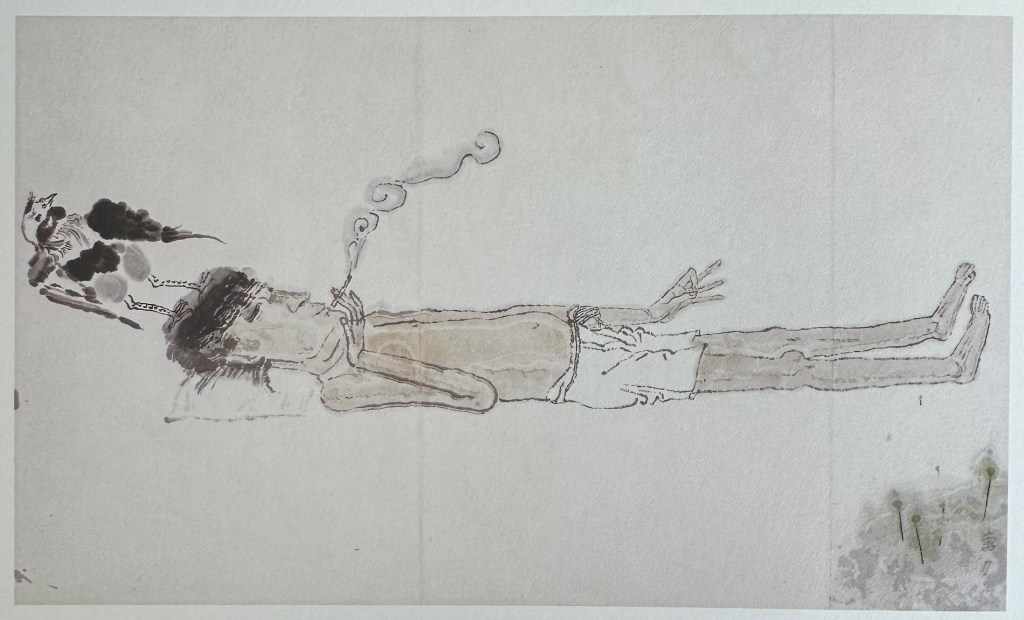
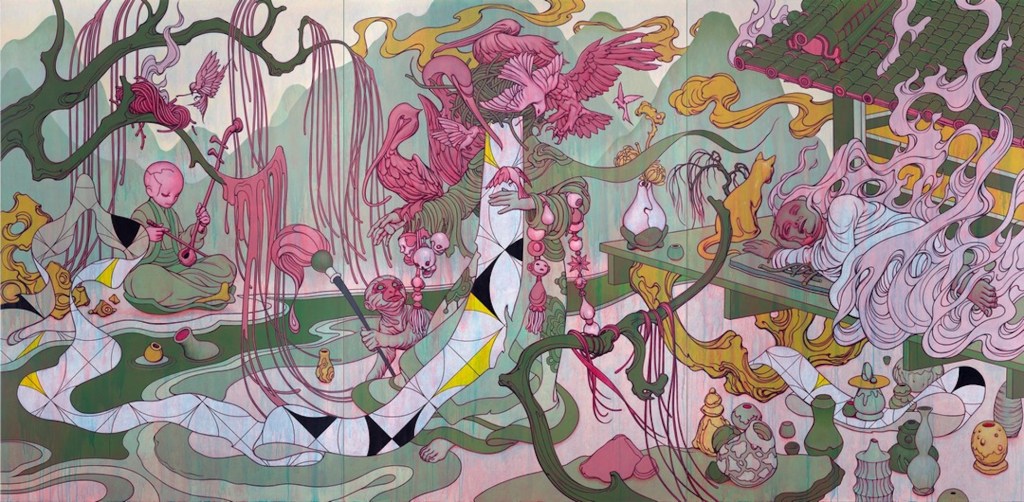
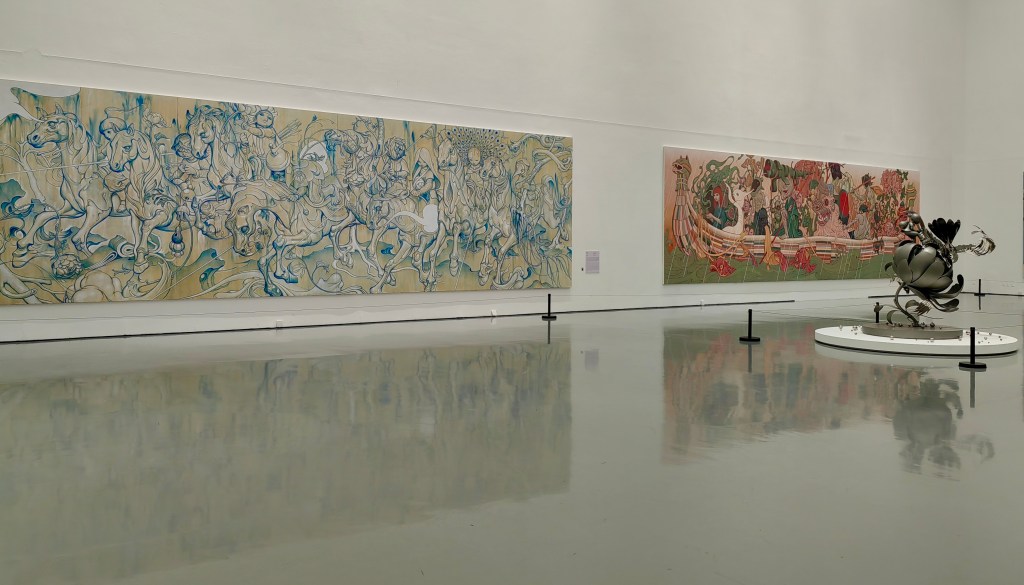
The final room of the exhibition left me in awe. Six massive paintings, each over 10 meters long, sprawling yet detailed, demonstrating Jean’s ability to create on both an epic and intimate scale. Descendants—Blue Wood, inspired by Seoul’s Lotte World Tower and the fairy tale Jack and the Beanstalk. Aviary depicts an imagined world inspired by Chinese folk legends. Monks, bird deities, erhu … many traditional Chinese elements intertwine, emerging from the mind of a sleeping monk enveloped in flames. An enigmatic dreamscape!

Aviary, acrylic on three canvases, 246 x 120”

Eternal Spiral IV is more than just an exhibition of James Jean’s talent; it’s an invitation into his ever-shifting, multi-dimensional world where dreams, myths, and reality collide. It left me in awe and inspired. In Jean’s own words, “ultimately, it’s about having the freedom to create whatever imagery I want.” I believe that freedom comes from his impeccable skill and dedication to art. While Jean’s art has a distinct style, but he has managed to breakthrough with constant searching for both meaning and new ways of expression. 

Did I mention that his first NFT “Slingshot” was sold at $469,696.35? I have also picked up my long abandoned sketchbook. 🙂

Slingshot (3m tall statue, part of the “Pantheon” collection in the show)

Some Filler Projects

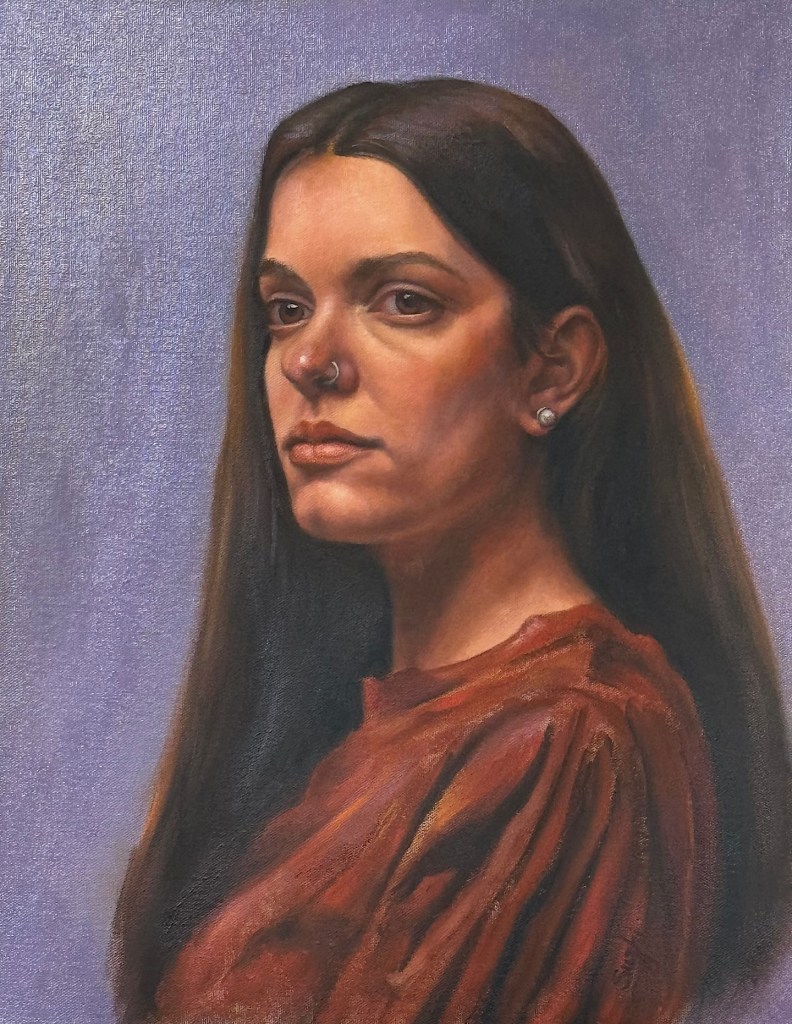
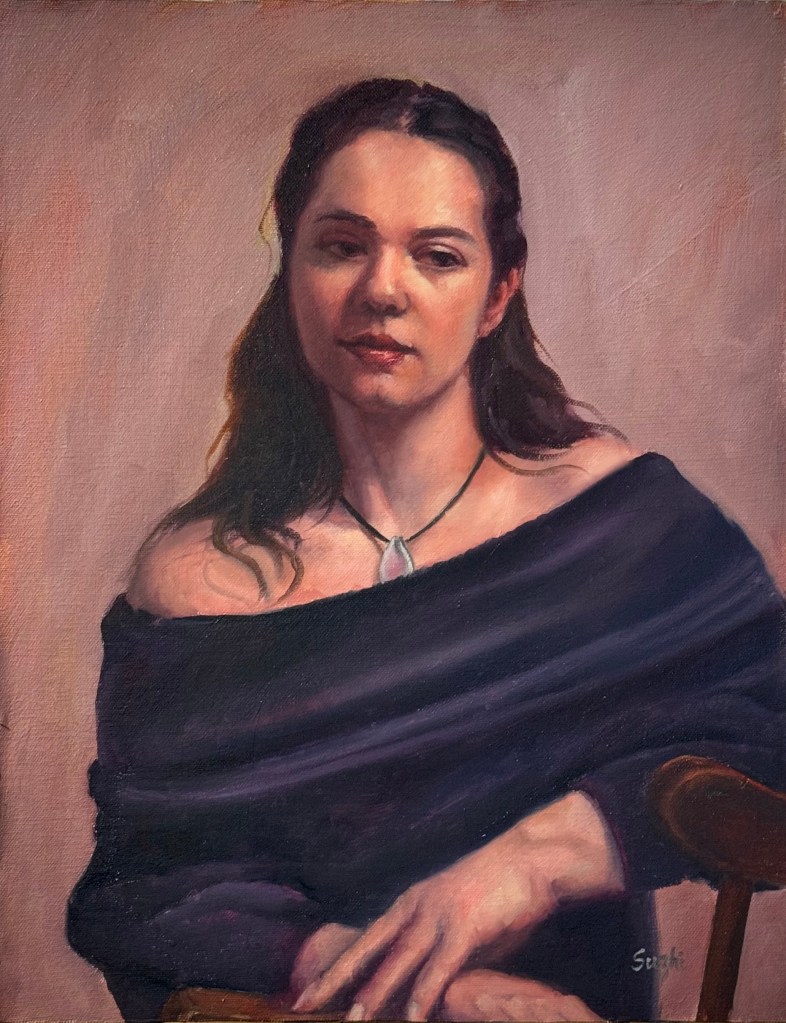
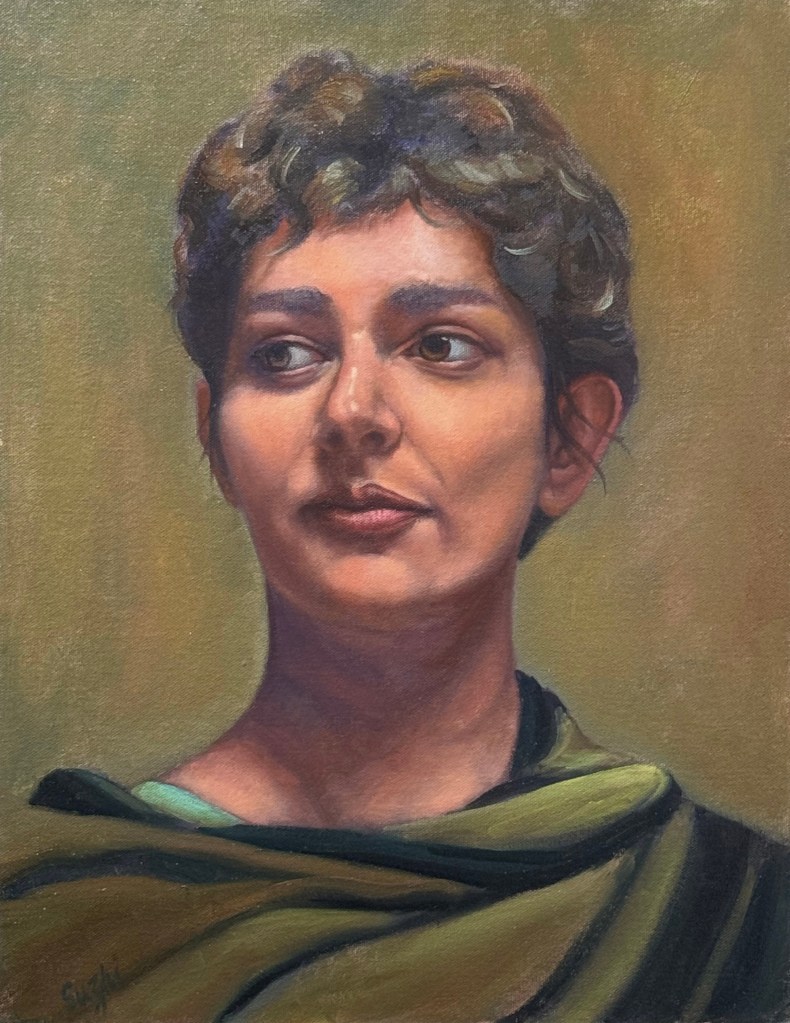
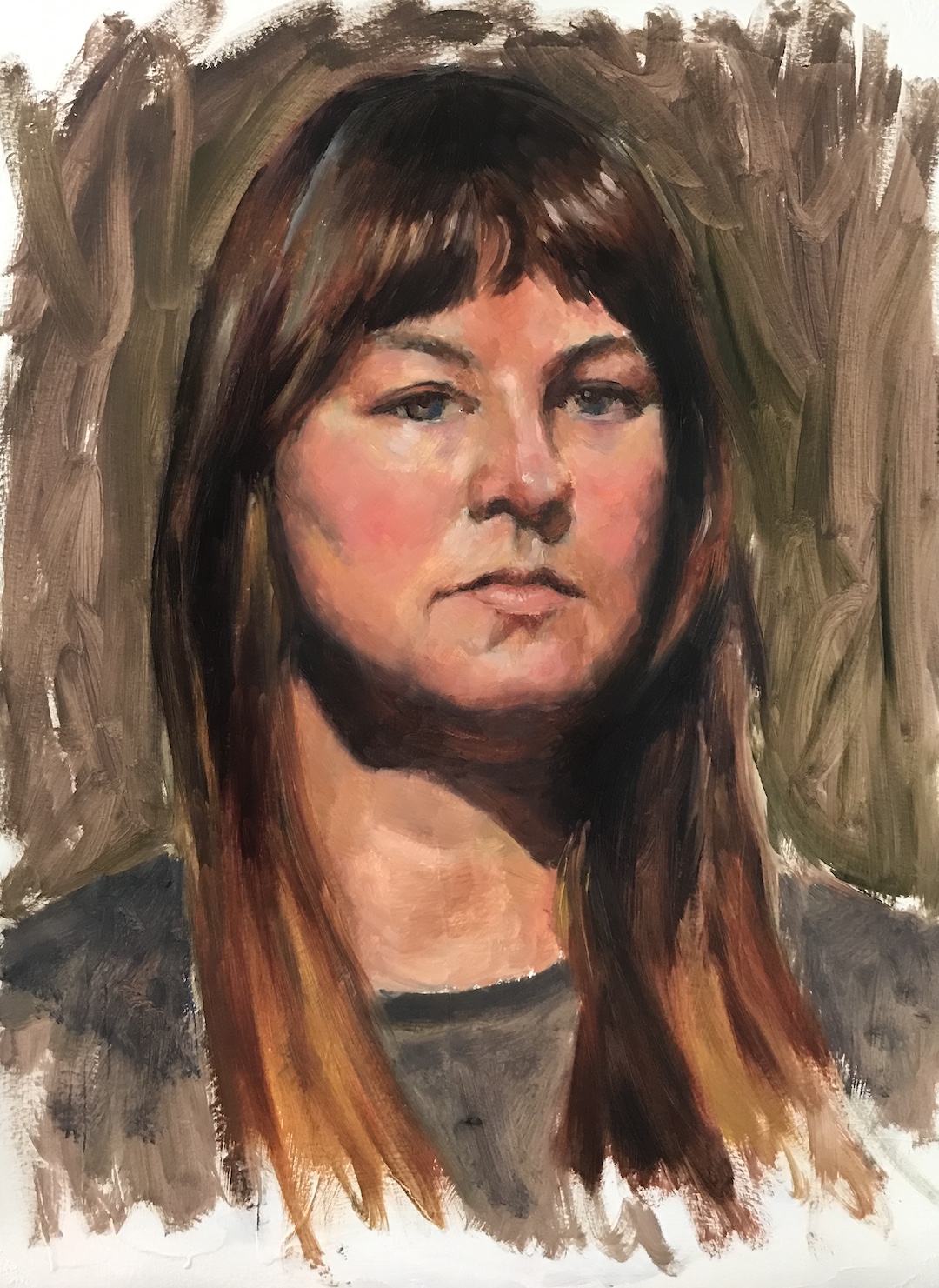
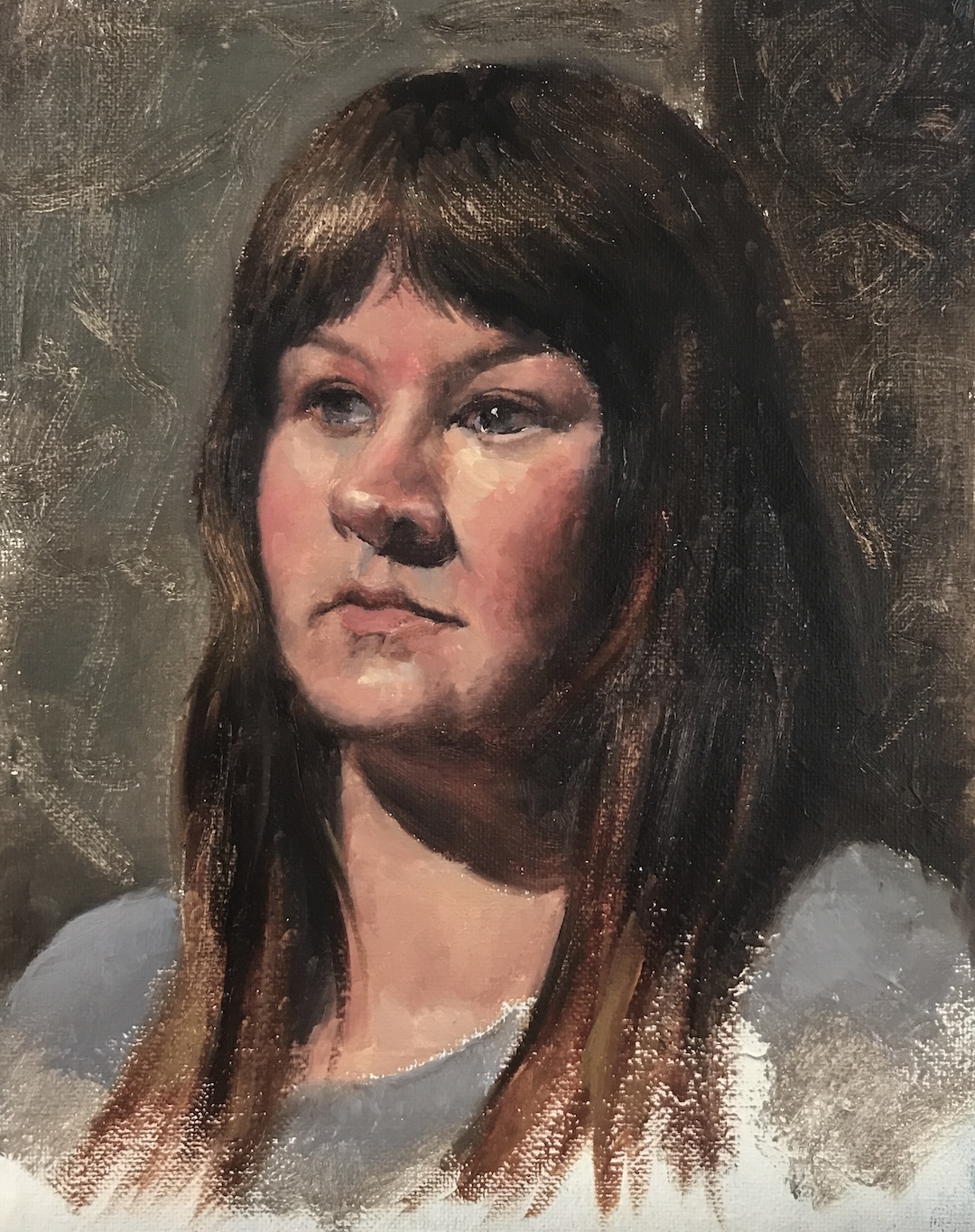
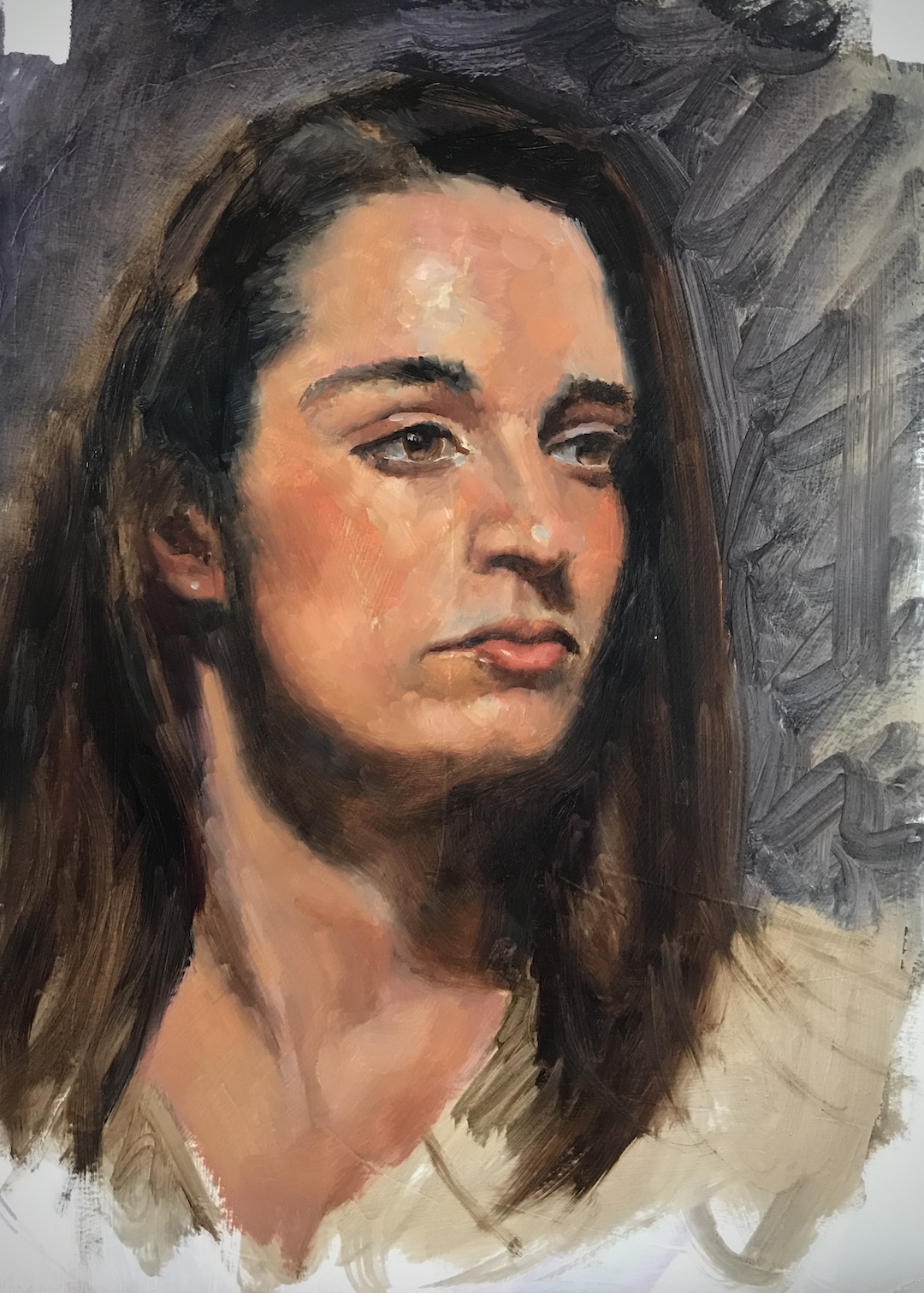
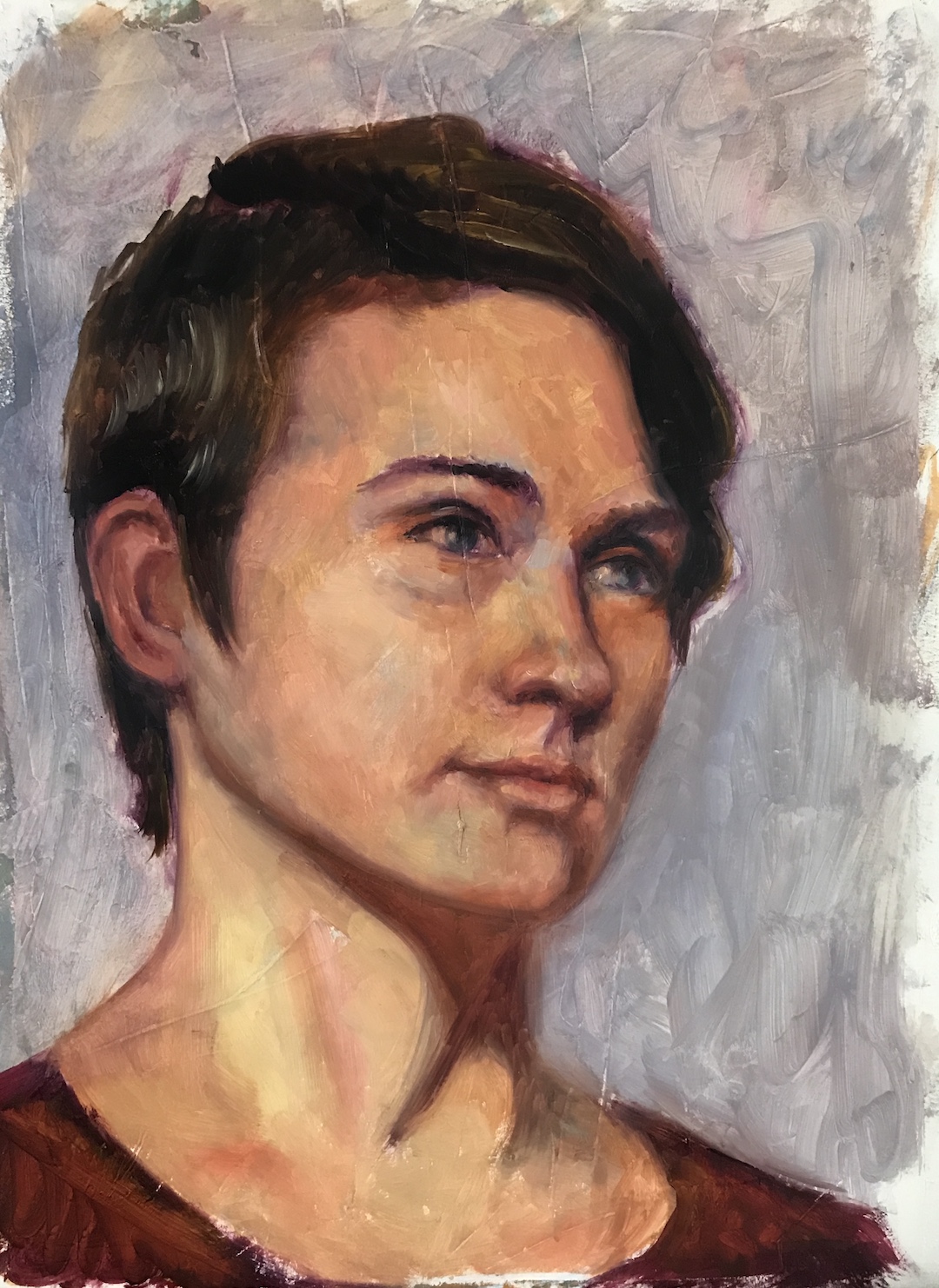
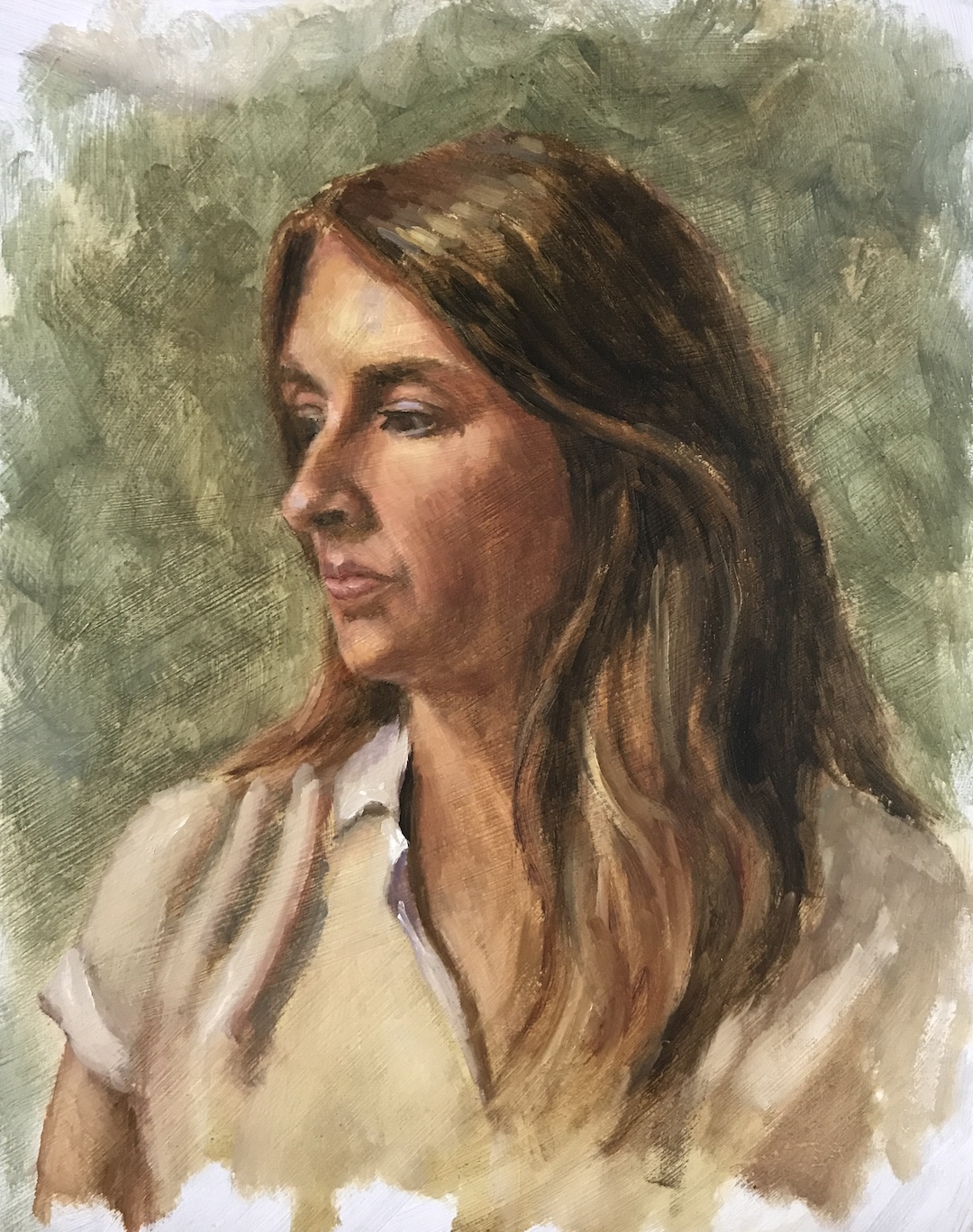
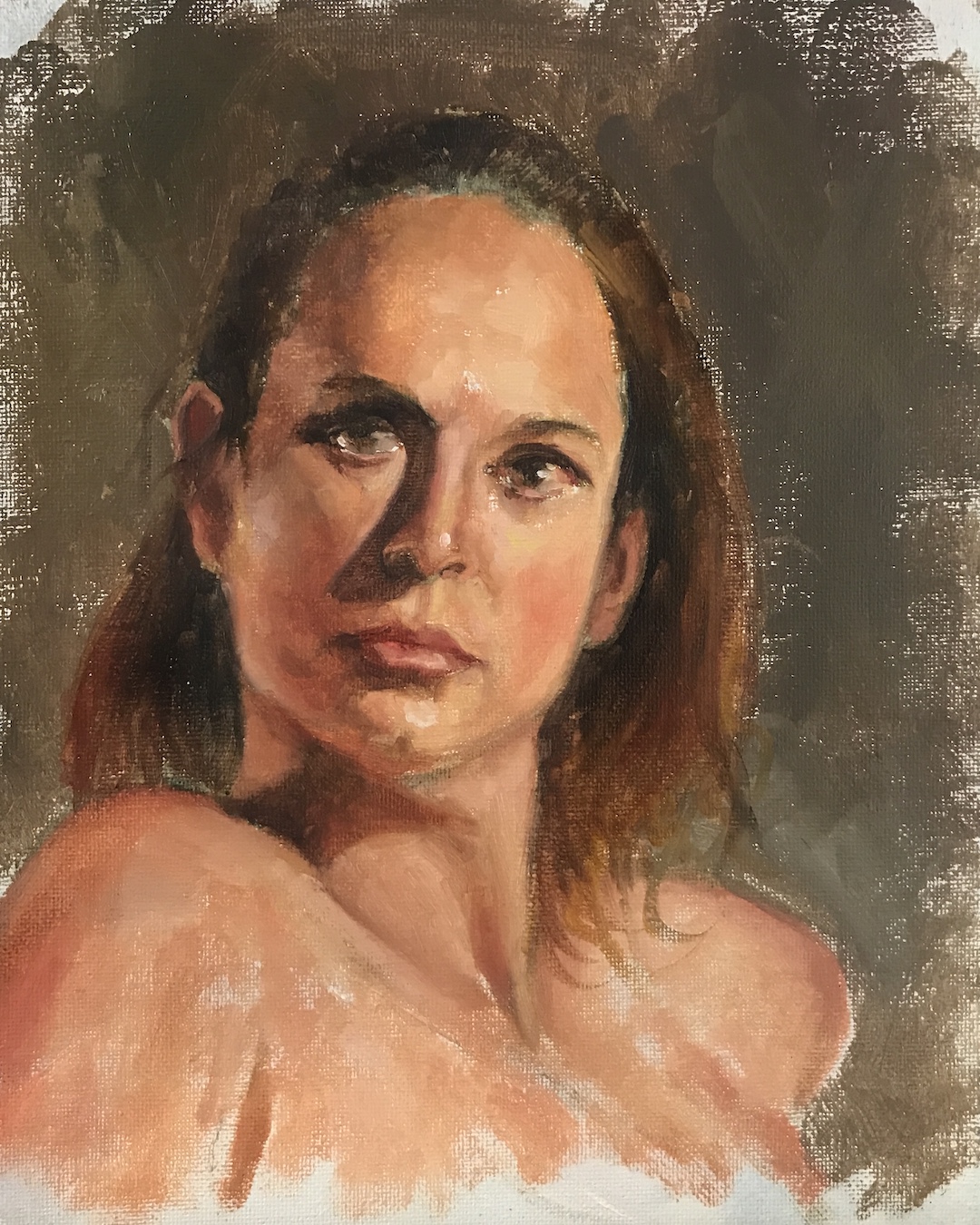
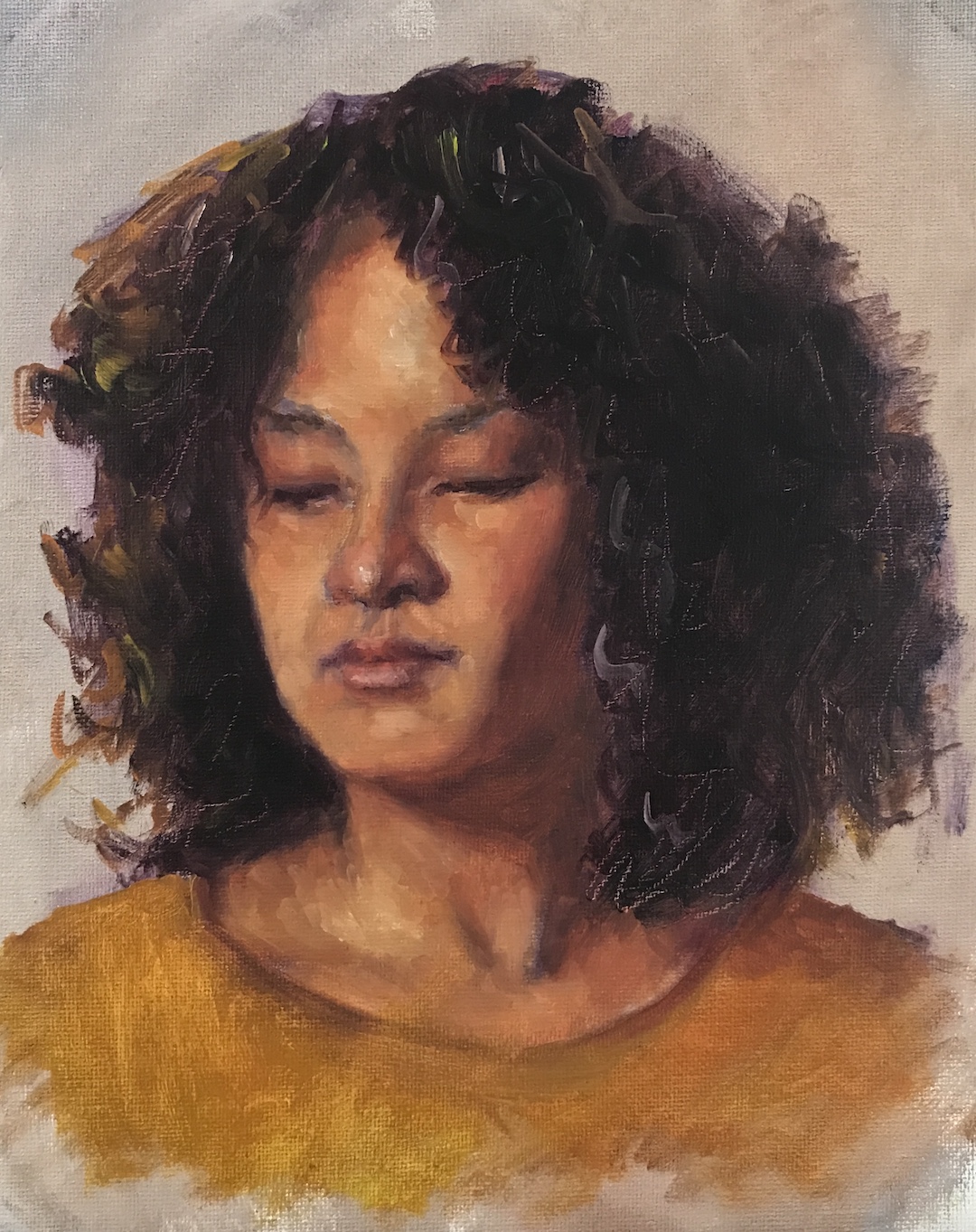
There are a couple of still life projects ongoing, and in between, I completed a few portraits using models from East Oaks Studio’s live streaming. Previously I focused on trying to finish the sketch, smaller in size, within 2 to 3 hours, aligning with each streaming session. This time, I used bigger panels, and allowed myself as much time as I wanted. The results are more rendered and complete-looking pieces:

Evee, oil on canvas panel, 14 x 18 in, July 2024
Tina, oil on canvas panel, 14 x 18 in, July 2024
Kailey, oil on canvas panel, 14 x 18 in, July 2024

A few notes:

  • I call these “filler projects” because they were not part of my summer plan. However, I find that while waiting for a layer to dry, or stalling at certain stages of the painting, doing something different alleviates my anxiety. It’s so much better than idling around not achieving anything!
  • I neither went for close likeness nor the exotic look in my previous Schiele-ish attempt. However, I do feel that Schiele exercise has left its mark.
  • For me, the greatest gain from these paintings is that I have started to consolidate my method. In each case, I started with a Zorn palette, and added to it as I went on.
  • Mix it up and never stop painting!
Channeling a Bit of Schiele?

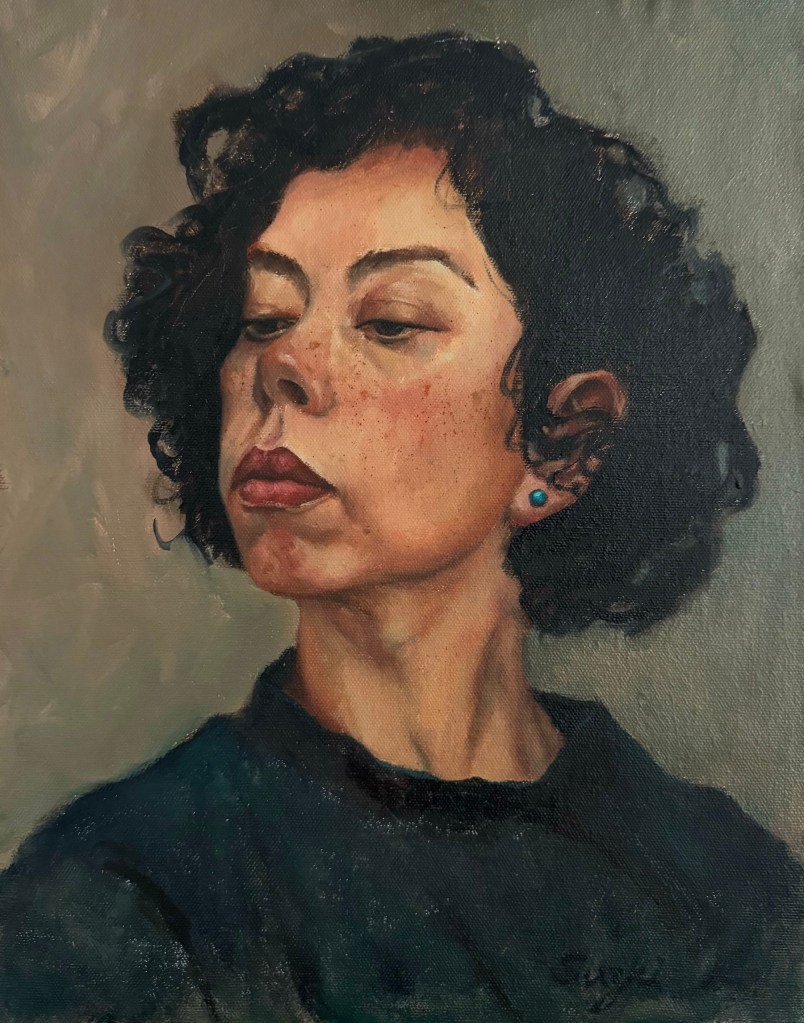
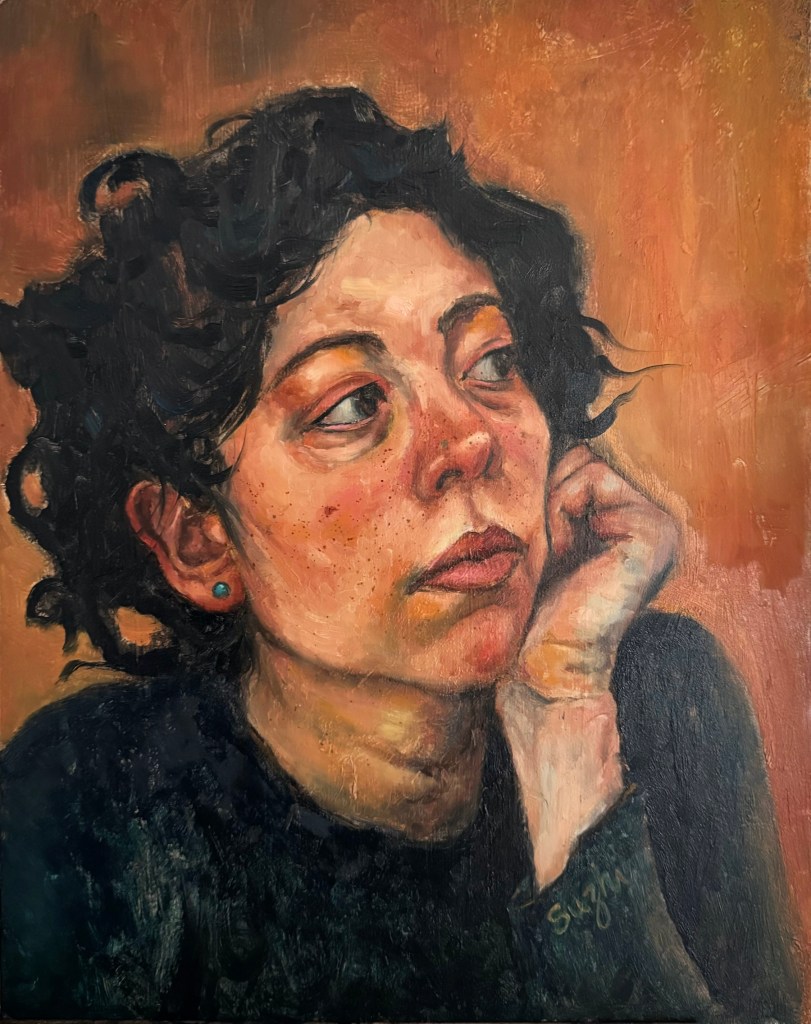
Feeling a bit lost with my portrait practice recently, I ventured to try something new. I was attracted to the works of the Austrian Expressionist, Egon Schiele (1890 -1918) by his unique use of colors and lines, and his focus on conveying strong emotions. After indulging myself with his art for a while, I have a desire to break from likeness and accuracy and focus on a feeling, a mood, or an air. Hence the following:

Monica, oil on canvas board, 11 x 14, May 2024
Still Monica, oil on canvas board, 11 x 14, May 2024
Annie, oil on canvas board, 11 x 14, May 2024

A few notes:

  • These are not done as studies of Schiele. I personally don’t think his style is replicable.
  • I tried to manipulate the mood with different color schemes.
  • I deviated from the reference a lot, with invented or exaggerated expressions.
  • As always, I found my shaky mastery of anatomy and the lack of understanding of the light effects the biggest barriers to go further in creation.
  • I am not sure where I go with this: it is fun to do something different, but it is also a painful reminder that I need to practice the basics more.
  • But again, did I say it is fun? So at least once in a while …

Fruits, Eggs, and More

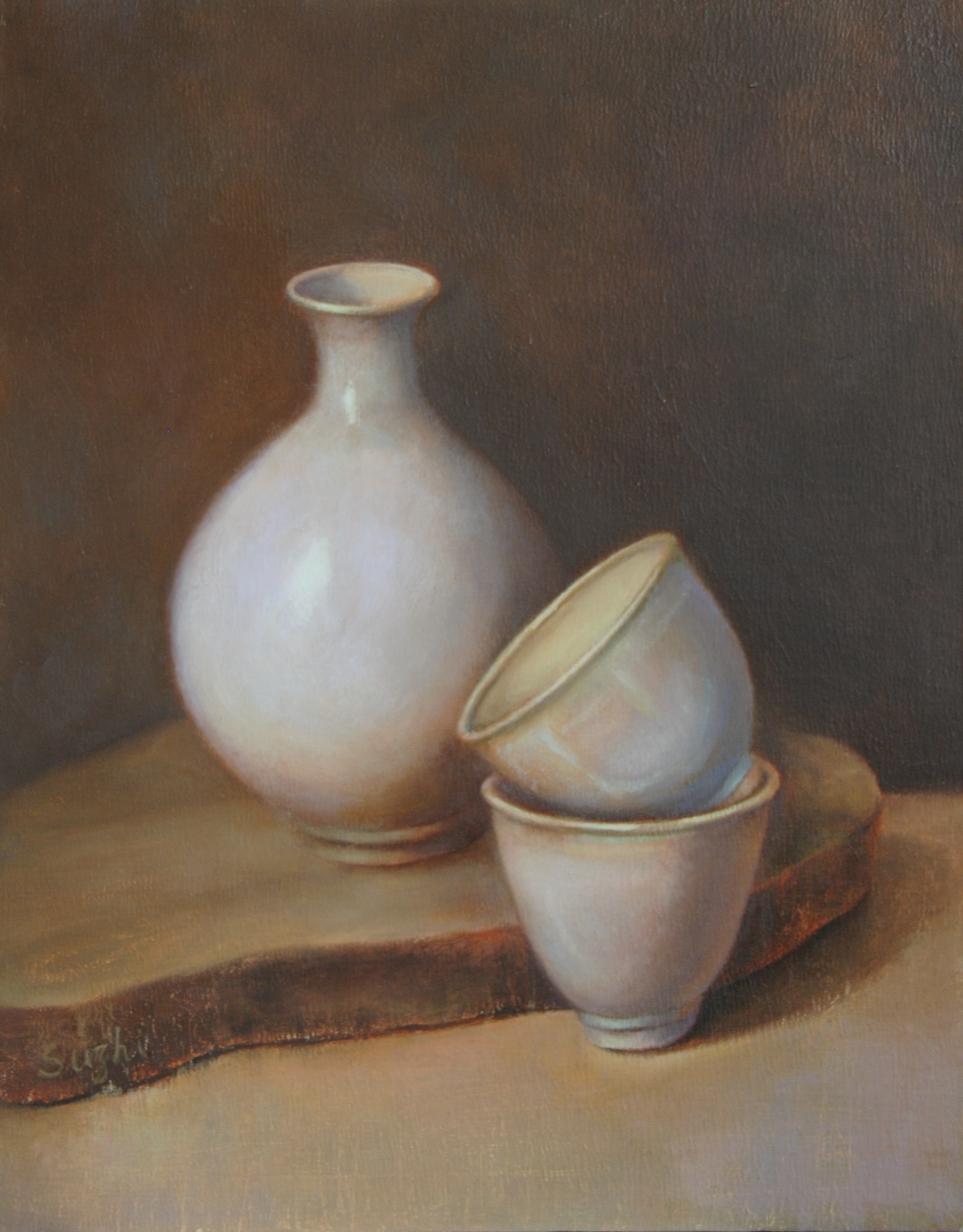
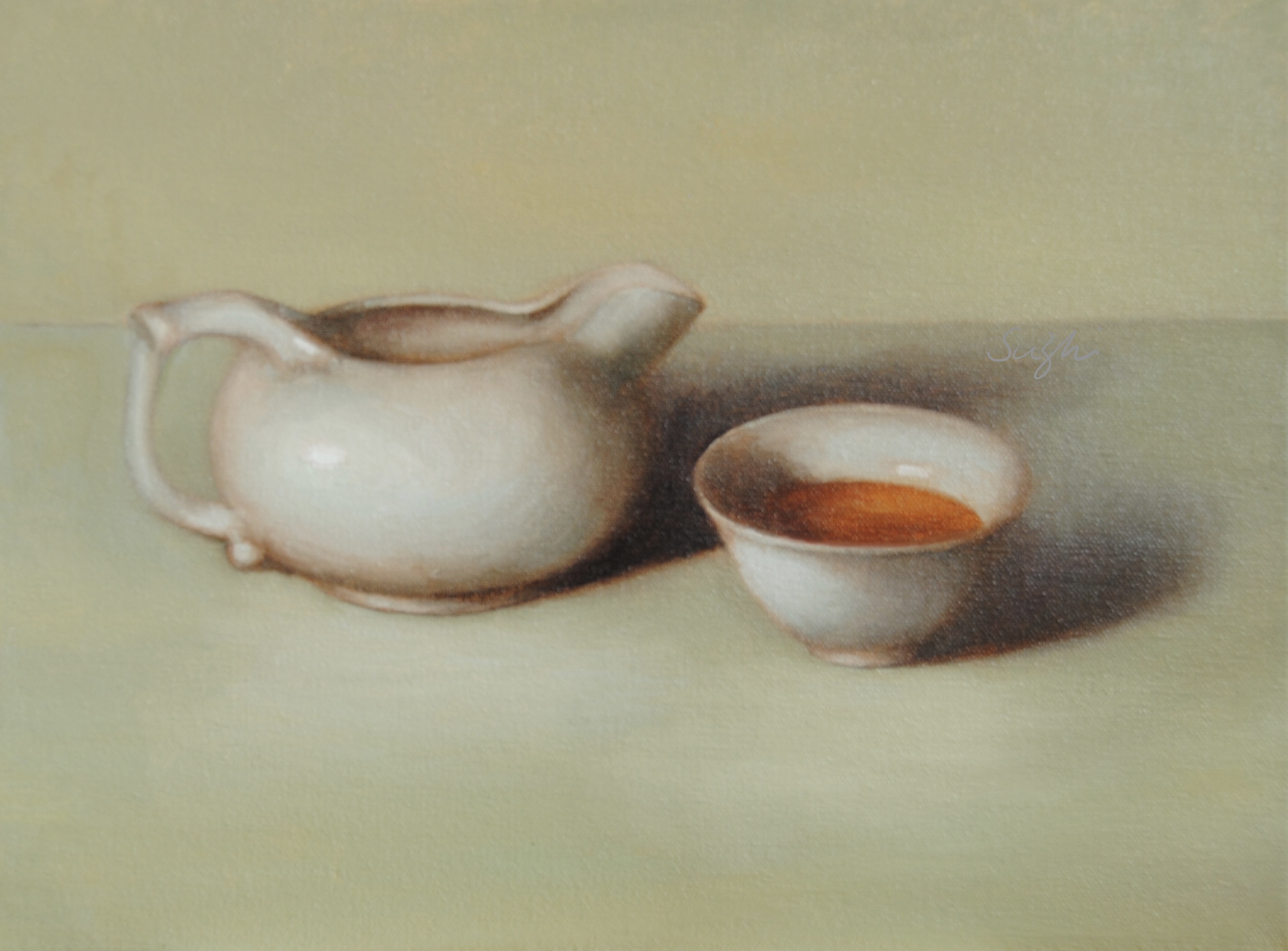
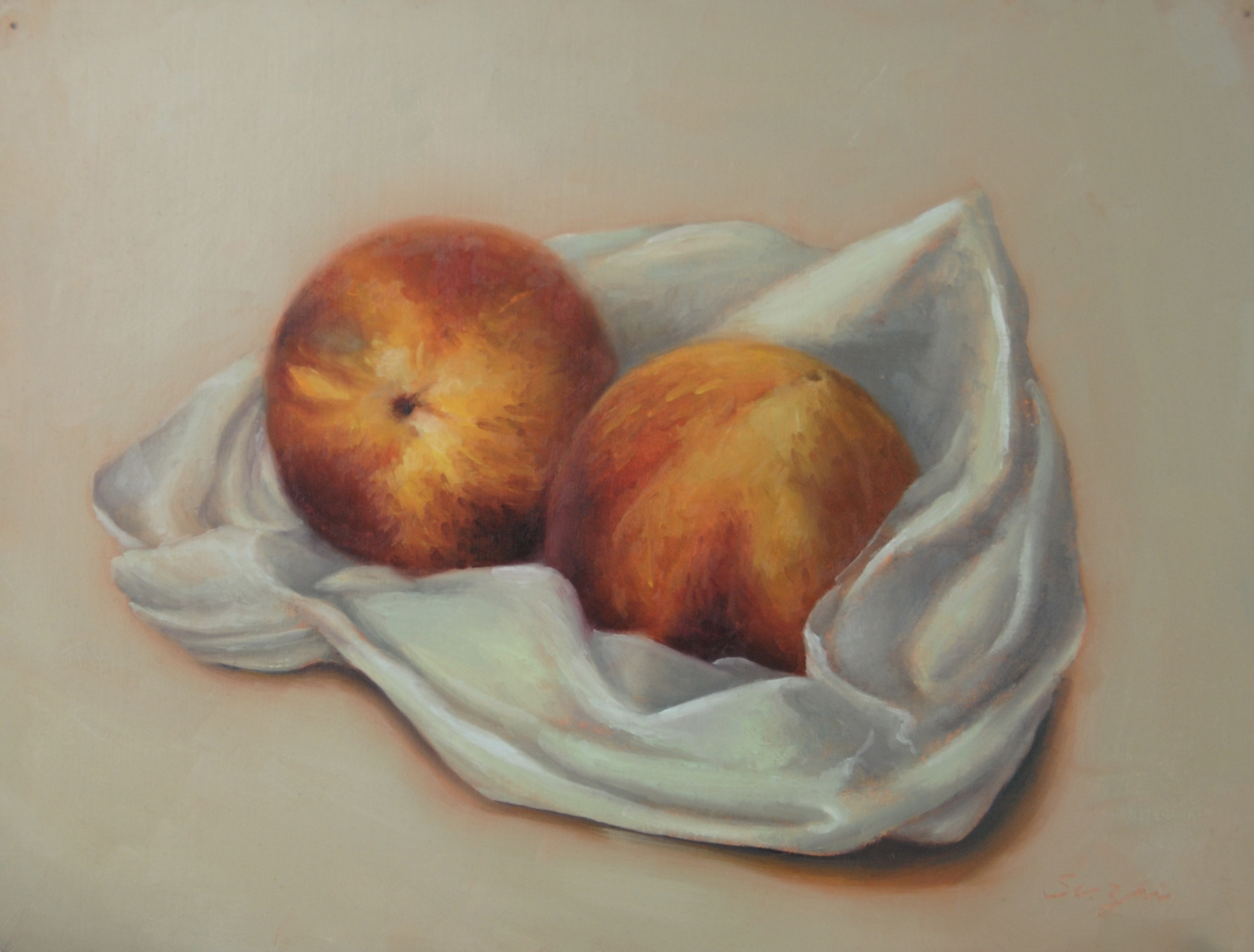
Moderate still life endeavors on various surfaces:

Wooden Cup, oil on canvas board, 11 x 14, Spring 2024
Oil and Orange, oil on MDF board, 9 x 14, Spring 2024
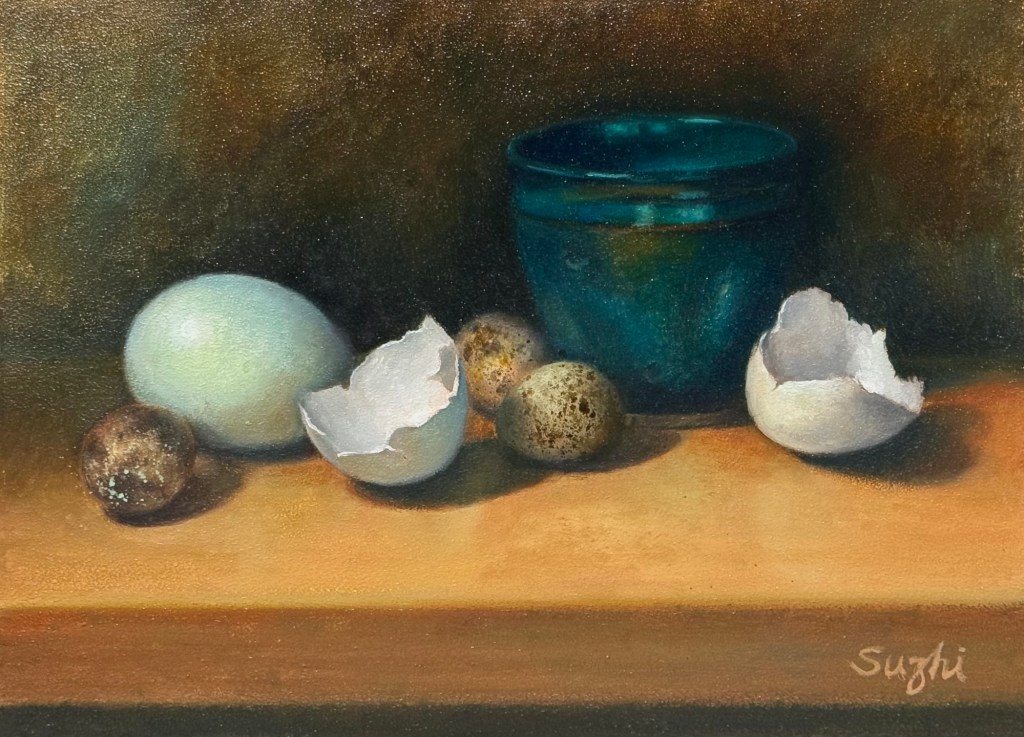
Quail Eggs and Shells, oil on aluminum board, 9 x 12, Spring 2024

Two things I am struggling with:
1. Sunken-in: it is the appearance of a dull matte area in a section of an oil painting, usually caused by overly absorbent grounds, too much solvent, or earthy pigments. In my case, it is the umber and the black. I tried oiling out – apply one part Gamsol + one part Galkyd to the dull area. It helps for a while, but overtime, it might go back a little. Varnishing is supposed to be another way to improve, but so far I find that even less helpful. The process is demanding of patience too, for you need to wait till the paints touch dry to apply the rescue, and then wait for the rescue to dry to see if it actually works.
2. Taking a decent photo. I assume it would be better if the I wait long enough for the paints to be drier, and somehow there’s no sunken-in – the shine is even. Or, invest in a better than iPhone camera? 😳

When to Stop – Never?

I have a vivid memory of my early watercolor classes. As we busily worked on our pieces, our teacher, peeking from behind, said suggestively, “Know when to stop! Don’t ruin it…” We all felt nervous, guessing if it is “me” she was insinuating. Knowing when to stop becomes a thing always rings in the back of my mind when I am painting in watercolors. Understandably, it is not easy to remove the paints when they are on paper. Even when I moved to acrylic and oil, in theory you can keep piling paints on, I still hear that question being asked in classes and workshops. The obvious answer is you should stop when a piece works, but do you always know that? Then let’s say, you know it doesn’t work yet, should you keep trying or move on to the next one?
In one of the East Oaks’ early livestream, Michael Klein answered both parts of the question. I am paraphrasing here: I always know what kind of result I want to achieve and there’s no such a thing as overworking a piece. If you think a piece is overworked, it probably means you haven’t worked enough yet. You only stop when a painting works, and it is better to make the current one works before moving on to the next piece. If you haven’t solved the problem with the current piece, how could you make the next one better? 

Mr. Klein’s remarks shook me, but it also makes perfect sense. The concept that there was a moment in the past that the painting was perfect is faulty. If you don’t know where to end, should you even start? If you do know, what made you keep working on it in the first place? 

Klein’s answer also reminds me what Jeff Watts repeated in some of his demo videos, that you should paint each painting as if this is the one by which the world would judge you. Dale Zinkowski, whose tutorial I am following nowadays, echoed something similar. In a way, this is inline with the concept of “holding yourself responsible” that we discussed previously. We learn from making and correcting our own mistakes. 

So, to know when to stop, before starting each painting, sort out your goal as clear as possible in terms of the mood and aesthetics you want to achieve. Traditionally, you do that with thumbnails or draft paintings. Nowadays you can employ Photoshop or ProCreate in the design and drafting process. You can modify the digital version till it looks like the painting you want before you start, judge the progress against it, and keep working on it until you reach the goal. When not sure, put the painting aside and look at it from time to time. I used to do that for days or weeks, but according to the talented and prolific Scott Burdock, he sometimes leave a piece open-ended for years. You don’t need to decide if a painting is done on spot. Give it time, and then give it more time. (Unless you are working on something with a deadline, then the deadline calls for you.)

This process is more challenging for a watercolorist. Watercolor paper, however high quality, only takes so much beating. The innovative artist Niel Murphy found a way to expand the design process to the entire art making process. He started with a watercolor painting, scan it into Photoshop to keep working on it digitally, then print it out and paint more on top of that. This process is very expandable – you can work on the piece forever – at least in theory. 

A logistic problem rises. If every painting has the potential to be worked into something, we should only work with the best materials we could afford at any time, right? What if? This is the advice many artist give. Do not waste your time on poor materials. It is very against my stingy nature, but I find using better materials help to hold myself responsible. I am less likely to give a half-hearted effort or abandon a piece by telling myself it is just a practice. I just need to find more affordable but good materials. MDF or aluminum board, limited palette, there are some options. 

Of course in the process of learning and practicing, not every initiative marches toward a gallery.    I can’t possibly make everything work as it intended to be, but there are ways to keep options open. I used to throw out or paint over the old paintings. I still do, but I remember to keep a digital copy. In the days that I am too languid to pick up a brush, but feel obligated to do something art related, I turn the into digital patterns.

Any piece of art has the potential to morph into longevity. 

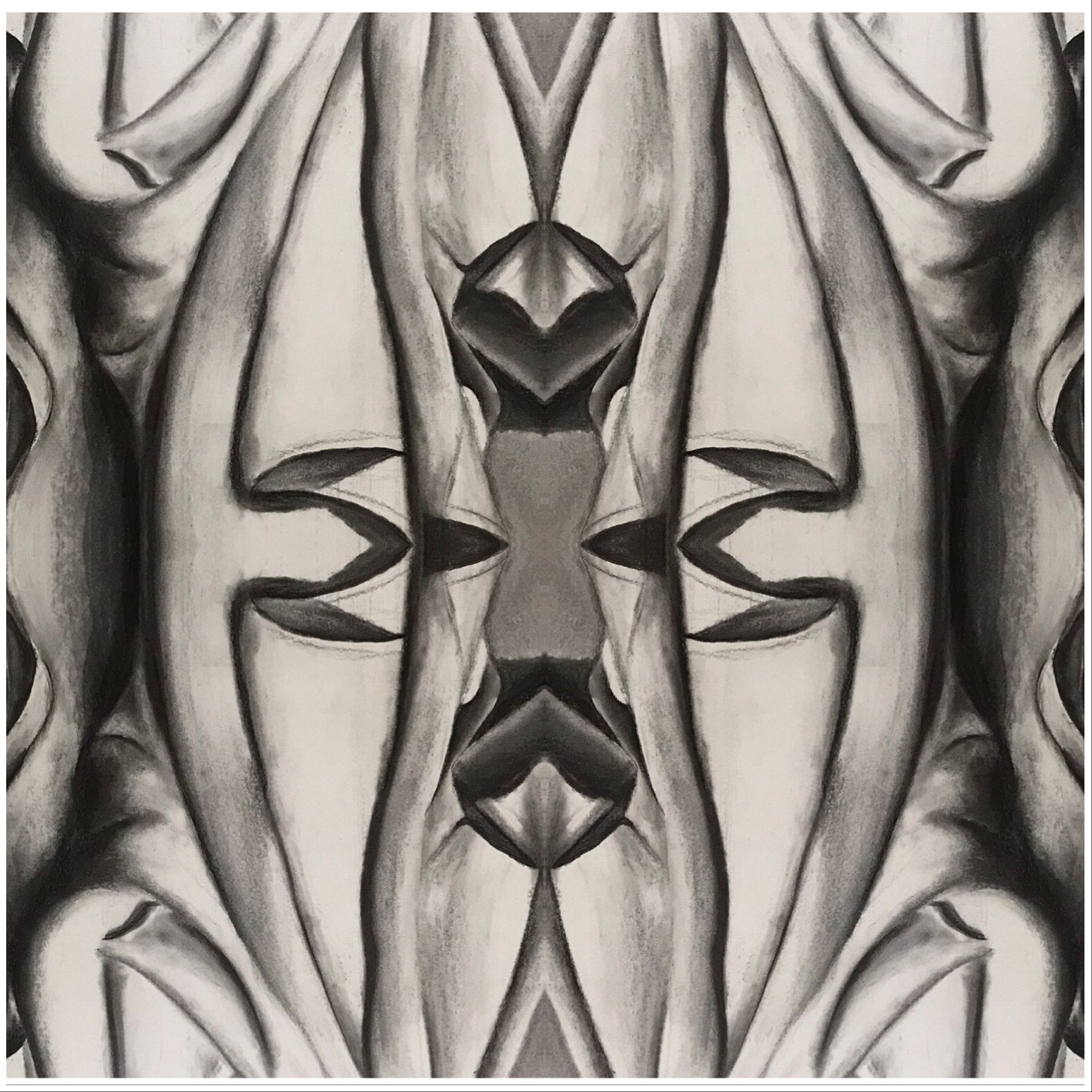
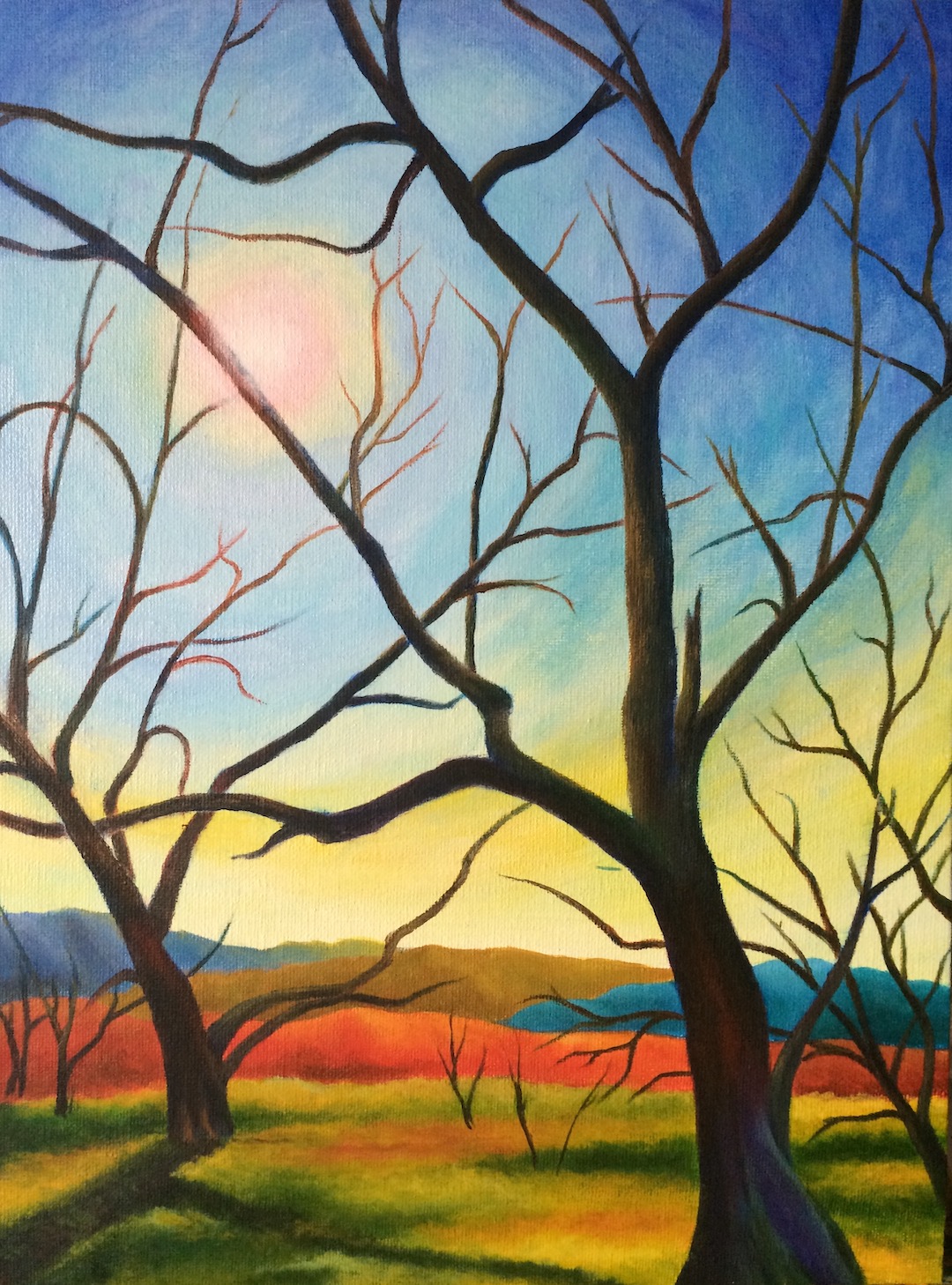
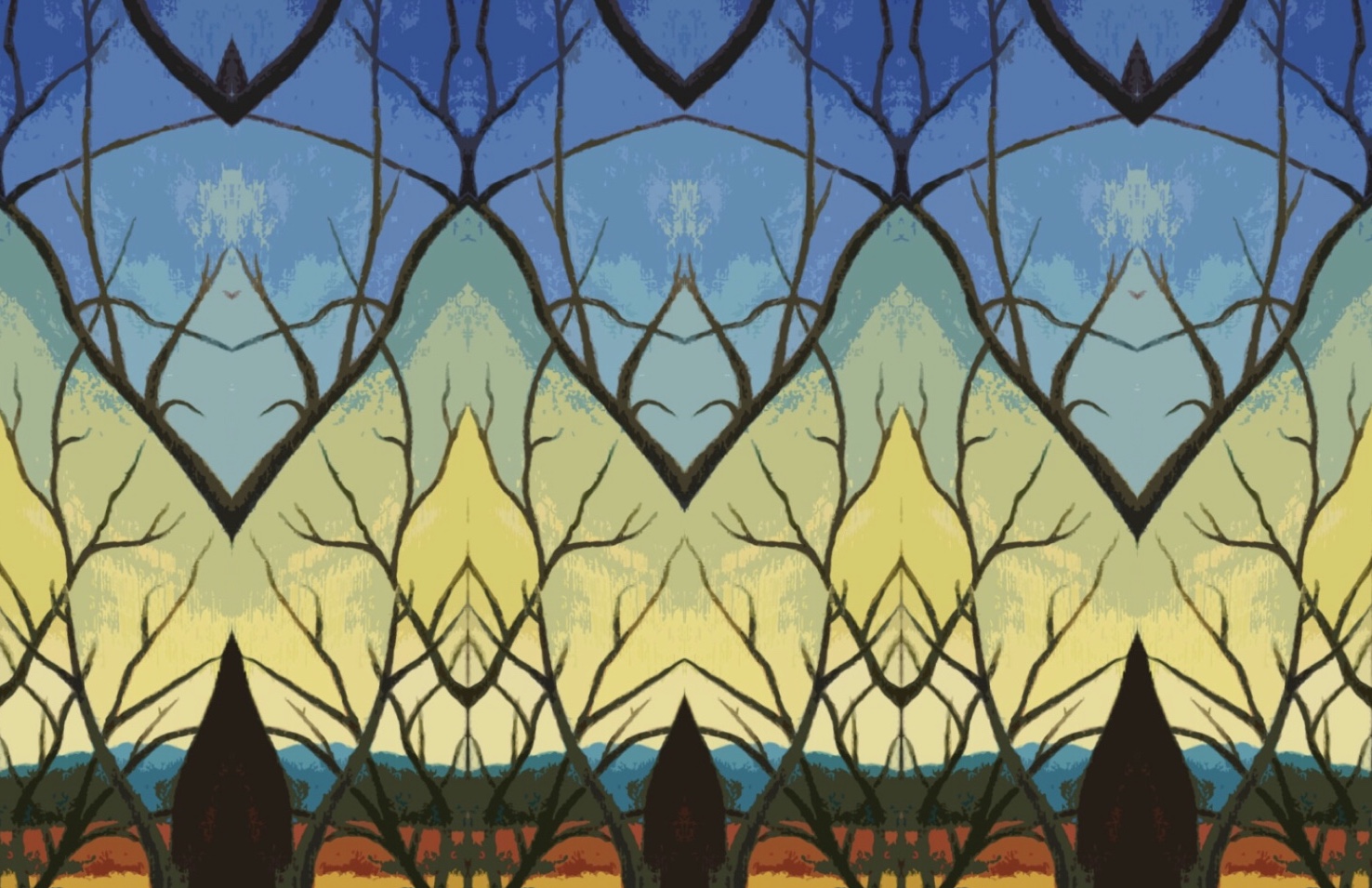
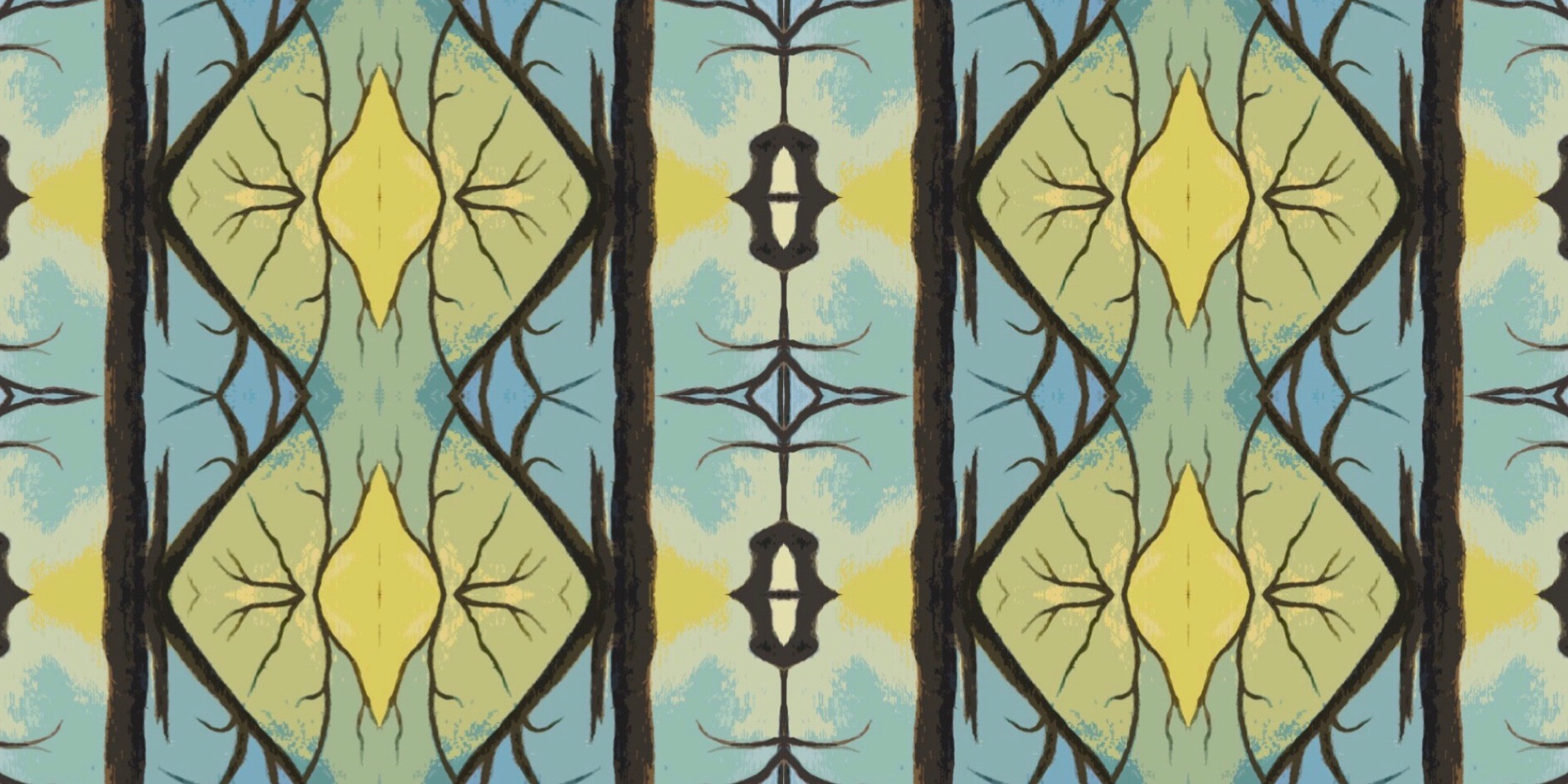
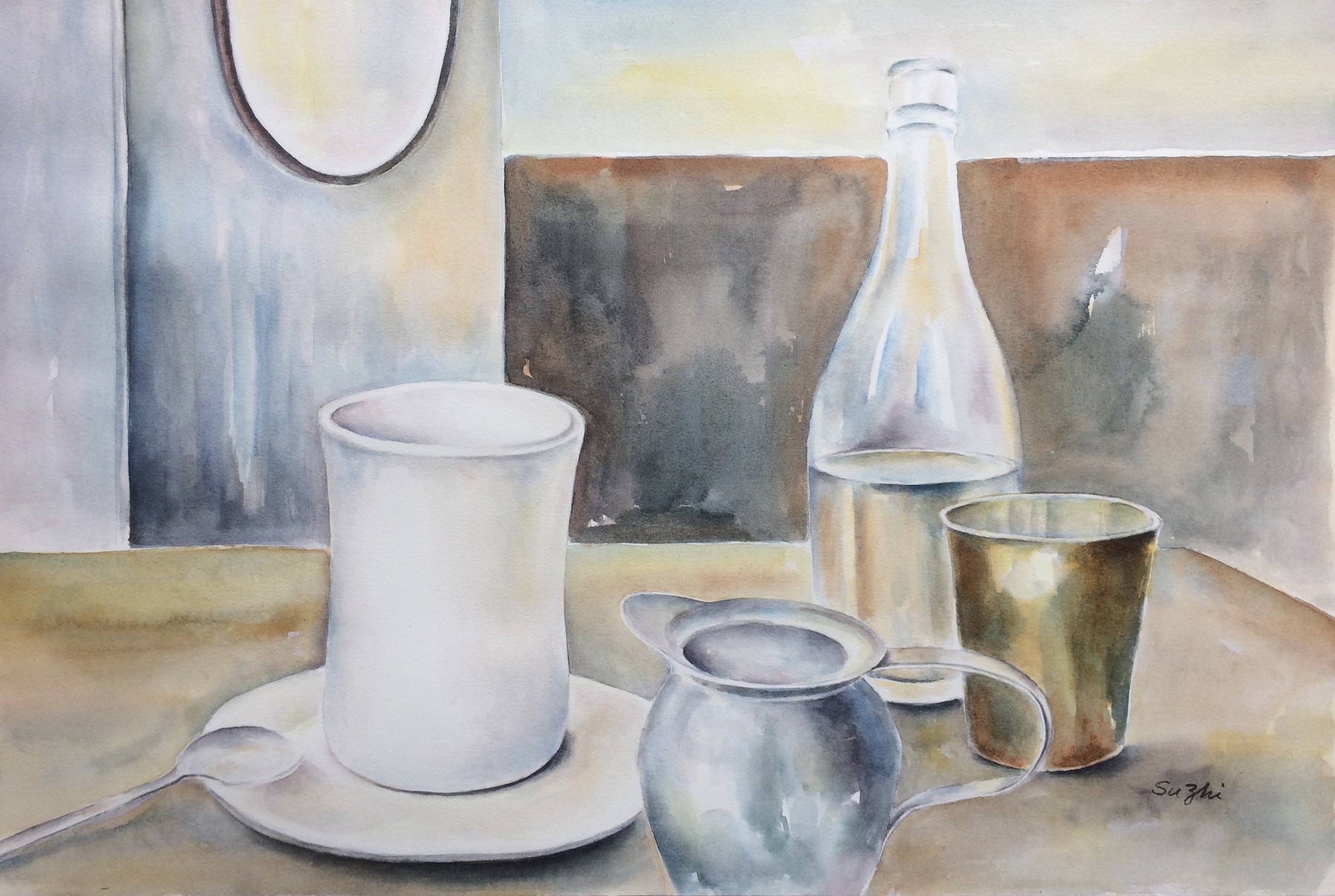
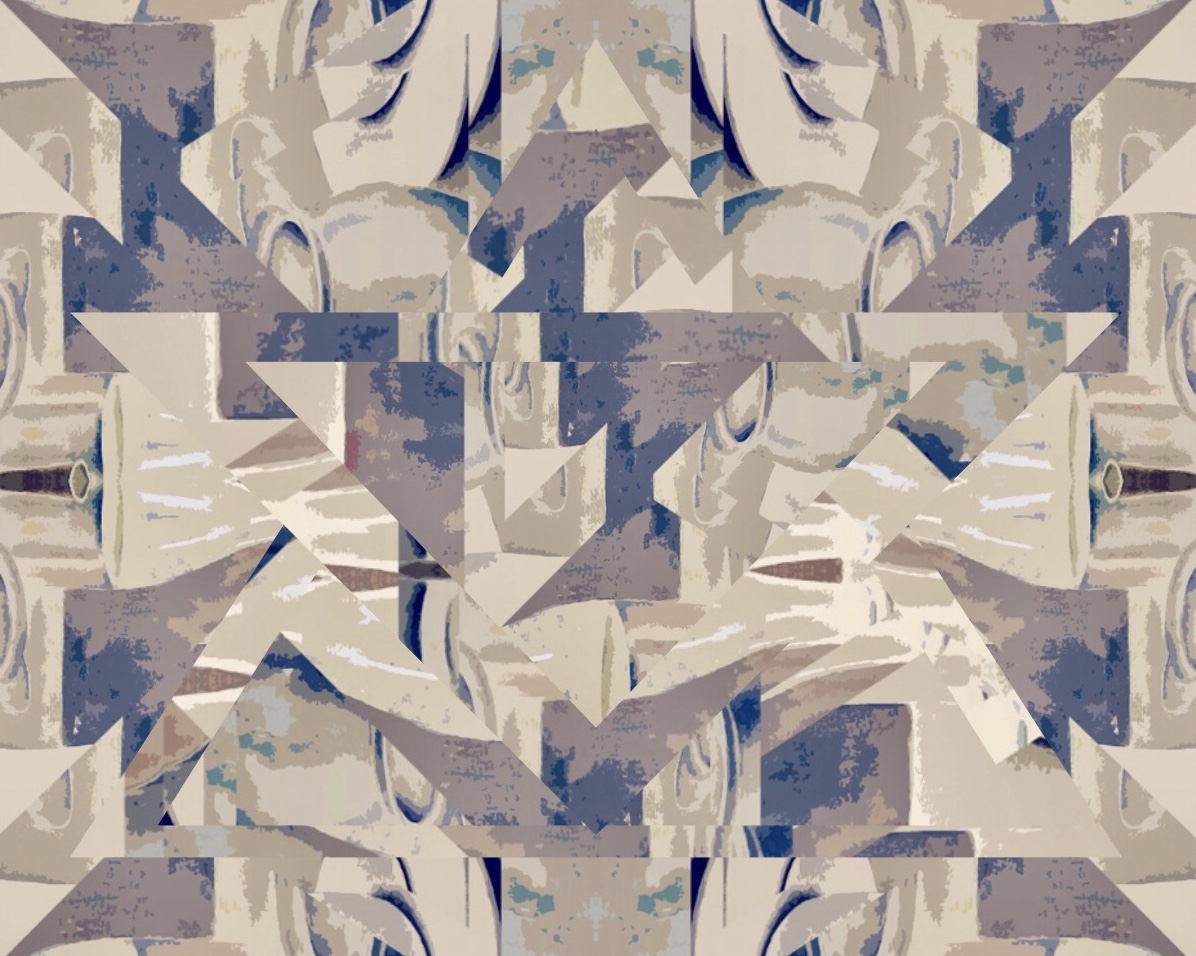
Here are some of the patterns I made from old art pieces (shown first):

Portrait Sketches (1)

It is always a mystery to me how long it takes an Alla Prima painter to finish her work. Most of the demos I watched online were one to three hours long, and never did an artist claim it as a finished work. It is also hard to tell if the artist doing the demo was aiming at a complete work or just an oil portrait sketch. Plus, how do you even define the completeness of a piece? Those lovely and highly admired vignettes by the late Richard Schmid, are they finished works? 

When I was taking online classes at Watts Atelier, Jeff’s demo was usually a one-hour video, and he expected students to finish their piece in no more than 1.5 to 2 hours. That was a guideline I rarely followed. Not that I wasn’t willing to; I just didn’t have the adequate skills and mindset to achieve it. I took a video lesson from Susan Lyon earlier this year thanks to my East Oak Studio subscription. She advocates an exercise of doing a live portrait within one hour and then doing the same pose 2 more times in a row. The idea is to focus on the essence – what you can see when you squint. With repetition, you could improve your focus along the way. You go into these exercises with good preparation. She used a limited palette – transparent red oxide, ultramarine blue, and white, and she would premix colors into a value scale. The most important part is the mental preparation. You decide in advance where your darkest dark and lightest light is, and if they appear in multiple places in your reference (more than often, that’s the case), you must choose one. You also need to decide where the strongest edge would be – where the sharp contrast is (because when values are close to each other, the edge disappears). Other things that need to be considered include composition, what atmosphere to create, what types of strokes you want to employ, etc. I would say this is a great checklist to start any painting. Festina lente – as Sean Cheetham said, “Take your time on everything if you want to paint fast.”

East Oak Studio does a monthly free streaming called “Oil Painting from Life.” You can paint portraits and sometimes still life along with their resident artists and hear them chat. Most sessions are between 2 and 3 hours. I enjoyed the program very much, but I find myself constantly struggling when the time is up. Should I leave it as it is or keep working on it?  Deep down, I see myself as an indirect painter. I like to take my time and work in layers, just like most artists at East Oak, but they all vouched for the benefit of doing these shorter Alla Prima paintings. Leaving those paintings as they are is against my nature, but keeping going could yield diminishing returns. So far, I have managed to not go beyond the streaming timeframe. Before each painting, I reviewed the decision list from Susan Lyon’s lessons and tried to make my practice more effective. 

From the Portrait Society of America’s auction page, we can see artists do sell their sketches. Who knows, maybe after a million hours of practicing, someday, I will look at my two-hour painting and think, “Yep, that’s a thing.”

Here are some recent sketches I did, most of them are 9 x 12 or 11 x 14 and done within 2.5 hours:

Summer and Peppers

For the first time in four years I was able to travel to Beijing and hence the absence of new posts. At the first glance the city seems largely unchanged, except for the long lines outside every gallery and museum. I don’t know if people are just hungry for art or it is the “lipstick effect” of the flagging economy, but the never ending queues didn’t go well with the scorching weather on record. Soon I noticed an apparent missing of international tourists, and a lack of liveliness in general everywhere we went. People are getting by, but not looking forward too much. It could be the weather, or the “laying back” that everyone was talking about. Regardless, I ended up not doing too much.

The couple of exhibitions I did managed to attend shared some commonalities in a strange way. The Graduation Show from The Central Academy of Fine Art – China’s most prestigious art academy was an expose of vibrant young minds. Walking among a hodgepodge of contemporary media, we were constantly attacked by explosions of lights, sounds, and immersive installations. While traditional techniques were not completely forgotten, they took a back seat to ideas and functions behind art.

Meanwhile, the National Gallery of China celebrated its 60th anniversary with a display of its permanent collection. For the domestic part, the media were conservative and the contents were propagandistic. The international part featured many crafts from the “One Belt One Road Initiative” member countries. It could very well be the most diverse exhibition I have ever seen. In terms of media and the ideas represented, this was the opposite of the students’ show above mentioned. However, art was equally sidelined in both cases, which brought to mind an online comment on Chinese rock music I once read, “I heard the rock, but where’s the music?”

The shows also caused a little panic inside when I looked back on my extremely lack of “idea” art, for example:

Three Peppers, oil on canvas board, 9 x 12 in., 2023
Peppers, oil on canvas board, 11 x 14 in, 2023

I’ve always cherished the simple joys of composition and color harmony, but these exhibitions had me questioning—do I need to dig deeper? Must I have something grander to say? Do I truly have something to say? In an era that one can put ideas into MidJourney and let it generate a picture, does this make the traditional artistic skills obsolete, or on the contrary, make them more important in defining what is art?

In China, schools commence each year on September 1st. It seems fitting to conclude may summer idling and wondering on this day. Time to get back to the basics, back to work (and leave the thinking part to GPT)! 🙂

More Flowers

Shadow Play, oil on canvas board, 11 x 14, 2023
Pink Roses, oil on canvas board, 11 x 14, 2023
Daffodils, oil on canvas, 12 x 12, 2023
Company, oil on canvas board, 11 x 14, 2023

I don’t have much to say about these except that one of these is based on a MidJourney generated image :)))). Can you tell?

Cézanne – Reading Notes (2)

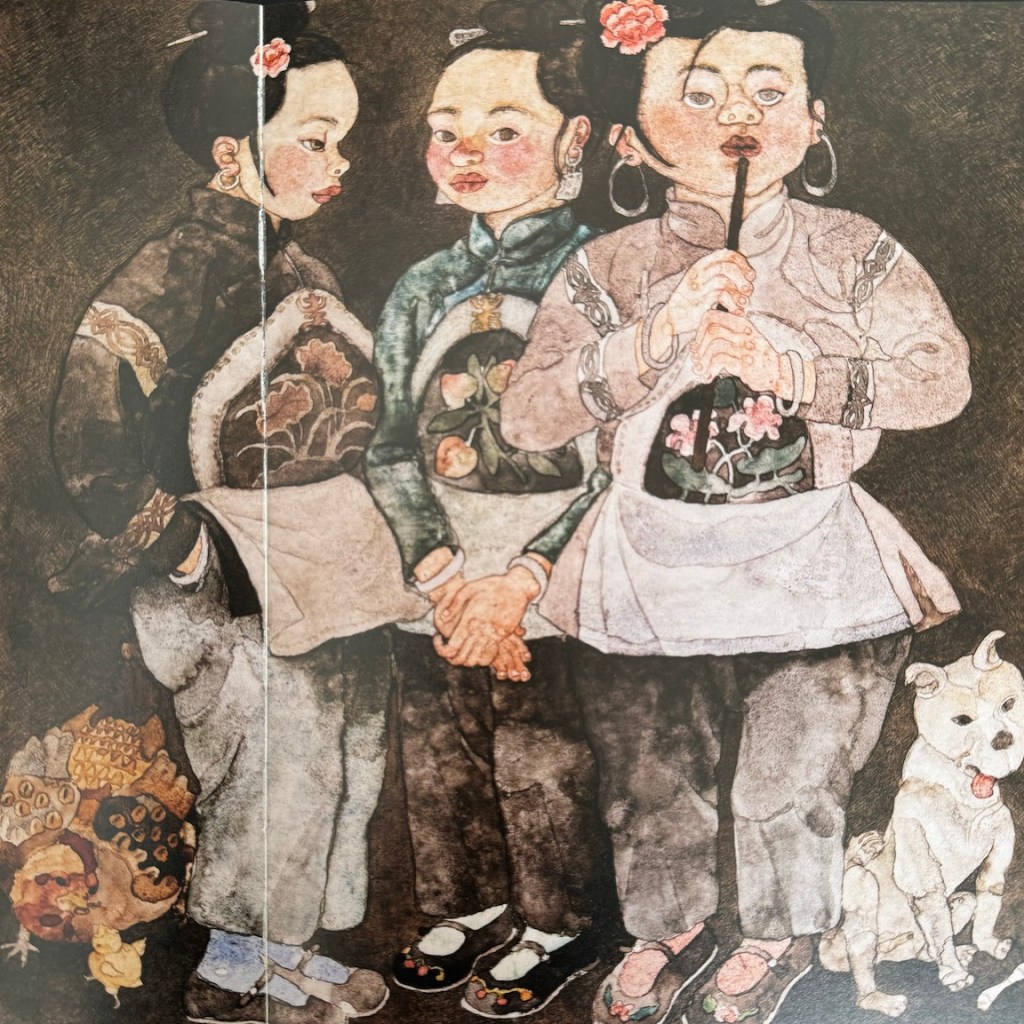
Among the books I read on Cézanne, two of them focuses on his watercolor. They are Cézanne in the Studio: Still Life in Watercolors by Carol Armstrong, and Cézanne’s Watercolors: Between Drawing and Painting by Matthew Simms.

The two watercolor books are a rich collection of the artist’s sketches, finished and unfinished works in the medium. Watercolor and gouache were often used by old masters as studies for a bigger oil piece, and it seems to the be case for Cézanne early on. However, later in his life, when his reputation began to be established, he increasingly make watercolors as independent works of art.

Cézanne’s watercolor is as unconventional as his oil paintings. The charcoal drawings, the white of the paper, and even the artist’s changing thought all become part of the composition. We see the draft, the negotiating and the final status on one page. This provides a unique window into the artist’s painting and the thinking process.

Still life with Green Melon, watercolor on paper, c.1906
Still Life with Apples, a Bottle and a Milk Pot, watercolor on paper, c. 1904

Unlike J. M. W. Turner (1775 – 1851) and other watercolorists, Cézanne adopts a touch by touch and color by color method. He layers translucent patches with gestural brushwork, resulting in a vibrant and casual overall appearance, with fragmentary and kaleidoscopic details. However, the actual process was deliberate and labor-intensive.

Still Life with Blue Pot, watercolor and graphite on paper, 48.1 x 632 cm, c 1900-1906

Contemporary figurative artist Ted Nuttall also employs transparent patches of colors to create energetic and vibrant paintings. While both artists are deliberate in their approach, Nuttall’s use of dots helps complete the painting, whereas Cézanne’s colors, used as lines, remain exploratory.

Africa, Ted Nuttall, watercolor on paper.

On a side note, for those interested, Cézanne uses a limited palette, as revealed by this nerdy study: “An Investigation of Paul Cézanne’s Watercolors With Emphasis on Emerald Green.”

Show News

Here are the group shows I participated recently:

“Works on Paper” exhibition, currently on view at the Pacific Art League:

Memory, watercolor on paper, 23 x 29 in.

Santa Clara Valley Watercolor Society 55th Annual Member’s Exhibition:

Once Upon A Time, watercolor on paper, 10.5 x 14 in.

“Portrait” Art Competition at Art Room Gallery:

Father, oil on canvas board, 14 x 18 in., February, 2023
Me, oil on canvas, 18 x 24 in, January 2023

A few notes:

  • The watercolors were originally painted a couple of years ago, but I did some major revisions this year before the shows. I have yet to figure out how to date works like these.
  • The experiment of revising past works gave me a lot of ideas. Some of the old paintings may find a new life, and some of the creating processes may never end!
  • The portraits are the first time I entered my oil paintings to a show. They both received “Honorable Mention.”
  • I feel lucky that the “Portrait” is an online show, because none of the pieces I entered is completely dry. Northern California was darn wet this past winter!