For most of September, I continued working on a new series featuring rabbits. I’ll dedicate a post to that when I’m done, hopefully soon. In moments of frustration, hesitation, or simply needing to look at something different, I distracted myself with a couple of portraits.
The inspiration, once again, came from the one and only earthsworld, though by the time I was done, the original photographs had mostly become scaffolding. I had three things in mind: don’t copy the photo, think in big shapes, and work some patterns into the painting.
I also wanted the two portraits to go in different directions. One would have stronger value and color contrasts; the other would stay closer in value, softer and more subdued.
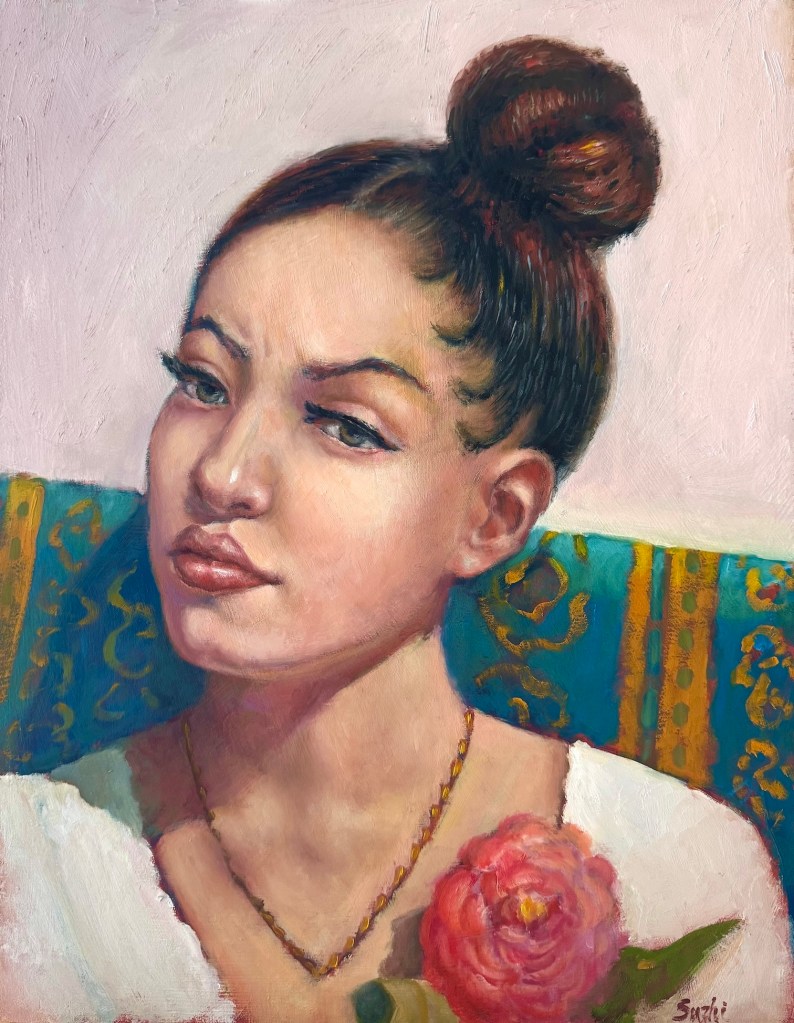
Rose and Teal, oil on board, 14 x 18 in. September 2026
The woman with the high bun was meant to be the colorful one. I started with a fairly simple warm-cool contrast: the warm skin, flower, and touches of gold against that large teal shape running behind her. From there, I tried to let some visual rhythms travel through the painting. The curls and loops in her hair echo the curving lines in the sofa pattern, which in turn pick up the shapes of the flower petals. I didn’t want the patterns to simply decorate the background. Ideally, they would help pull the whole painting together.
For the most part, I think that worked.
The yellow pattern on the teal surface, though, was a little random. I knew I wanted something there, but I didn’t design it carefully enough before painting it, so parts of it feel more improvised than intentional. The flower suffered a similar fate. By the time I got there, apparently I had decided a flower was just a pink blob with enough petals to make its identity clear.
Still, I like the overall effect. The larger shapes remained reasonably intact, and the portrait feels decorative without becoming too ornamental. Most importantly, I managed not to chase every little detail in the reference, which, for me, counts as progress.
The second portrait was supposed to be almost the opposite.
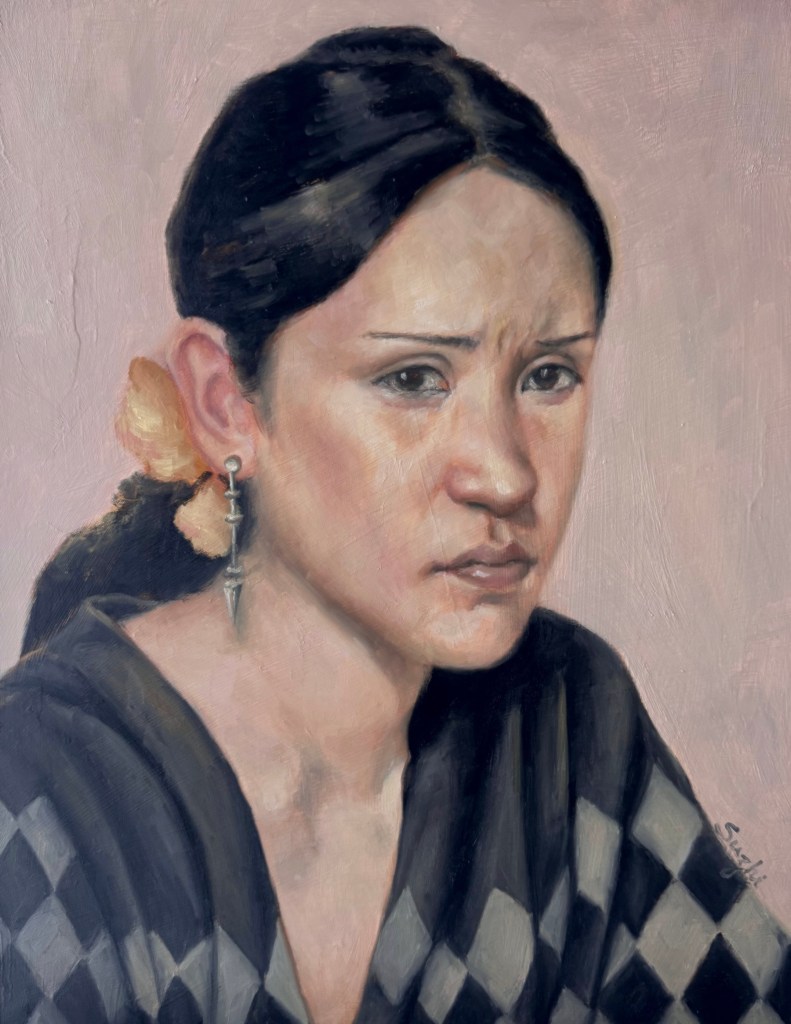
Checkered, oil on board, 14 x 18, September 2026
Before I started, I had a very clear mental image: a pale, pastel-ish painting with a narrow value range. The checkerboard sweater would be loose and barely defined, more suggestion than pattern. The face would emerge quietly from the surrounding grays and pinks. Nothing too sharp. Nothing too black.
That was the plan.
Halfway through, I found myself carefully painting folds into the sweater and defining one checker after another. Apparently the checkerboard had other ideas. Eventually the lower half of the painting became much stronger and more structured than I had intended.
I stopped. Left it alone on the easel for a few days, and looked at it from time to time.
Finally I decided that rather than trying to drag the painting back toward my original idea, I would follow where it had already gone. I deepened the black of the hair, strengthened the eyes, and clarified some of the facial features. That gave the upper part enough visual weight to hold its own against the sweater.
It is definitely not the painting I pictured before I started. But I like it.
There is something satisfying about the contrast between her very controlled, almost stern expression and all those large geometric shapes below. The darkened hair and the sweater also emphasizes the big shapes I aimed for from the beginning, just much more insistently than expected.
These two paintings reminded me of something that seems to happen over and over in my studio. I start with a fairly specific goal, then at some point the painting wanders off. Sometimes I fight it and make things worse. Sometimes I follow it and end up somewhere more interesting. The art is to pick the battle.
I still want to paint that second portrait I originally imagined: pale, quiet, loosely defined, with the pattern barely there. Someday I’ll give it another try.
Each time I spend a substantial stretch away from home, some buttons in me get reset. From Copenhagen to Prague, from Tokyo to Beijing, distance and a string of museum visits kept shifting how I see things. When I finally came home, the studio looked slightly strange. Ideas that felt urgent before the trip sat there like notes written by someone else. I usually need a round of cleaning and reorganizing before I can find the mindset for painting again.
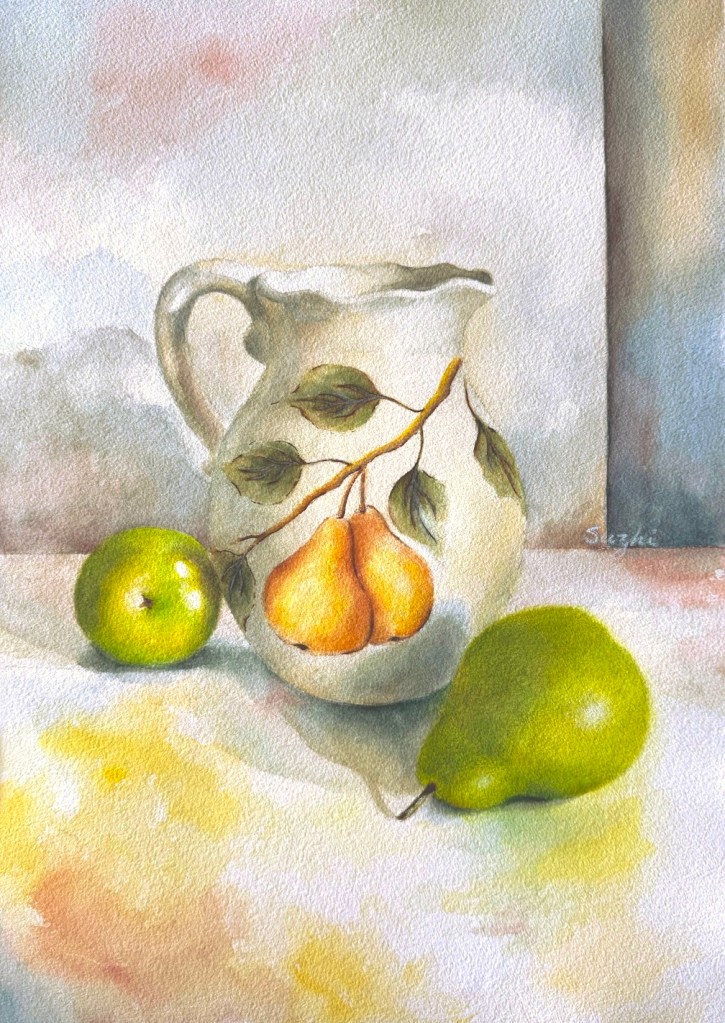
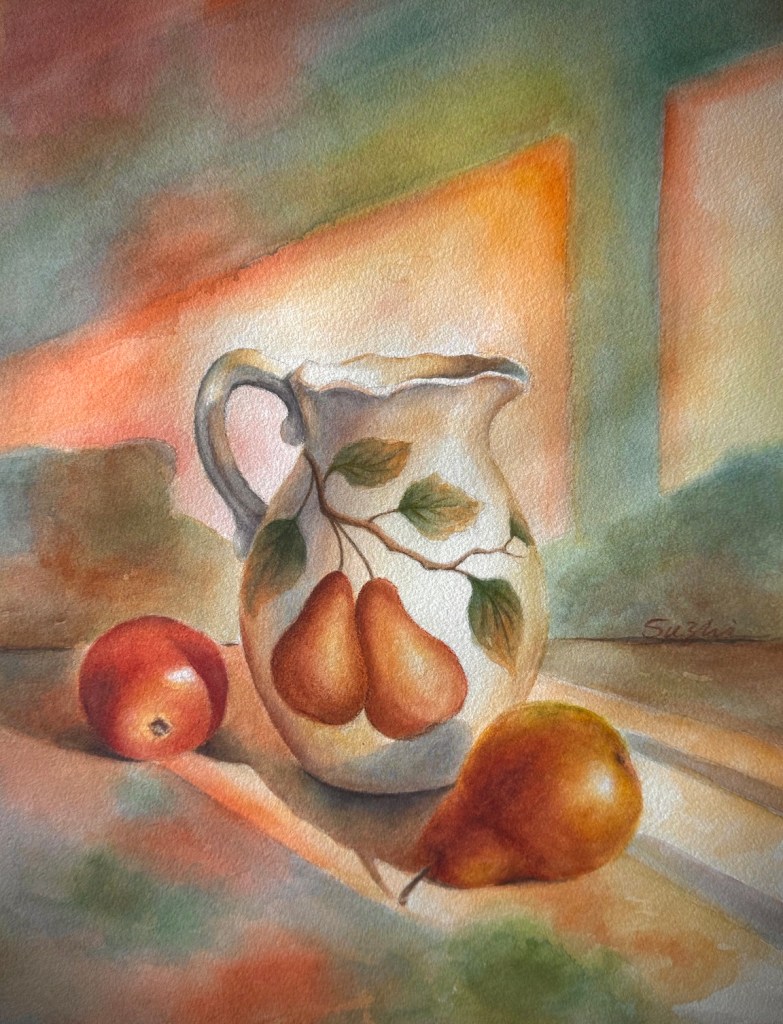
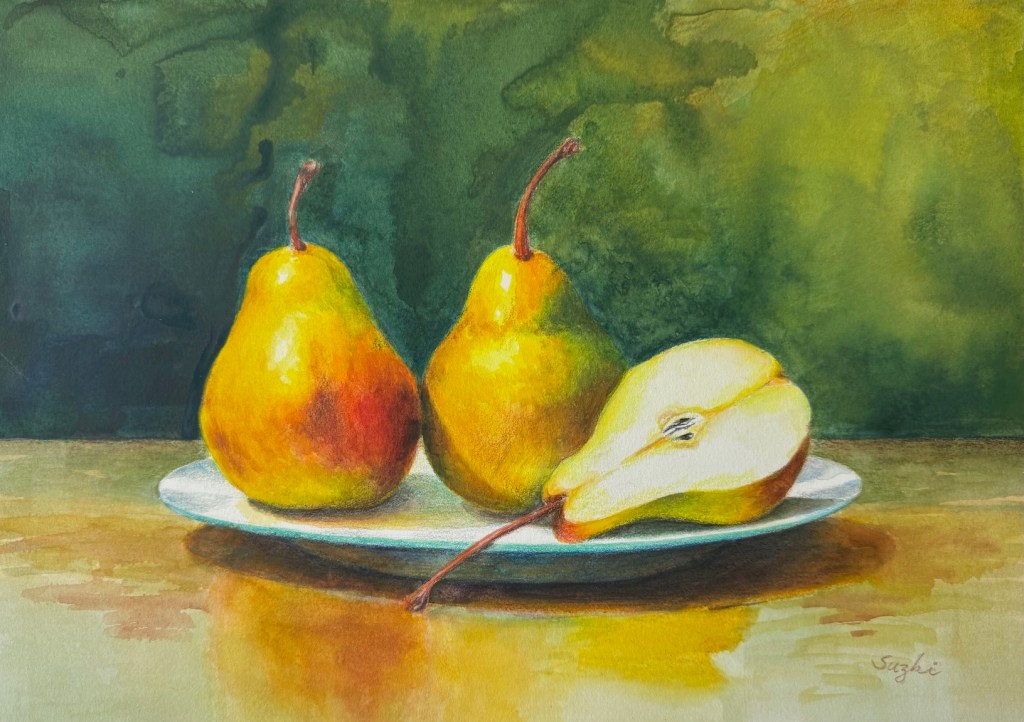
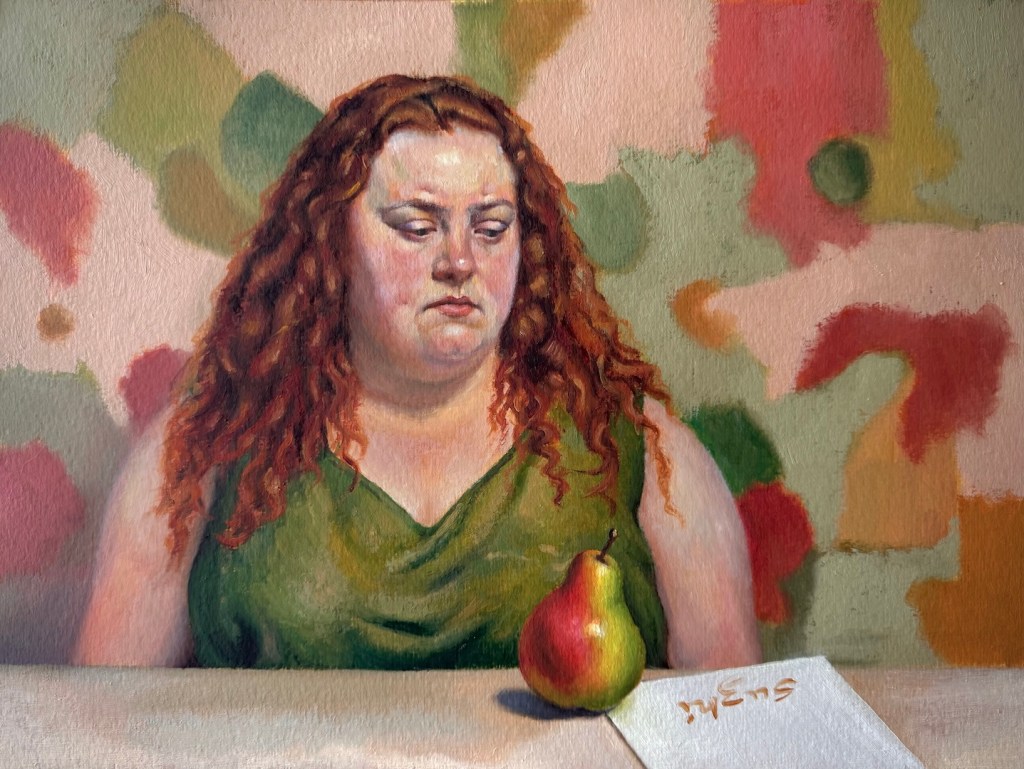
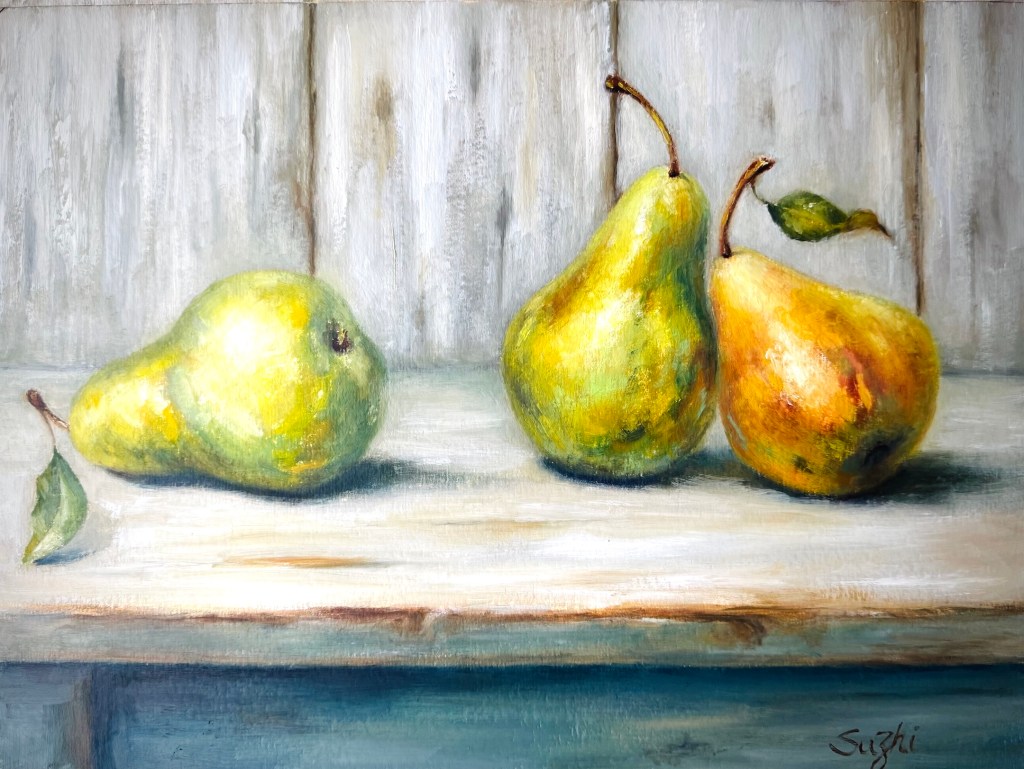
Before I left, I had been deep in pears. There were drafts and unfinished paintings waiting. I struggled to return to them. It took quite a while to find the mood to sit down and finish what I had started. Meanwhile it became very clear that I was not in the pear mood anymore.
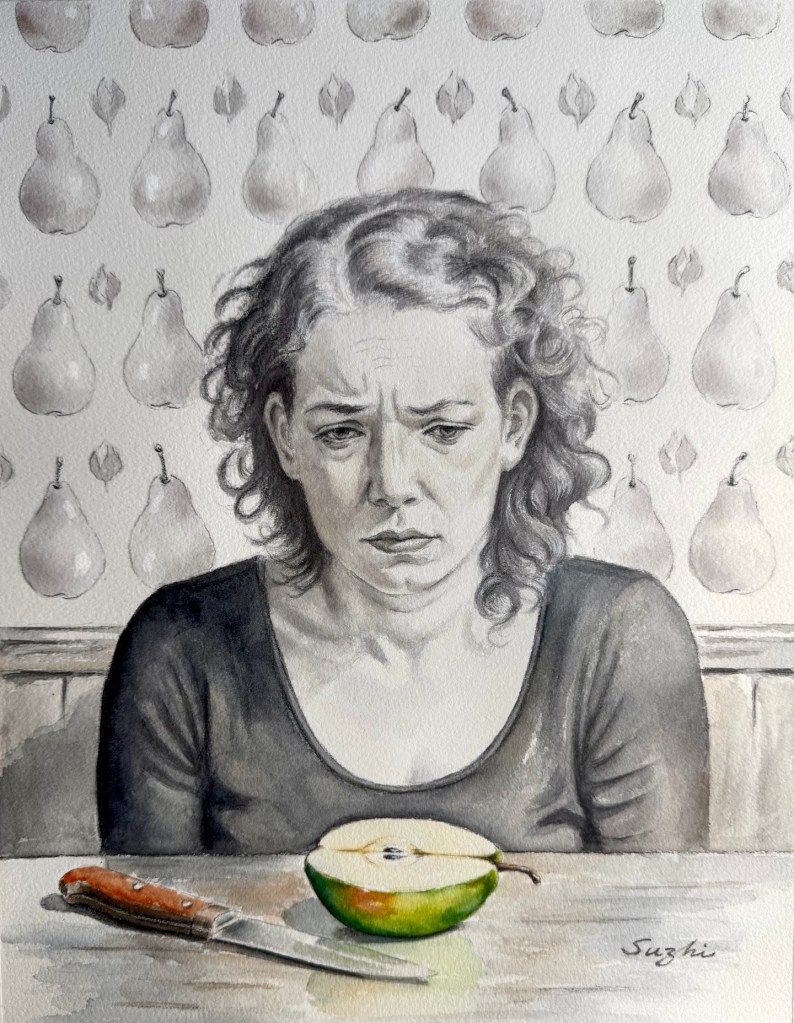
The first of these is a watercolor and pencil piece. Before the trip, I finished the pencil draft, and had a few plans for the coloring. Looking at it now, I would rather it stay in that monochromatic vibe. The only parts I made saturated arethe pear and the knife. In Chinese, pear 梨 (lí) shares its sound with 离 (lí), to leave, and 分梨 (fēn lí), “to divide a pear,” sounds exactly like 分离 (fēnlí), “separation.”. That is why halved pears carry a small domestic superstition: you don’t split a pear with someone you don’t want to part from. The woman looks worried, almost miserable, staring at the halved pear on the table. The pear pattern on the wall behind her echoes what is going on in her mind: a repetition of li, li, … pear, parting, pear, parting. I hoped the painting would tell a story. I also hoped it would tell, a little sideways, my own separation from the theme. The pears are still there, printed all over the wall behind her, but the one in front of her has already been cut.
Parting, watercolor and pencil on paper, 11 x 14.5in, August 2026
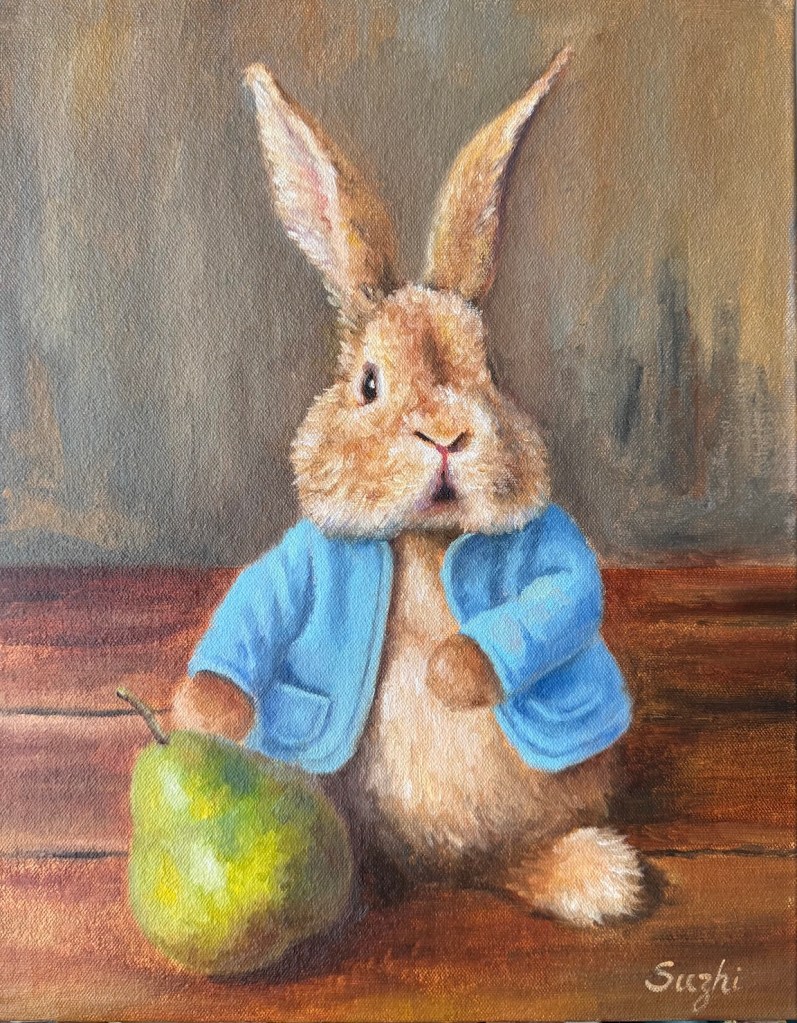
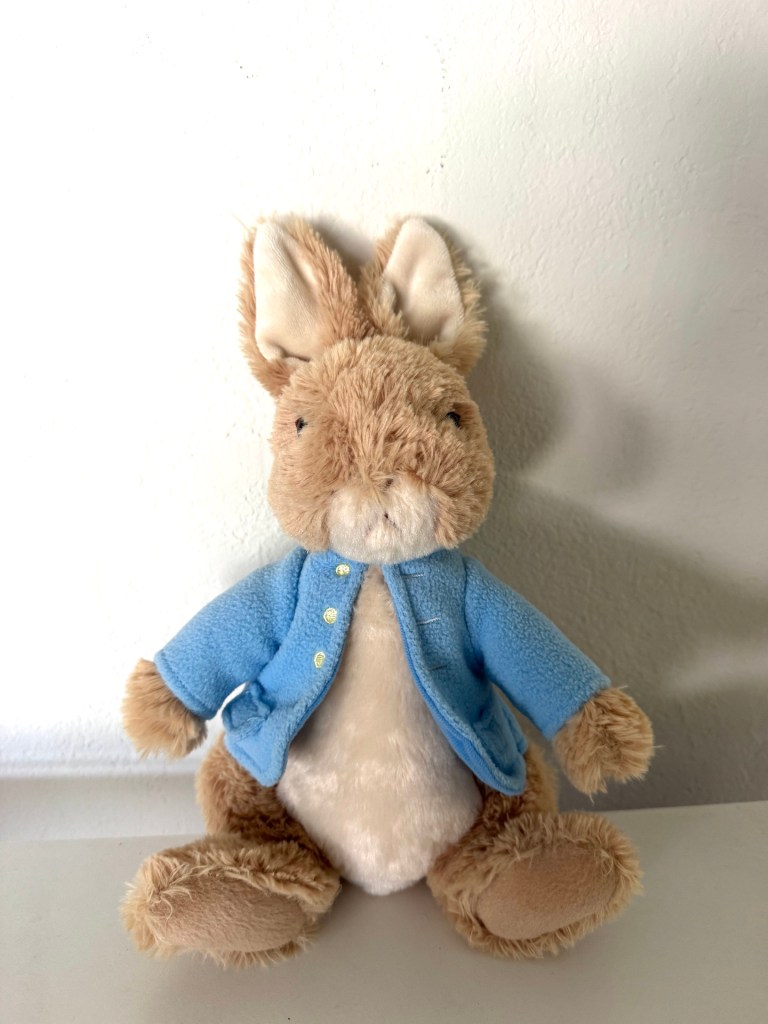
The second painting introduces a new character. A rabbit has found a pear. The rabbit is based on a stuffed animal of mine named Blue. Blue has accompanied me for many years, it was fun to bring him to life a little and put him in a painting. I think of this one as a transition. The pear is still in the picture, but it has been handed over.
Blue, oil on canvas board, 11 x 14in, August 2026Blue
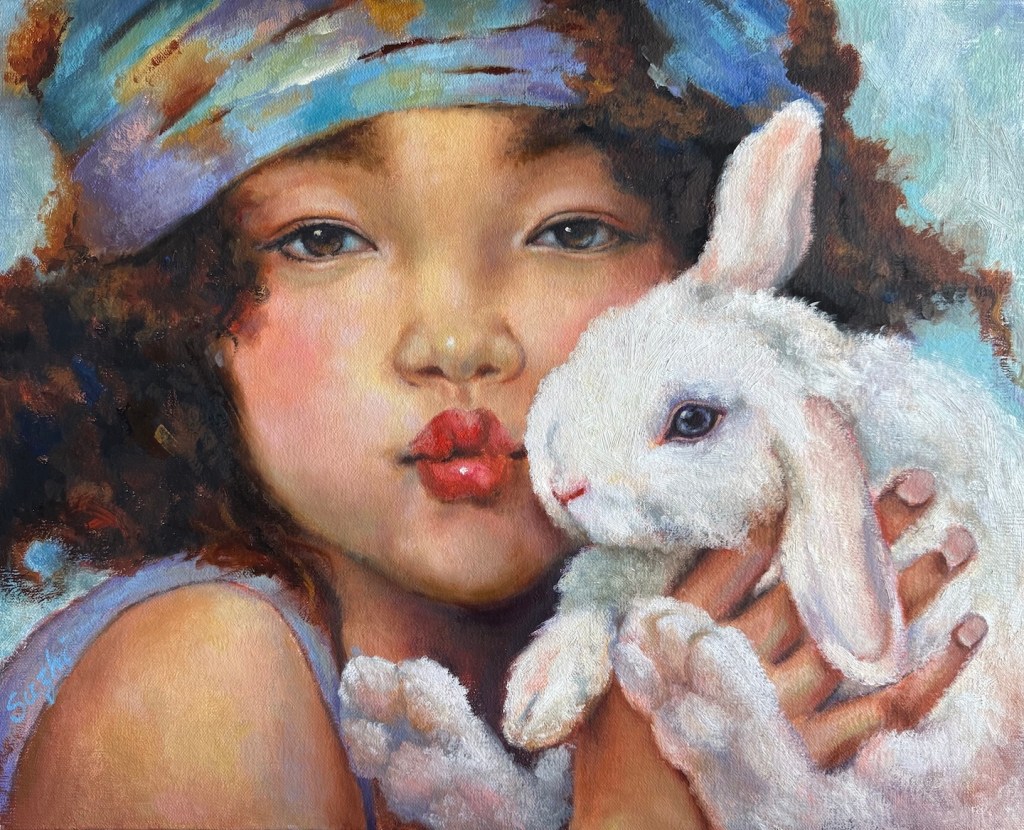
The third is a girl and a rabbit. In the draft, it was a girl holding a pear before the trip, but rabbit completes the design so much better. I have a fondness for rabbits; it has been my nickname in the family for as long as I can remember. The girl is imagined, though she carries a vague resemblance to a much earlier version of me. So I am going to paint myself either way, as the girl, or as the rabbit.
Company, oil on canvas board, 16 x 20 in, August 2026
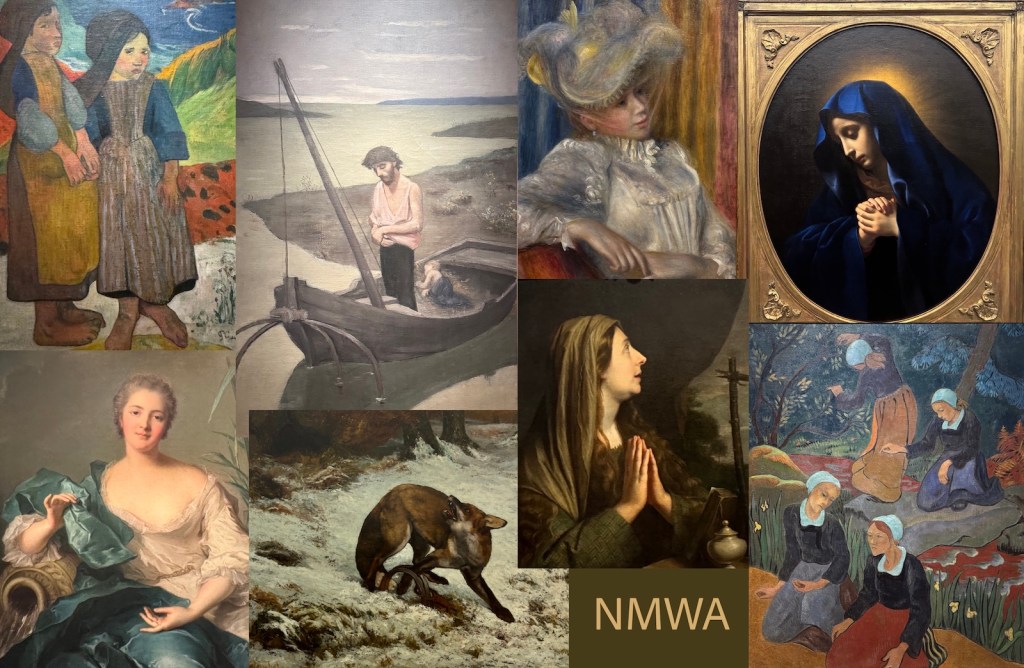
The first time I went to Ueno Park, I visited the Tokyo National Museum, accidentally dropped into Tokyo University of Arts’ Sunday Museum for their 50th anniversary retro exhibition, and spent the rest of the day with Andrew Wyeth at the Tokyo Metropolitan Museum of Art. The National Museum of Western Art (NMWA) wasn’t even on my list. A few days later, heavy rain cancelled my Hakone plans and suddenly gave me extra museum hours. I figured I should go, if only for the building. The New York Times had called it something with “artistic significance and beauty” that could rival the paintings inside, but my expectations were low.
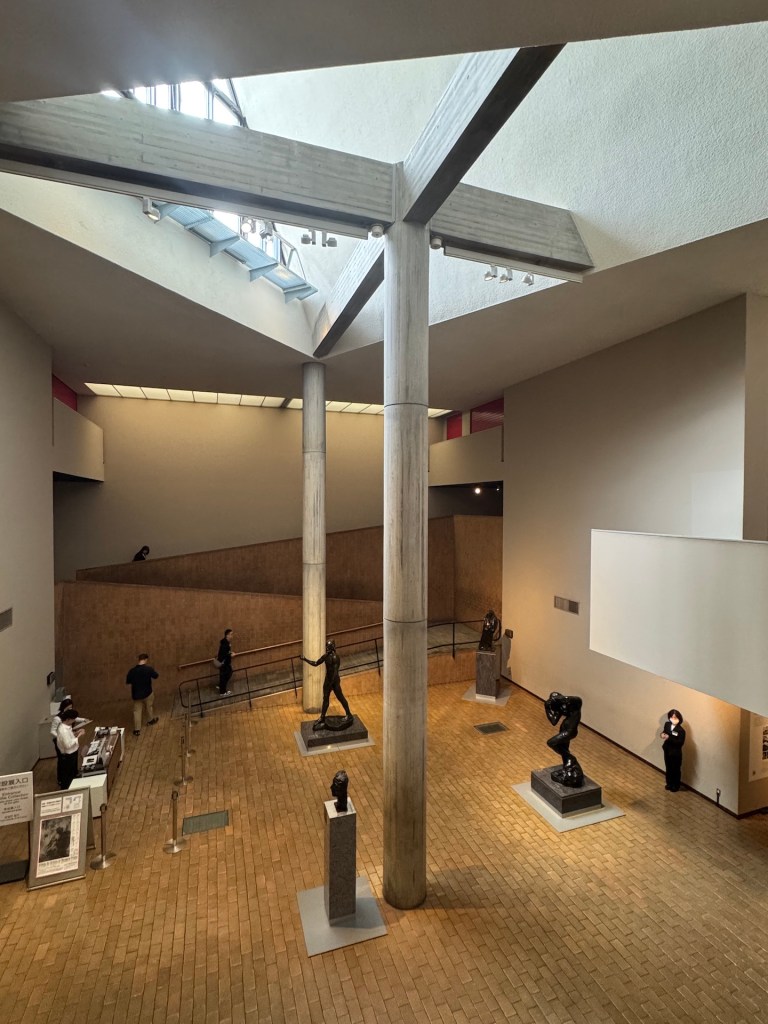
Inside NMWA
The main building of NMWA was designed by Le Corbusier (1887-1965), his only project in the Far East. It’s a concrete poem of his Five Points of Architecture. Pilotis lift the whole structure off the ground for an open, airy entrance. Inside, the square-spiral plan wraps around a central courtyard that pours natural light from above, exactly the “Museum of Unlimited Growth” he liked to dream up. Reinforced concrete with those textured precast panels gives it an honest, almost sculptural presence. Le Corbusier even asked for details of the collection while designing so the spaces would feel right for the art. It didn’t outshine what was inside, though.
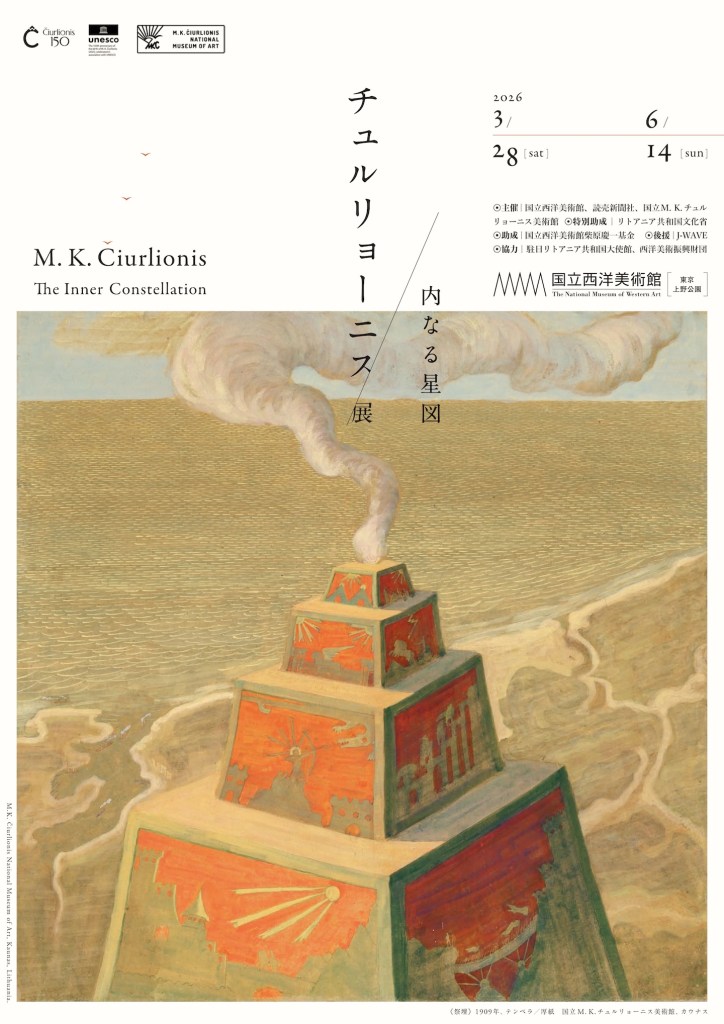
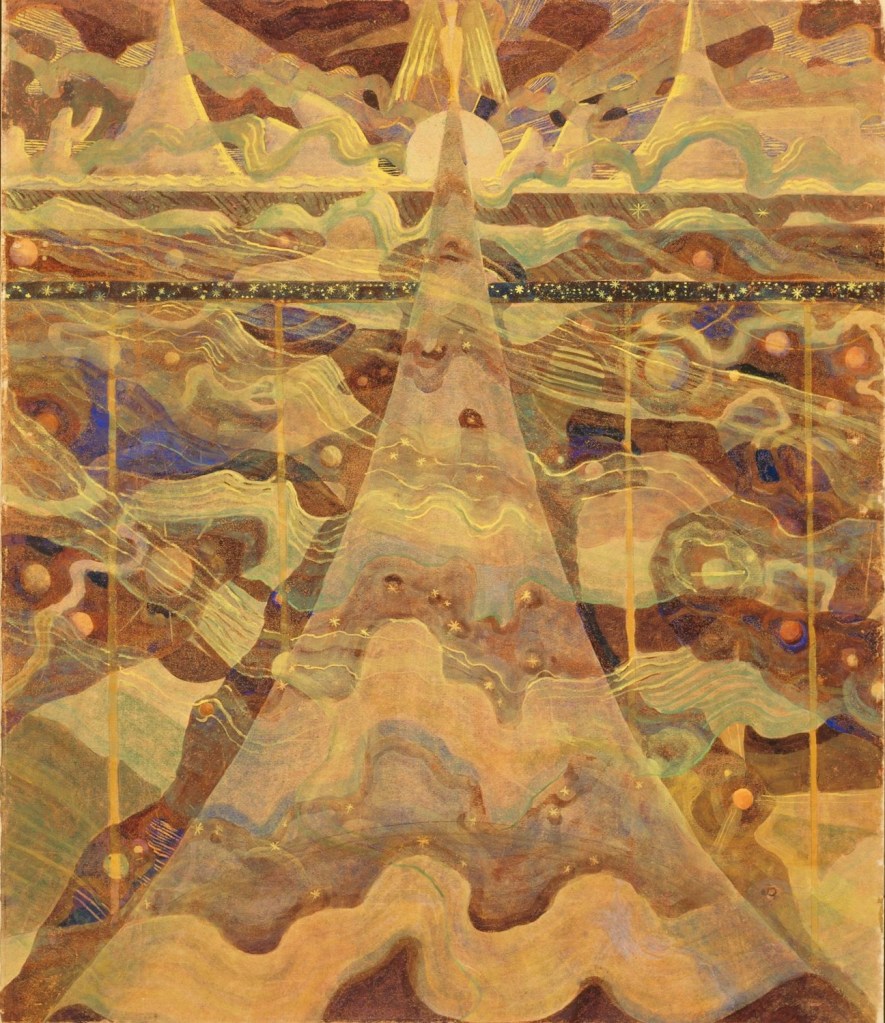
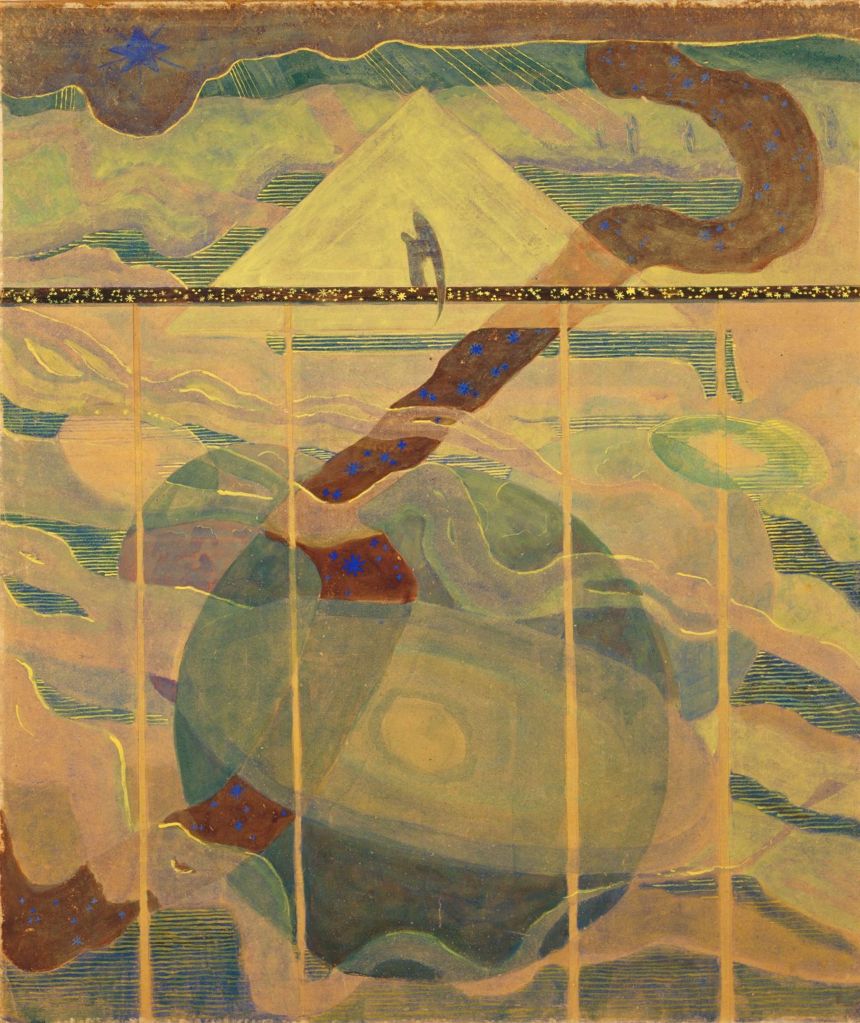
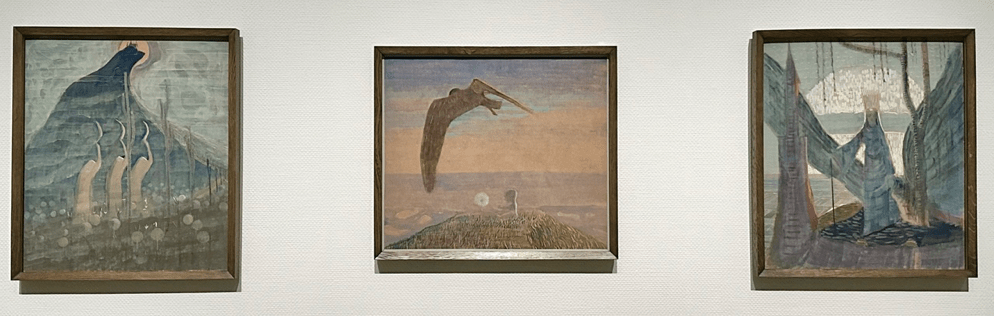
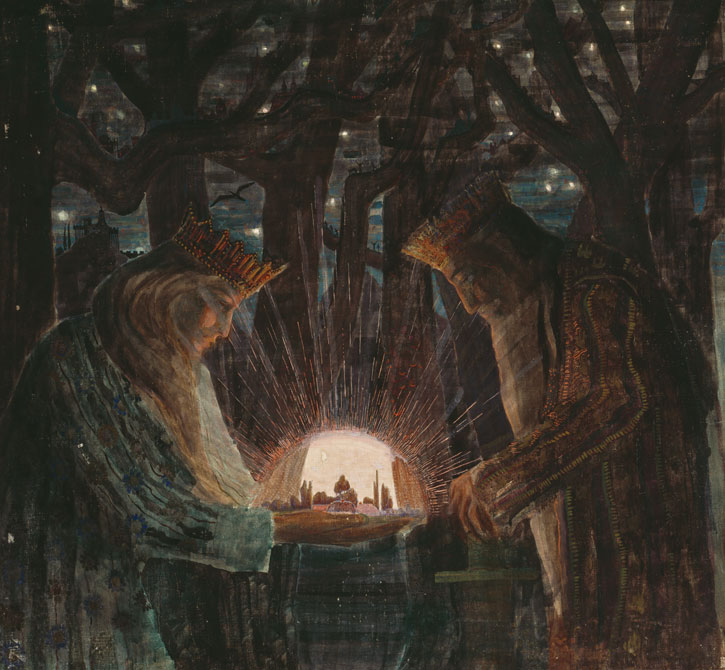
I first followed the crowd to the special exhibition: M. K. Čiurlionis: The Inner Constellation, a retrospective of the Lithuanian artist to commemorate his 150th birthday. This was the first time I’d heard of him. Čiurlionis (1875-1911) is Lithuania’s national treasure, a composer and painter whose life was cut short at 35. He composed some 400 pieces of music and, in just six years of serious painting, left more than 300 works. His musical training and talents were woven straight into his canvases: polyphony, sonatas, fugues, and he even titled works after musical structures. His paintings draw from Lithuanian nature, history, and ancient folk tales while also reaching into theosophy and astronomy to explore the human spirit and cosmic mysteries. The show puts special focus on the synthesis of the arts and synesthesia.
The exhibition is loosely structured in chapters: Prologue, Rhythm of Nature, Symphonic Paintings, Fantasy Dedicated to Lithuania, and Epilogue. What hit me first was the overall atmosphere. The paintings carry a close, harmonious value range with subtle shifts in tone that keep everything unified and quietly luminous. Contours do not push hard, and lines are fine and incredibly delicate. There’s a strong Art Nouveau decorative sensibility running through them, but it is not merely ornamental. Some pieces feel like picture-book illustrations with a hint of contemporary art.
Sonata 6, Allegro, 1907Sonata 6, Andante, 1907
That musicality comes through most clearly in the sonata series. The show includes three of the seven he created: the Third (Serpent Sonata), Fifth (Sea Sonata), and Sixth (Sonata of the Stars), all from 1908. Each movement is named after a musical tempo. The Sixth Sonata (Sonata of the Stars) is an artistic envision of outer space. Allegro depicts a chaotic yet beautiful cosmic space with galactic mists. A single horizontal band studded with stars runs across the composition like a Milky Way ribbon suggestive of space undulating as it intersects with planets and stars, generating a rhythm that resolves what initially appears to be chaos into harmony. There is strong vertical symmetry disrupted by oceanic whorls cascading through the composition, creating a sense of unity. Čiurlionis layers tempera to create rich, complex color in golds, warm browns, reds, and deep blues. In Lithuanian tradition the Milky Way is the path traveled by the souls of the dead, who continue living somewhere beyond it. The angel’s figure echoes that infinite journey. Of course Čiurlionis did not paint music literally but used rhythm of line and plane, flexibly waving forms, overlapping levels of landscape to create an effect of expanded space. When you look at the sonatas in sequence you start to feel the movement structure. These are high-level multimedia pieces before the term existed.
Fairy Tale, triptych, 1907
From 1907 onward Čiurlionis developed his own “fairy tale” vein— magical worlds, kings, princesses, knights, journeys, roads. In Fairy Tale of the Kings (1909), two kings face each other in a night forest, gazing at a glowing dome that contains Lithuania’s beautiful natural scenery and countryside. They embody a kind of duality, worldly rulers yet guardians watching over small Lithuania from outside.
Historian Greta Katkeviciene notes that the Lithuanian countryside and nature were very important to Čiurlionis, and the folklore coming from it dictated many of his subjects. This was at a time when Lithuanians were trying to define their identity under the Russian Empire, so the idea of a national art rooted in folklore was more than aesthetic; it was necessary.
Rex, 1909
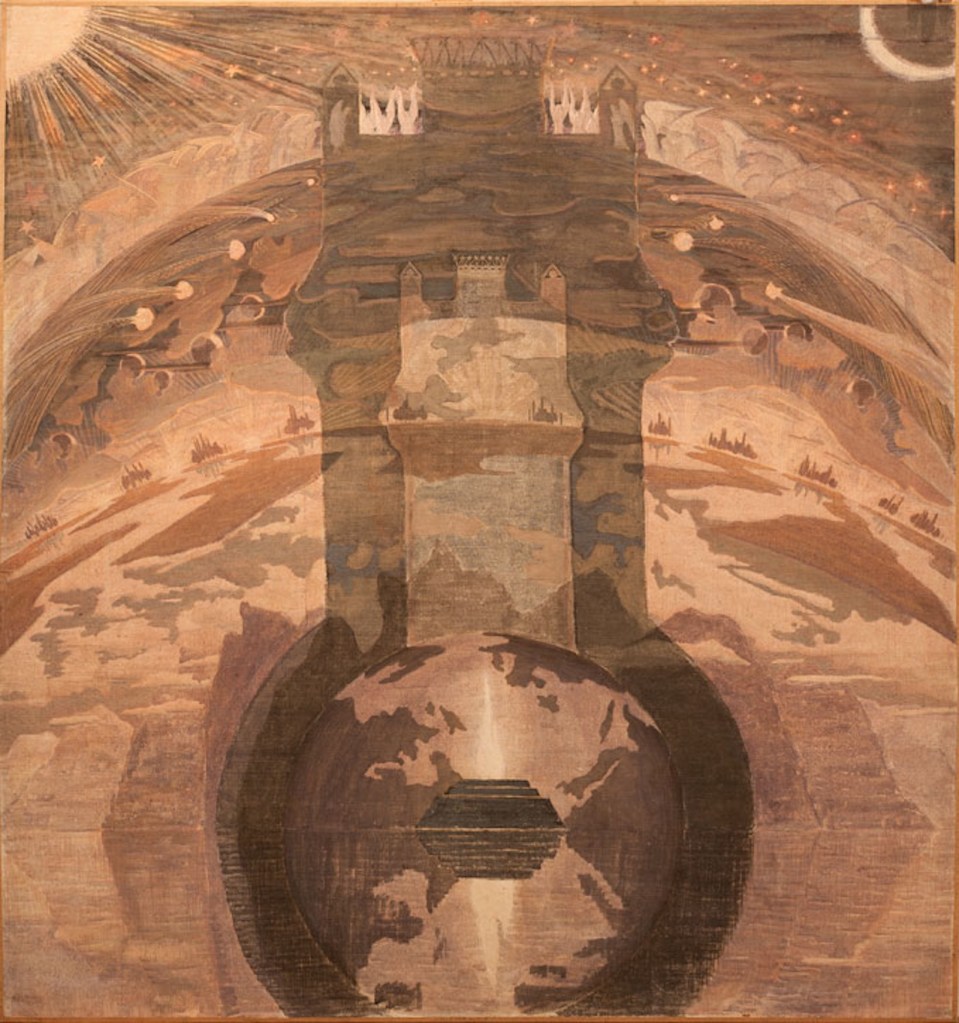
The exhibition closes with his largest and perhaps most iconic work, Rex (1909). This piece most fully shows his thought and formal explorations. On a canvas woven from beautiful tonal light and shadow, the four elements, fire, water, earth, and air are condensed. Under a structure as intricate as a grand symphonic poem, countless stars, angels, and trees repeat in layers while a double, semi-transparent king sits on the earth as if vertically piercing the cosmos. The whole composition has the feel of an intricate pattern or tapestry. Čiurlionis fused everything he had absorbed, Lithuanian nature worship, Hinduism, Egyptian mythology, theosophy, astronomy, and natural science, into one narrative system.
Under the Wave off Kanagawa, 1830-33Sonata 5, Finale, 1908
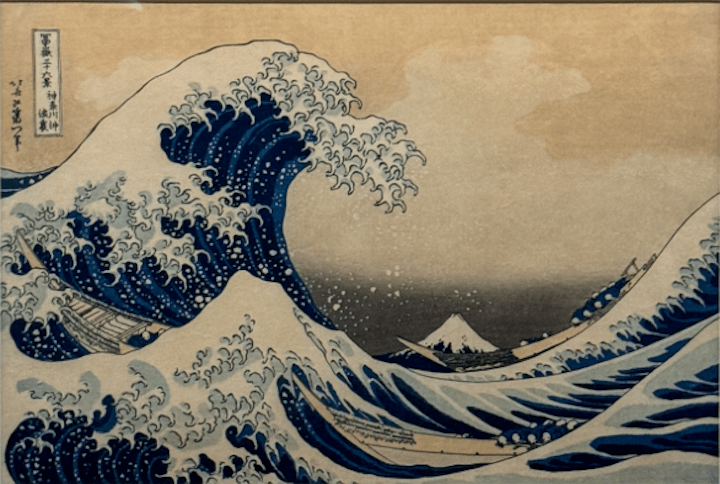
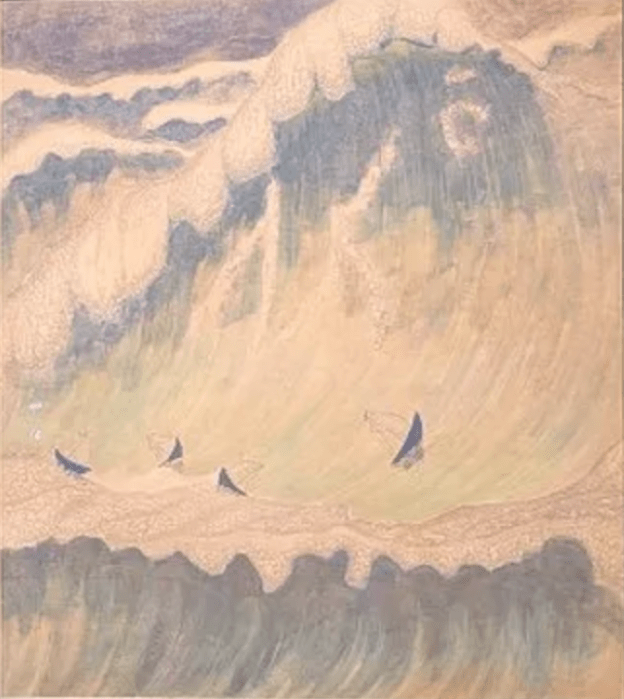
Čiurlionis was not widely traveled, but the influences of Symbolism, Art Nouveau, Japonisme, Whistler, and early Kandinsky are all there. It was almost too perfect that a major exhibition of Katsushika Hokusai’s (1760-1849) most famous Thirty-six Views of Mount Fuji was running at the same time. Though a Japanese artist, Hokusai’s work had profound influence among the Impressionist movement and beyond in the West, even on Čiurlionis. When one walks out of the subdued Čiurlionis directly into the saturated and clearly defined world of Hokusai, contrast is the first feeling. Yet you can see the resemblance in some pieces right away. For example, the finale of Čiurlionis’s Sea Sonata (Sonata No. 5), where a rugged large wave engulfs some boats, reminiscent of Hokusai’s Great Wave off Kanagawa. Superficial similarity aside, the way two artists compressed space into a decorative flatness, the subtle rhythmic quality, and the pictorial schemes all resonate. Seeing the two exhibitions side by side in Tokyo felt like a gentle wink from the universe, or at least from very thoughtful curators.
After the special exhibitions I visited the permanent collection of NMWA. It’s uncommon to find an entire museum devoted to Western art outside the West, and the permanent collection here punches well above its modest size. The museum holds roughly 4,500 to 6,000 works, including paintings and sculptures from the Renaissance through the mid-20th century. The core is the Matsukata Collection, which features Western works (heavy on French Impressionists and Rodin) gathered in Europe by Japanese industrialist Kōjirō Matsukata, but it is thoughtfully broader and still adding each year. Because of limited space they rotate the permanent displays from time to time, which is actually a nice invitation to come back. Every piece seems chosen with a clear eye for artistic quality and draftsmanship. You get the sense of a curator well-versed in Western art history who also understands a Japanese audience and takes care to build the bridge.
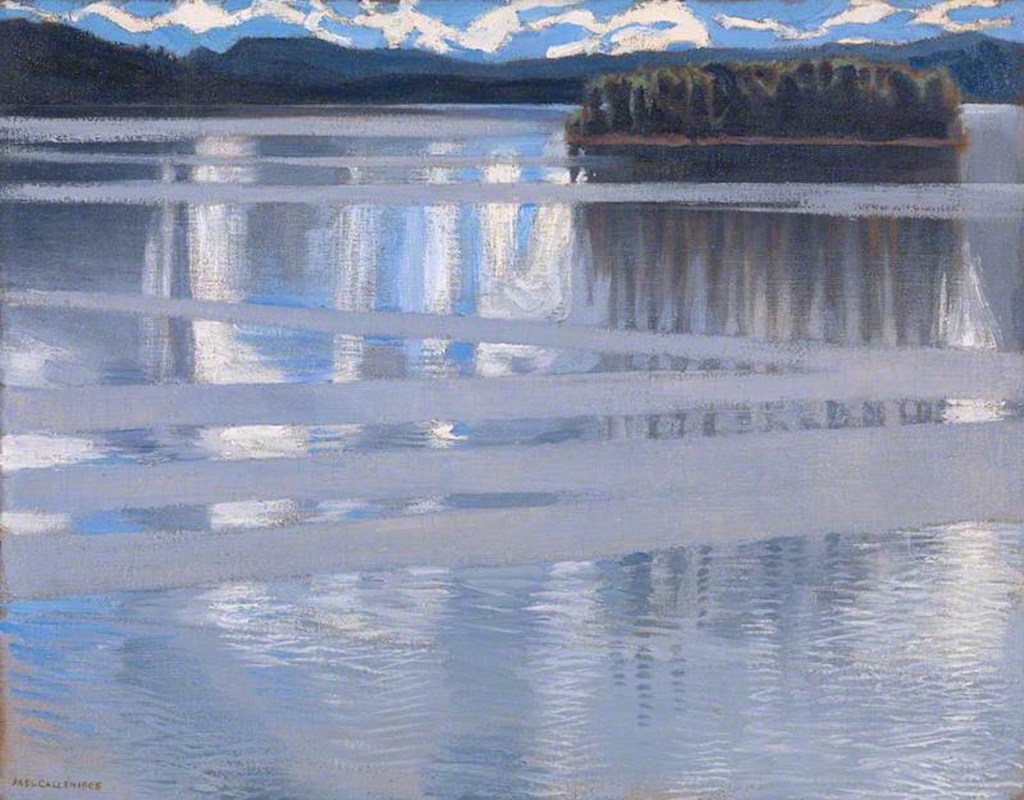
Island in the Atttersee, 1902Lake Keitele, 1904-6
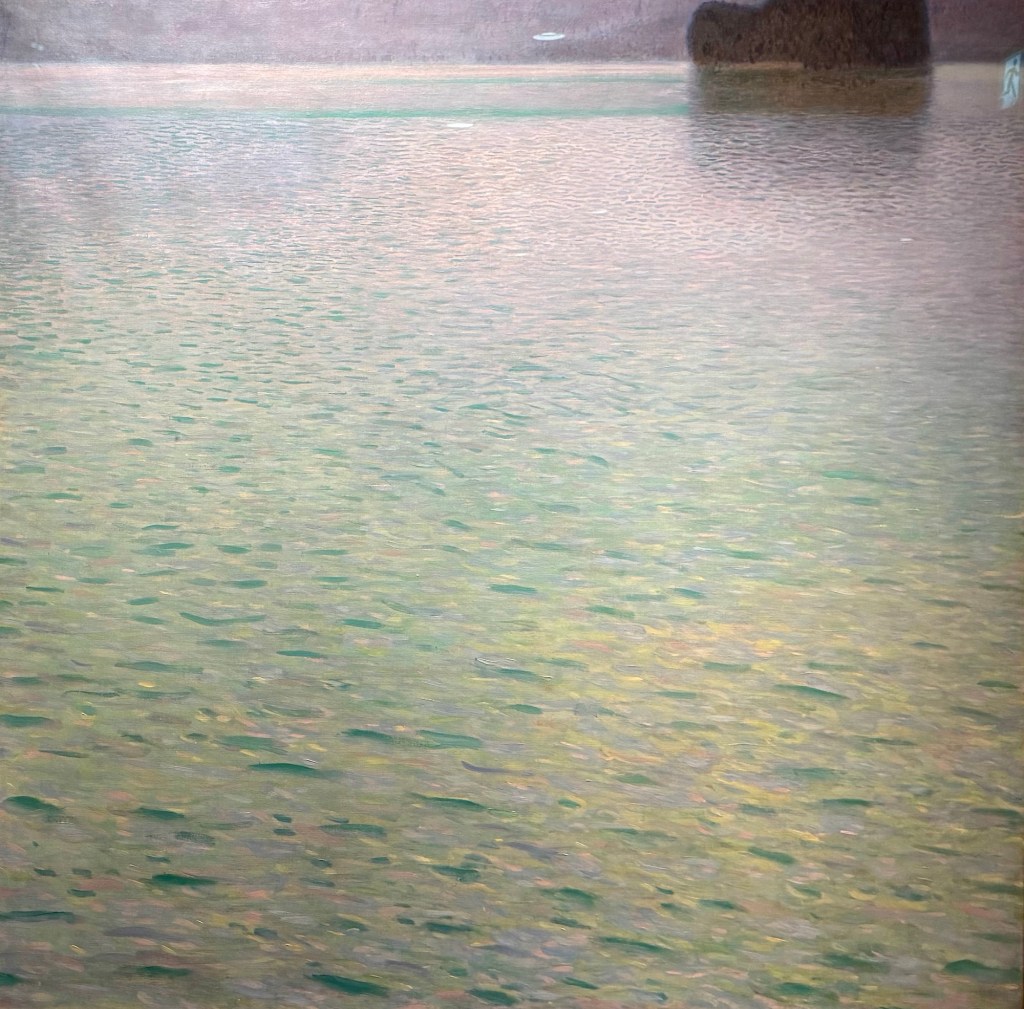
A perfect example is how they’ve paired Klimt’s Island in the Attersee with Akseli Gallen-Kallela’s (1865–1931) Lake Keitele. This isn’t the most iconic Klimt (no glittering golden portraits here), but it’s high quality and pivotal in his career. It is a calm landscape with hidden rhythm. Around the turn of the century, after the clamor surrounding his more allegorical works, Klimt created these lake images almost as a way to escape into a quieter world. The square format and the way he builds rhythm through repetitive yet irregular short brushstrokes that visualize ripples and light reflection on the water feel like pure artistic experimentation. Beside it is Lake Keitele, a work of similar subject and even similar composition, yet with completely different energy. Akseli Gallen-Kallela was a Finnish artist, less familiar to the world in comparison. This is one of his most recognized pieces. It is energetic, with zigzag linear forms that suggest wind across the water and the wake of a boat, evoking Väinämöinen, the poet-hero of the Finnish saga Kalevala. It’s nation-making, almost political, yet also introspective, with an awareness of the primitive world and a tendency toward abstraction. Not the shiniest pieces, but there is so much to appreciate and chew on. You leave having seen a famous name from a fresh angle and discovered a gem you might not have sought out otherwise. They also sit comfortably with Japanese aesthetic sensibilities, subtle, atmospheric, and and in tune with a contemplative spirit.
Museums don’t have to be the size of the Louvre or the Met to matter. In fact, the smaller scale here is part of the appeal. You get high-quality work without the pressure to “do everything.” The architecture itself (a UNESCO-listed Le Corbusier building) becomes part of the looking. You encounter artists who might get lost in bigger institutions, or the lesser-known aspect of a famous one. You’re invited to linger with niche perspectives but deeply original voices. High-quality draftsmanship, thoughtful arrangement, rotating displays, and with local audience in mind make the whole place feel welcoming, alive and generous.
I left feeling refreshed, and quietly grateful that Tokyo had made space for this particular meeting of unexpected connections. NMWA is a solid museum for Western art, a showcase for Japanese deep understanding and appreciation of Western culture, and a window for us to see how the West is presented and perceived from outside. Sometimes the most meaningful stops happen in the places you almost skip.
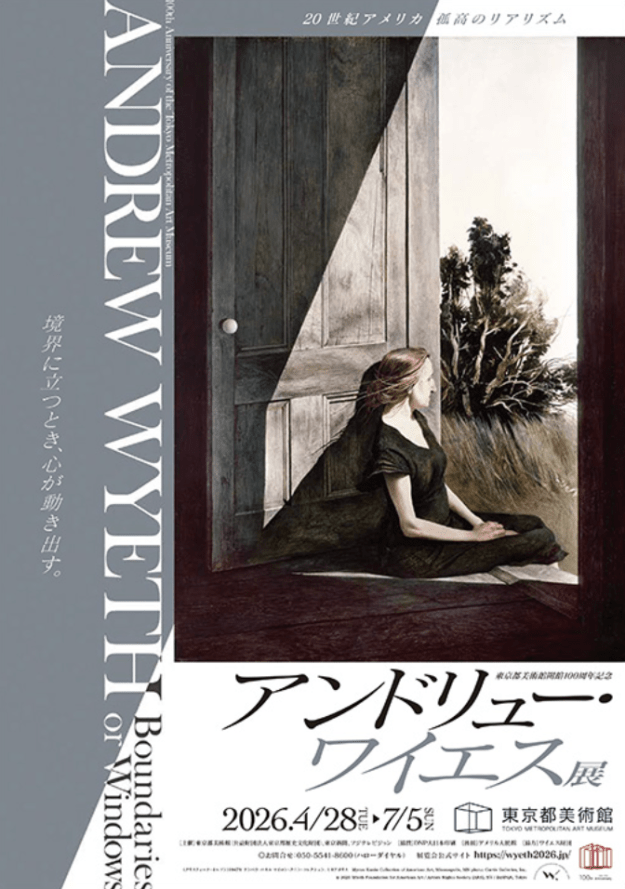
There are two museums in America that hold major collections of Andrew Wyeth (1917–2009). The Farnsworth Art Museum in Maine and the Brandywine Museum of Art in Pennsylvania. The latter happened to be on my way from Ithaca to Philadelphia. I had every intention of stopping by, but life (and flight schedules) had other ideas. Instead, I found myself in Tokyo two weeks later, standing in the crowded galleries of the Tokyo Metropolitan Art Museum for their major retrospective, Andrew Wyeth: Boundaries or Windows. It felt fitting, almost inevitable, like I was chasing Wyeth around the globe to catch another facet of his quiet, persistent vision.
The show had already been running for six weeks but was still packed. The audience ranged in age and felt noticeably younger than some of the more sedate crowds I have seen in San Francisco museums. The exhibition was organized around the theme of “boundaries,” a motif that appears repeatedly throughout Wyeth’s work through windows, doors, frozen waterways, and distant landscapes. Rather than following a strict chronological order, it was divided into five sections: The Painter Andrew Wyeth, Light and Shade, The Olson House in New England, An Expanding vision, Boundaries or Windows. This arrangement let the show move from who Wyeth was and how he worked, through the way light and shadow carried ideas of life and death, to the central role of the Olson House, then outward to a broader vision, and finally to the boundaries theme that pulled everything together. It was well-curated and thoughtfully organized around that single idea, and it gave me plenty to think about long after I left.
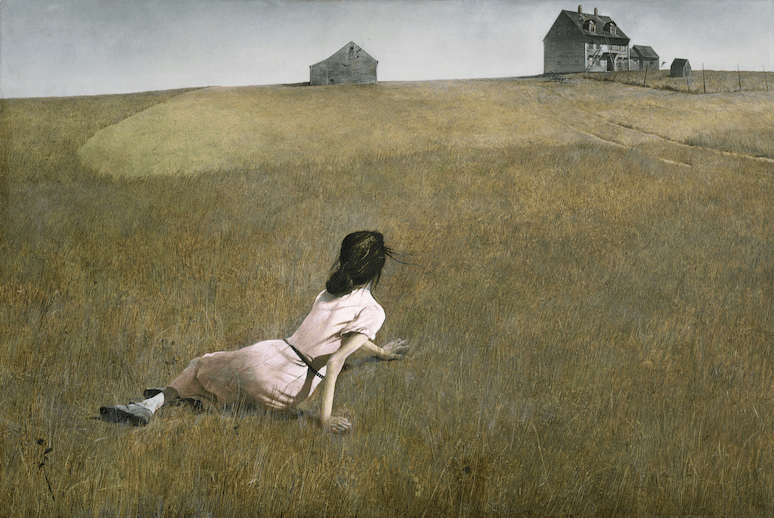
Christina’s World 1948Garret Room 1961
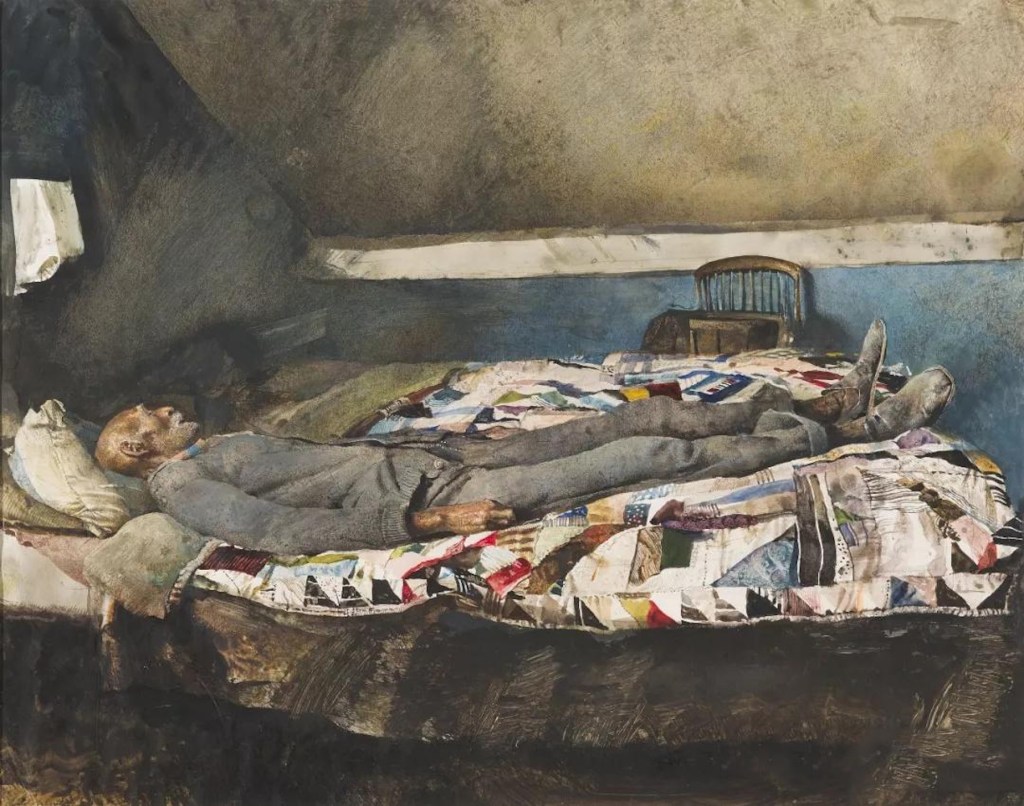
My initiation with Wyeth came in a composition class where we studied famous paintings using the concept of notan, trying to divide the composition into black and white. Artists like Winslow Homer, Norman Rockwell, and Wyeth were the easiest to analyze because they rely on strong value contrast and clear geometric divisions. With Wyeth especially, many paintings feel built from big, simple shapes and stark light-dark separations. Yet the closer I looked, the more questions appeared. Christina’s World (1948) and Garret Room (1961) are powerful, deeply humane images, but what about the sharp edges on that distant house, or the way the brightest white almost pushes out of the frame? Where does that quiet uneasiness come from?
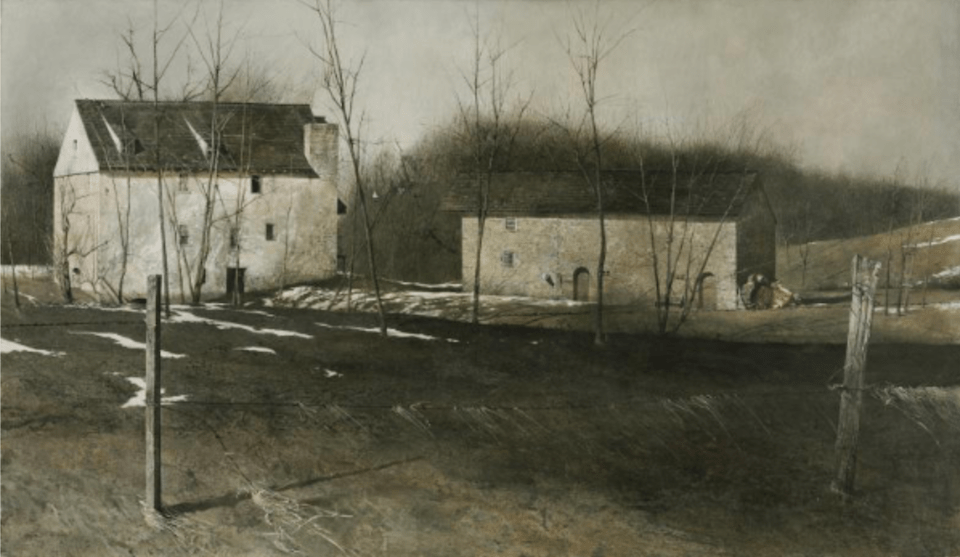
The Mill, 1962
Standing in the Tokyo galleries, the first thing that struck me was the wintery, subdued color palette. The lack of bright color gives the work a certain pressure and presence, but it also feels familiar, almost like the restraint of traditional Chinese or Japanese ink painting. Most of Wyeth’s subjects come from just two places: Chadds Ford, Pennsylvania, where he was born and lived much of his life, and Cushing, the small coastal town in Maine where he spent summers for decades. His work grew out of the narrative tradition of Winslow Homer and Victorian storytelling, but he turned it toward the hunters, farmers, and ordinary country people of those two specific landscapes. He captured the lingering spirit of frontier values, the loneliness of labor, the struggle with nature, and the quiet will to endure. To some critics it looked merely regional. To the wider public, it reads deeply American, and it traveled.
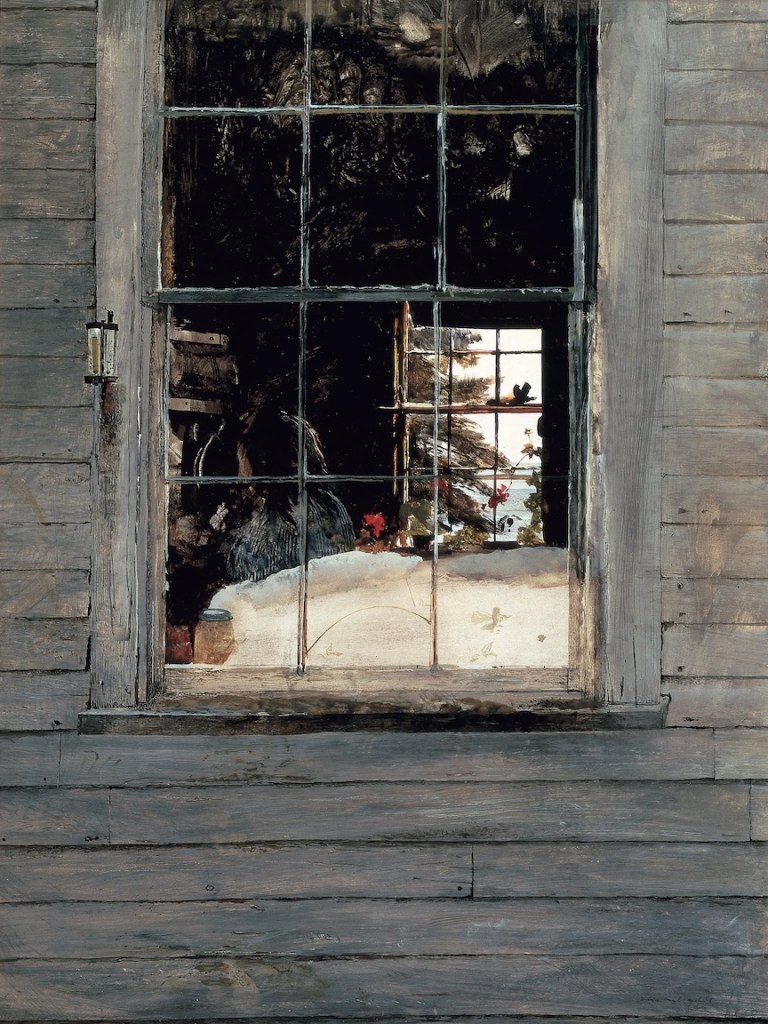
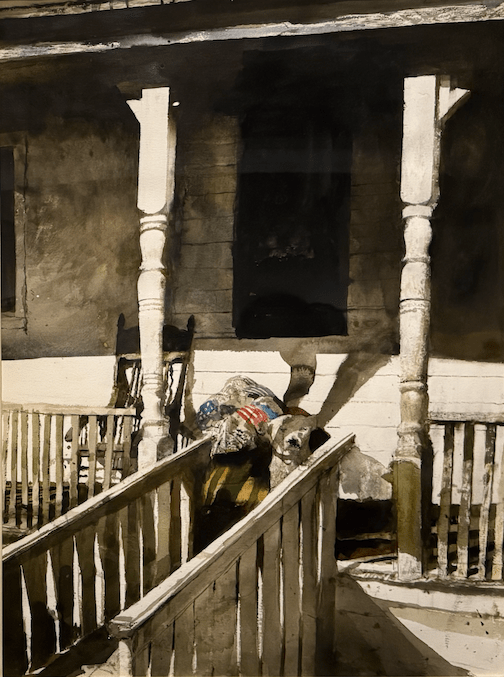
Geraniums, 1960Rag Bag, 1986
Though his father, the famous illustrator N.C. Wyeth, taught him directly, Wyeth grew up feeling somewhat overlooked in that large artistic household. He had a solitary, introspective childhood. You might assume the pale palette mirrors that inner life, but he always insisted he was simply staying true to what he saw in nature. He once remarked that he had complained more than once about his paintings looking too pale and washed out, yet the colors he chose matched the country he lived in. Winter colors here are exactly like that. If he came across a blue robin or anything bright and colorful he liked it, of course, but for him the colors of nature were always best.
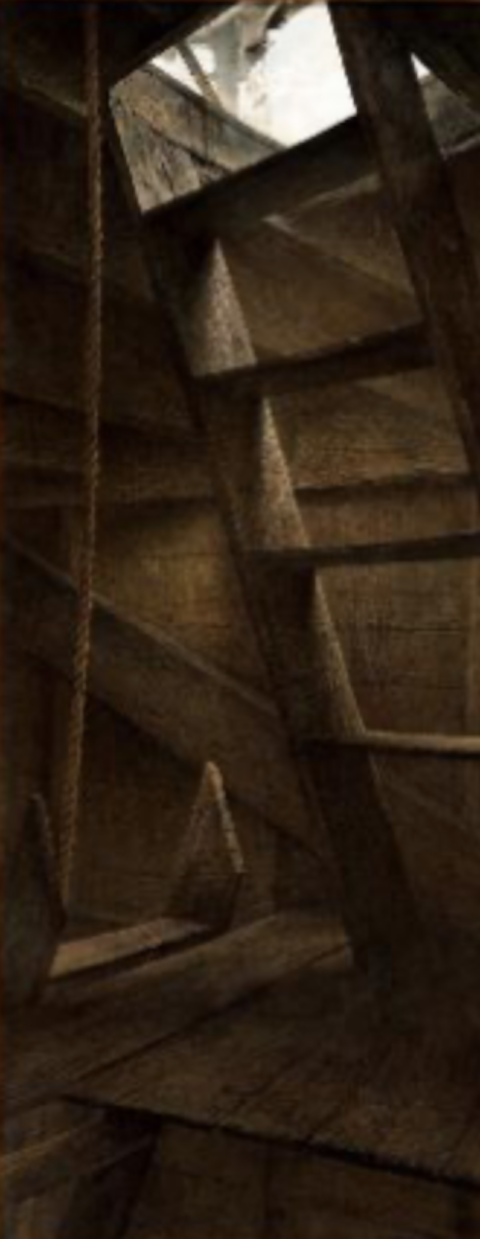
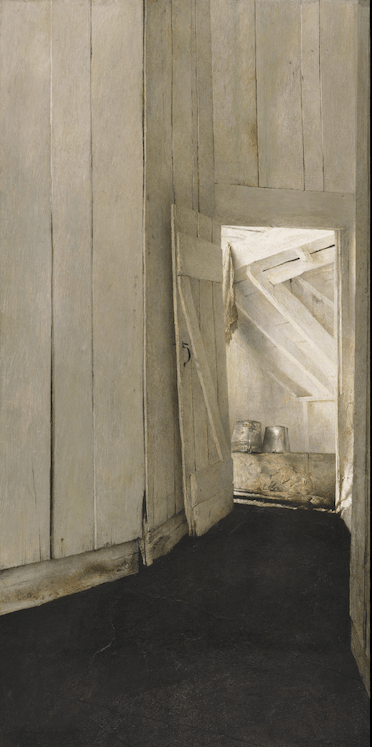
Toll Rope, 1951Cooling Shed, 1975
Then there is the composition I had already noticed in class. Strong value contrasts, clearly defined shapes, and big masses of dark and light create tension and focus. Wyeth himself said the sense of movement in his pictures came from careful arrangement and composition rather than expressive brushwork. From a distance many of the paintings read like abstract arrangements of shape and value. His unconventional cropping and vantage points echo experiments I saw in Utagawa Hiroshige’s (1797-1858) ukiyo-e prints “One Hundred Famous Views of Edo” at the Ota Memorial Museum of Art, another crowded Tokyo show that made the connection feel alive.
Close looking reveals his process. He started many works with loose, quick watercolor washes, then shifted into tempera, using drybrush on the elements that mattered most to him. “Drybrush is layer upon layer,” he explained. “It is what I would call a definite weaving process. You weave the layers of dry brush over and within the broad washes of watercolor.” Some people think painstaking realism signals emotional detachment. With Wyeth the opposite is true. The care feels like deep attention, almost tenderness. He often ignored the rules art teachers drill into students. Perspectives can feel skewed or emotionally distorted rather than optically correct. Edges sometimes stay sharp or textured even in the distance. The brightest highlights or deepest shadows land where they create the strongest feeling, not where conventional light logic would place them. These choices make his subjects feel a little uncanny, charged with psychological weight rather than simple description. His realism was never just a polite counterpoint to Abstract Expressionism. It was its own distinct thing, rooted in feeling, memory, and inner projection. The works read like personal novels that somehow remain universal.
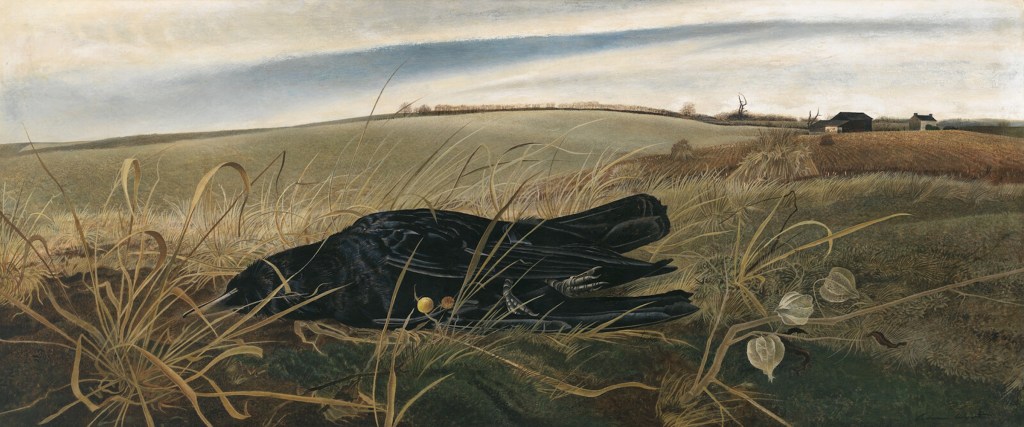
Winter Fields, 1942
Take Winter Fields (1942). The composition and brushwork are stylized, not strictly true to life, yet the painting still feels natural and real. It shows a dead, frozen crow he found near his home in Chadds Ford. He brought the bird into the studio, sketched it, and painted it in exquisite detail from a low, worm’s-eye view that makes the small creature loom large against its surroundings. The painting was made during World War II, and the stark image of a dead bird in a bleak field recalls dead bodies on battlefields. Despite the apparent precision, the distant trees are rendered as sharply as the crow in the foreground, something the human eye would not actually see. The effect compresses space toward the picture plane and is strengthened by the delicate, overlapping blades of grass that form a lace-like surface pattern. In the middle of the war he once remarked that you do not need to paint tanks and guns to capture its feeling. You should be able to paint it in something as simple as a dead leaf falling from a tree. In remote Chadds Ford he did exactly that, letting nature and landscape carry poignant narratives of loss.
Mother Archie’s Church, 1945Mother Archie’s Church Study, 1945 (Not in the Tokyo show)
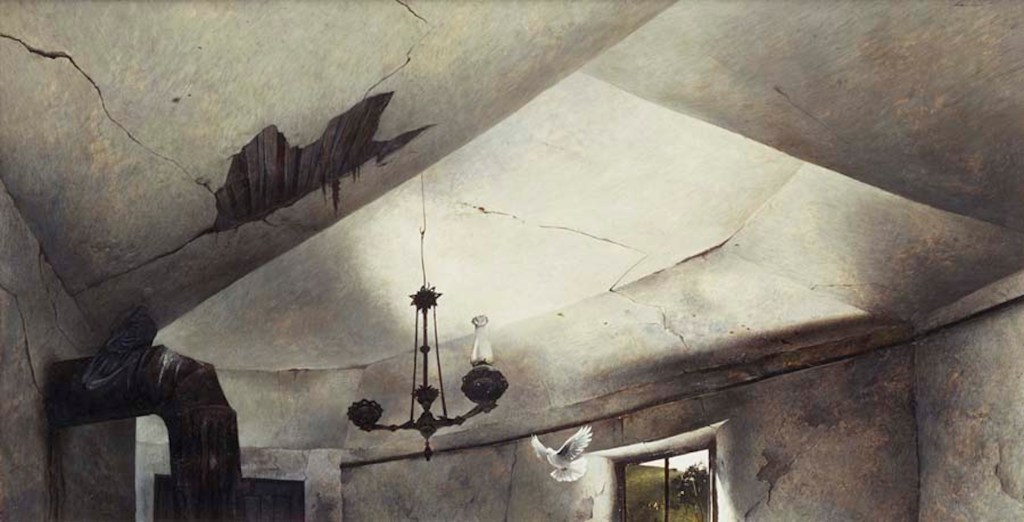
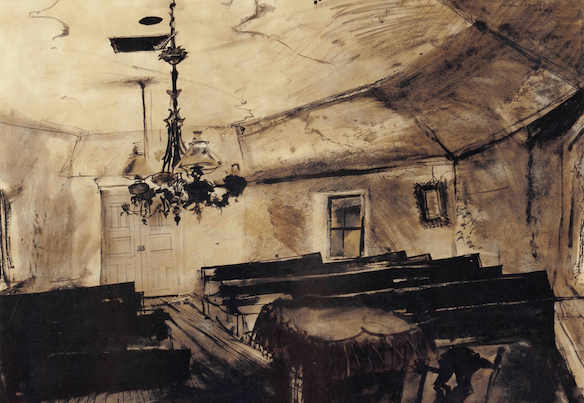
Grass is not the only place he hid a bird. In Mother Archie’s Church (1945), do you see the crow in the shadow? Without the white pigeon, the painting would read almost as an abstract play of shapes and value. The old Quaker meetinghouse stood on the site of the bloody Battle of the Brandywine and later became a church for the local Black community. By the time Wyeth painted it the building was already collapsing. He remembered attending services there occasionally, but eventually the building collapsed. As if reluctant to dwell in the sense of loss, the light illuminates and animates the pigeon and lifts the whole image into something more allegorical and cinematic. Especially when you track down the preparatory study for the work, the storytelling becomes more obvious. In fact, a lot of his paintings remind me of the cinematography in The Assassination of Jesse James by the Coward Robert Ford. Lingering lights, vast bleakness, solitary figures, all pregnant with narratives. Time feels slowed and charged with things left unsaid.
Flint, 1975Flint study, 1975 (Not in the Tokyo show)Flint study, 1975 (Not in the Tokyo show)
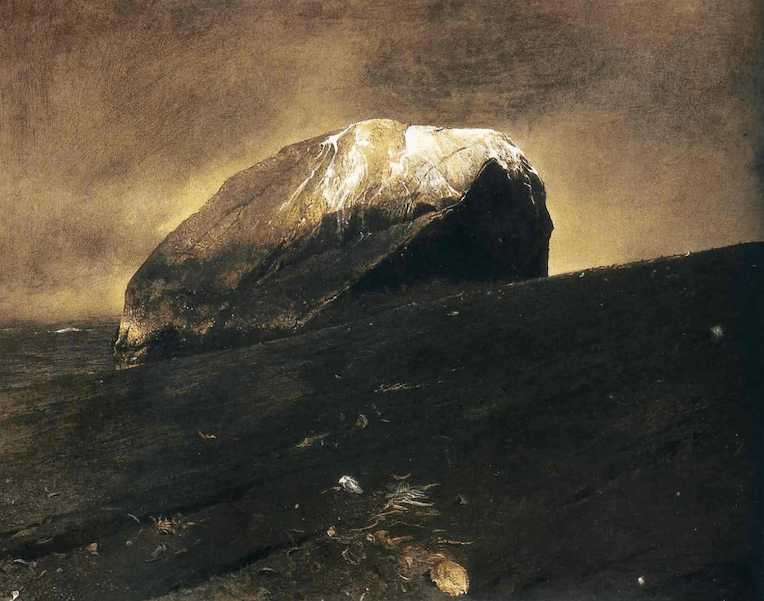
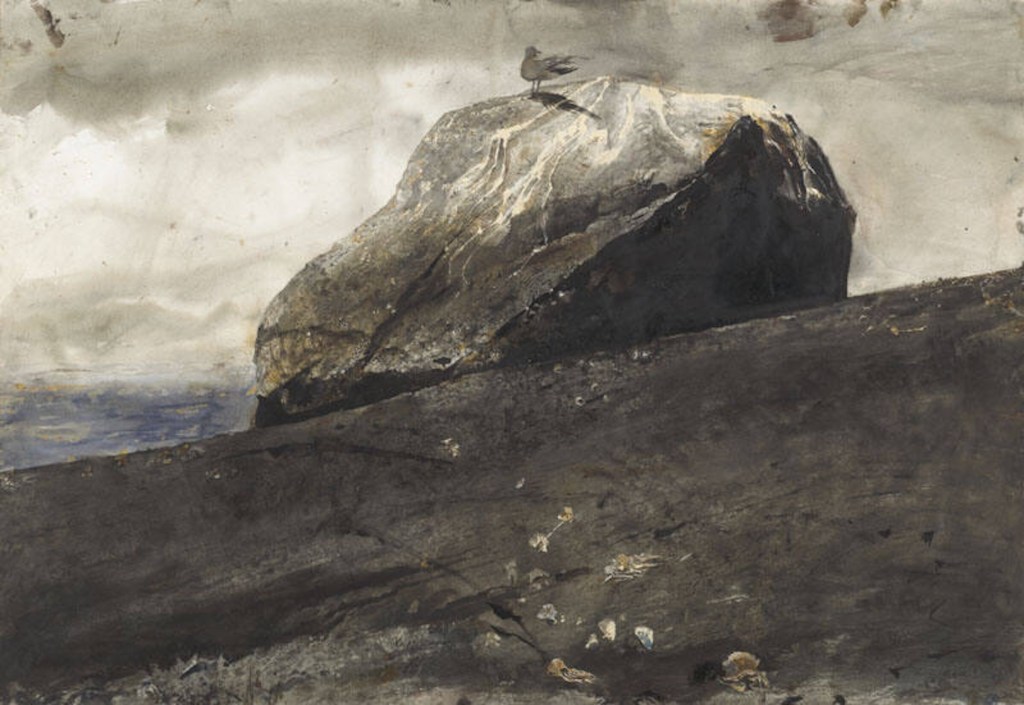
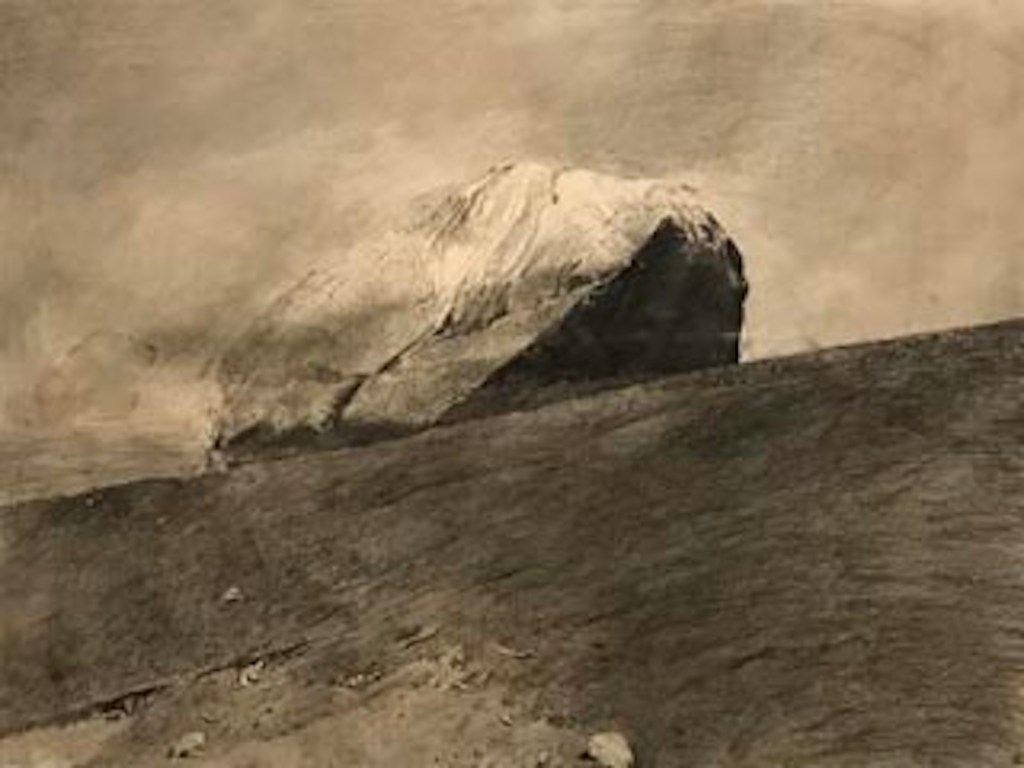
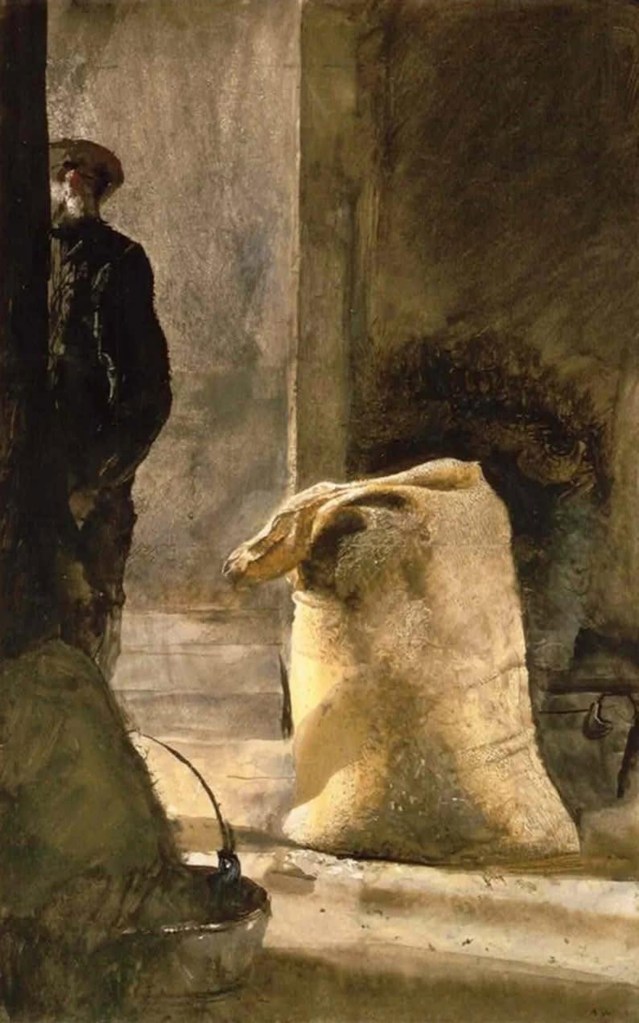
Flint (1975) is another case in point. Wyeth made several studies for it. In one the stone sits dead center with a seagull perched on top. In the final version he shifted the stone slightly off center, removed the bird, and added delicate highlights to the shells and fish bones in the foreground. The flint still reads as monolithic and eternal. The single dramatic light from above turns it into the central character of its own small drama. In Wyeth’s imagination, things like rocks or boats could stand in as metaphorical portraits or even self-portraits. He often drew parallels between the rocky Maine shore and the weathered lobstermen and fishermen he knew. Grain Bag from 1961, for example, he considered a portrait of Alvaro Olson, Christina’s brother.
Grain Bag, 1961Light Wash, 1961
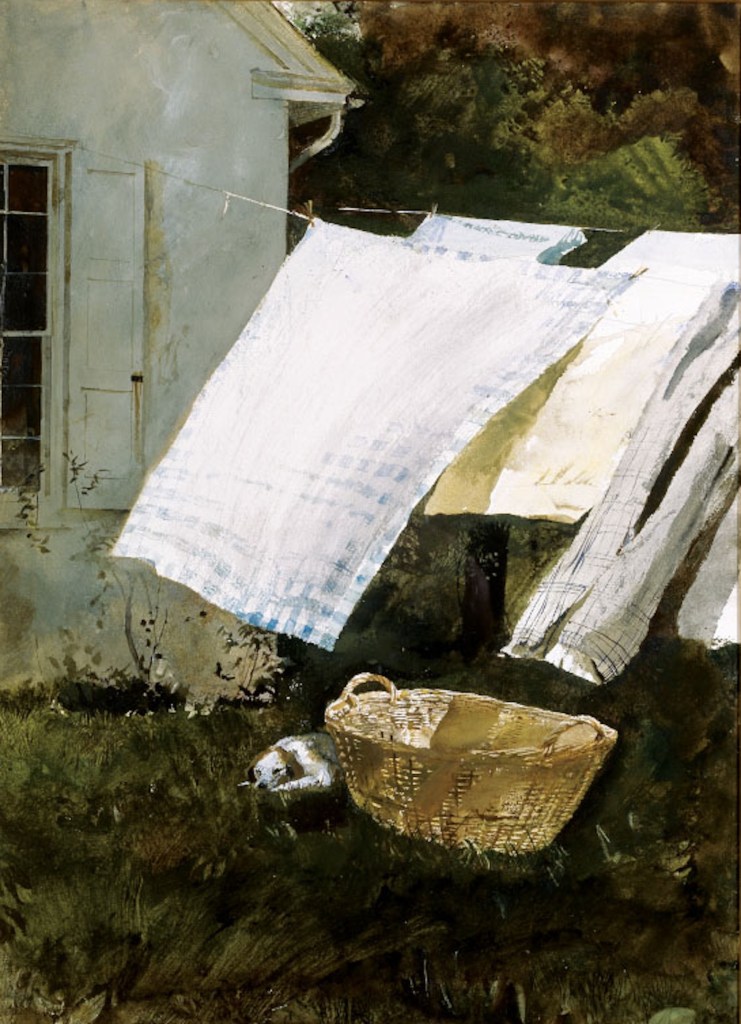
Wyeth once said, “I’m very conscious of the ephemeral nature of the world. There are cycles. Things pass. They just do not hold still.” It is almost as if his task was to eternalize a passing moment. The statuesque flint does that. So does the wind in Light Wash from 1961. The scene is set in Chadds Ford and shows the back of a house with a laundry line full of clothes drying in the breeze. A small dog rests behind a straw laundry basket. The contrast between the light-colored laundry and the darker surroundings is carved out with sharp lines, almost like a boundary. Yet the two worlds are not frozen apart. The wind is clearly moving the laundry, blurring and crossing that division. The basket below hints at the moment just before or after, while the dog, the only living presence, could stir at any second. He catches solitude, movement, and something more.
Spool Bed, 1947
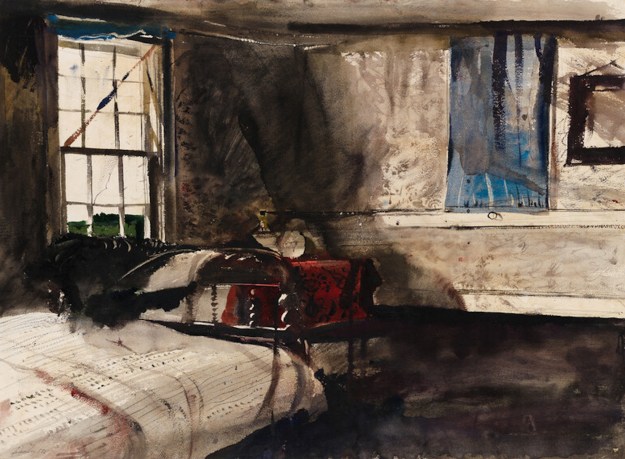
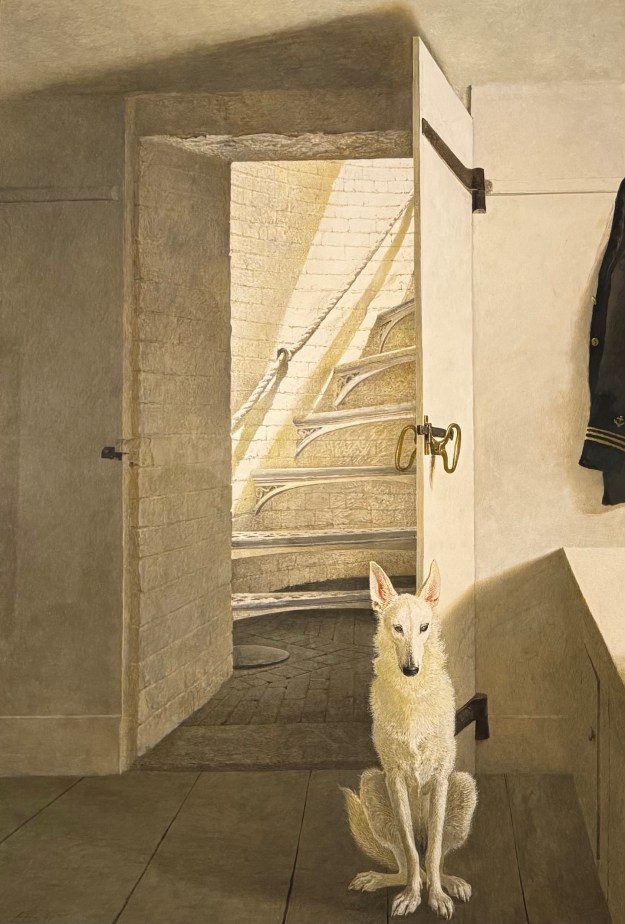
Two of my favorites from the show were both interiors, one earlier and one later. Spool Bed from 1947 has a muted overall palette but uses more saturated color for accents. The wet areas feel less controlled. Black ink bleeds softly into the surrounding space. Broad, expressive brushstrokes and lines of varying weight run and cross, yet what comes through is a dead silence, a sense of desolation. Light Station from 1983 shows the interior of a lighthouse on tiny Southern Island, Maine, which the Wyeths owned. The family dog Nome sits obediently in front of a door that opens onto a staircase leading up. Light from the lighthouse spills down from above. Positioned by the entrance, Nome seems to guard it. If the spool-bed painting carries a ghostly, abandoned feeling, this one feels meticulously kept and watched over. Notice where Wyeth placed his darkest dark and his whitest white. The painting still holds its balance. While you look at the elegant dog, your mind keeps wondering where the owner of that half-shown sailor jacket went, and where those stairs actually lead.
Light Station, 1983
I kept thinking how naturally all of this sits with certain East Asian sensibilities. The quiet melancholy, the sense of accumulated time and memory, the way life and death feel continuous rather than opposed, the faint hope glimmering inside desolation. It resonates with ideas of impermanence and the Japanese sense of mono no aware.
Wyeth’s deep independence, his refusal to chase whatever happened to be fashionable, reads as profoundly American. That same independence also spoke to artists in China in the 1980s. At a time when many young painters were still working under the long shadow of Soviet-style revolutionary realism, Wyeth’s pictures arrived like a revelation. His quiet, desolate yet poetic style, focused on the inner life of ordinary people, offered something different: a way to hold on to hard-won figurative skills while leaving room for personal feeling, small sorrows, warmth, and poetry. The “Wyeth wind” that blew through Chinese art circles back then has not entirely died down. As one observer put it, his work showed that art did not have to be about t grand historical or ideological themes. It could simply attend to the small joys and sorrows of everyday life with honesty and craft. Wyeth’s simplicity and seclusion feel almost like the ancient Chinese hermits. As Tao Yuanming put it, “There is true meaning here, yet when I try to speak of it I forget the words.”
Thin Ice, 1969
That possibility still feels radical. These days contemporary sections in museums across continents can start to blur together, concept-heavy, visually thin, strangely interchangeable. Wyeth’s stubborn commitment to place, technique, and inner truth stands out. He stayed true to himself, to the tools he mastered, and to the emotional and philosophical weight he wanted to carry. The result is work that still draws crowds of all ages in Tokyo, work that feels both deeply local and quietly global.
I left the museum thinking that chasing Wyeth had been worth every detour. His pictures do not shout. They linger. And in that lingering they keep offering the same generous question they have been asking for decades: What if the old tools, handled with care and feeling, are still more than enough? It comes down to purity of heart and a deep, wholehearted passion for art.
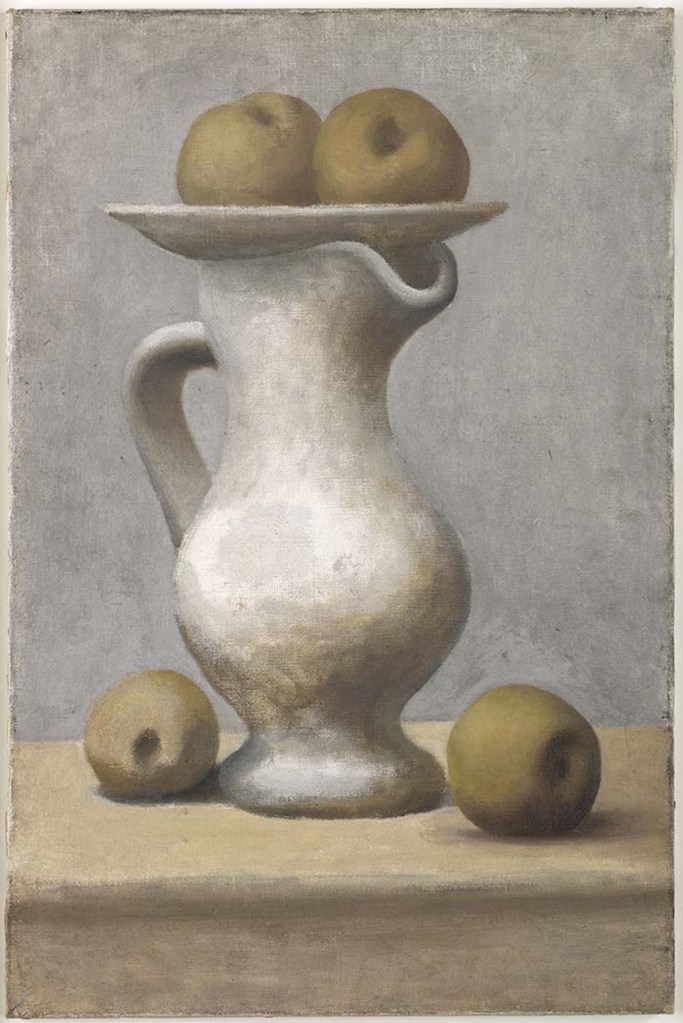
I first saw Pablo Picasso’s Still Life with Pitcher and Apples decades ago at the Musée national Picasso-Paris. It’s a mid-sized canvas (65 × 43 cm) with a simple domestic arrangement painted in a realistic style and muted colors. When surrounded by the artist’s more famous Cubist experiments, this piece was actually quite eye-catching to me.
The painting dates from 1919, right in the middle of Picasso’s so-called “return to classicism” period. After the visual fireworks of Cubism and the disruption of World War I, many artists (including Picasso) felt a pull toward order, solidity, and older traditions. For him, the turning point came during a 1917 trip to Italy. Walking among the ancient ruins and frescoes of Pompeii and Herculaneum left a deep mark. The chalky, fresco-like palette and the calm monumentality in this still life feel like a direct echo of those weathered walls.
The big, sculptural shapes and slightly off-kilter perspective also bring to mind Paul Cézanne. You feel like you’re looking slightly down at the table surface while simultaneously gazing up at the plate balanced on the pitcher’s rim – a spatial effect that only happens when you look at something truly grand. Meanwhile, the overall tranquility, the way the objects seem to breathe in their own dusty light, reminds me of Giorgio Morandi. Both Cézanne and Morandi have shaped how I see still life: not as decoration, but as a slow conversation between forms, space, and light.
While hunting for fresh ideas to keep my pear journey going, I decided to do a direct study of this Picasso with a deliberate pear twist. The original composition looks deceptively simple, but it’s full of subtle choices. It forms almost a top-bottom and left-right symmetry, broken only by pulling the jar slightly off center and rolling one apple a little forward. Most artists would instinctively avoid this kind of arrangement, and it seems Picasso was pushing the limits as much as possible. I followed the basic scheme but broke the symmetry further to give it more life and movement. (More importantly, I’m not Picasso. I didn’t want to risk flirting with poor composition!)
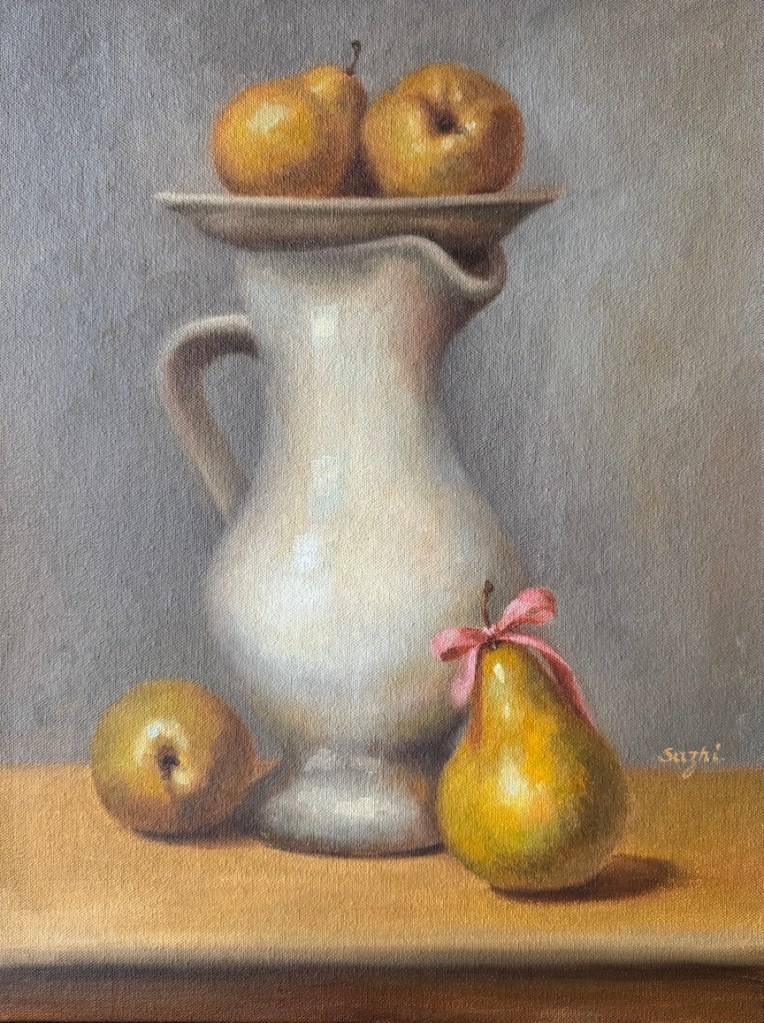
Picasso and Pears, a study, oil on canvas board, 12 x 16, April 2026
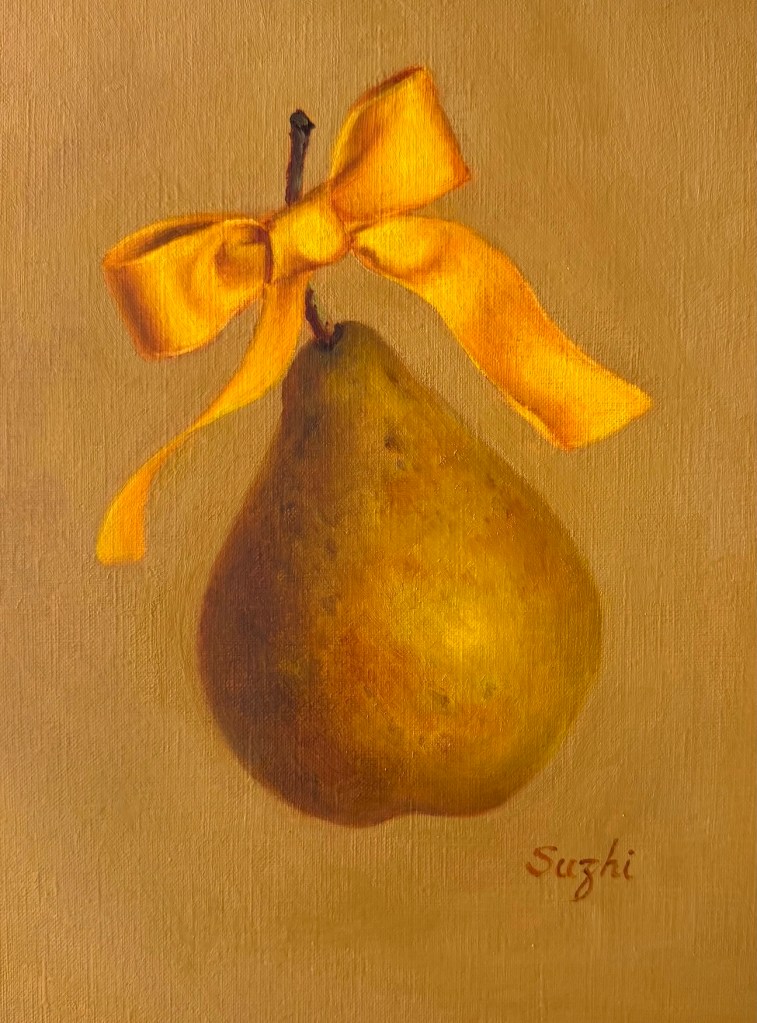
My version keeps the same central white pitcher and the plate perched on top, but I swapped in pears for the apples. The colors are much more saturated and warm: golden yellows with touches of greens that glow against the softer gray background. One pear on the table wears the pink bow I promised I’d revisit after Golden Bow (yes, the one from last month’s “Pear Maniac Continued”). It adds a tiny spark of playfulness and ties this piece back to my ongoing pear obsession.
What surprised me while researching for this writeup is how many art historians and critics interpret the pitcher itself as a hidden portrait of a voluptuous woman. Its swelling curves suggesting a generous torso, the open spout like a mouth, the rounded forms on top echoing breasts or eyes. That reading completely escaped me! I did notice the sumptuous curves and the overall sensuality of the forms, and I did wish to replicate that same generous, bodily presence in my study. Now looking at mine and the original side by side, my pitcher is not as sexy as Picasso’s, but the plump, curvaceous pears sing a louder tune. I completely changed the subject! Picasso had a lifelong habit of turning everyday objects into something human and alive; I am just in pear mood.
Painting this study felt like a quiet dialogue across time: Picasso’s restrained classicism meeting my warmer, juicier pear world. It reminded me why I keep returning to still life — it’s never really “just objects.” There’s always a pulse underneath.
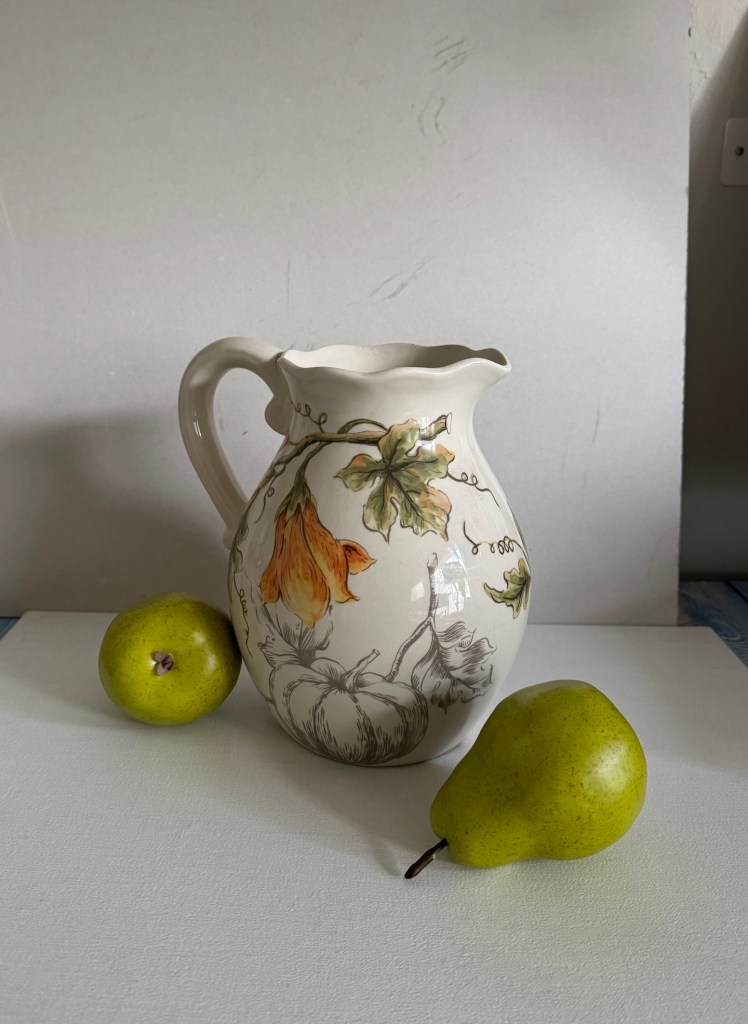
After the study comes the creation. I also set up a real jar and pears in my kitchen. My jar had some pumpkin patterns on it, and I changed them to pears. Even though I didn’t place a plate on top, my painting still has four “fruits”: two as patterns on the jar and one real pear on each side.
set up
In the beginning I had two conflicting ideas. One was to follow the Picasso piece and do a muted-color painting, and the other was to go the opposite direction and make it colorful. I decided to try both in watercolor first (it’s faster). As always, even the “muted” one turned out more saturated than I planned, but I would say the overall effect is still on the quiet side. The colorful one… well, the warm lighting and shadow patterns almost devour the subjects. It’s dramatic, a little chaotic and I guess it landed on the maniac part of the pear journey.
Pears and Jar 1, watercolor on paper, 11 x 16.Pears and Jar 2, watercolor on paper, 11 x 16.
I treated these two paintings as testing ground so I didn’t spend too much time on them. I don’t know yet if I would further develop these into oil paintings. To turn them into stronger watercolors, I clearly need more practice with designing patterns on objects, and figuring out how to paint big shadows without mudding the colors. For now, I just enjoyed the experiments. Failure or success, I had a really good month of painting.
March kicked off with two leftover thoughts from the previous month. While cleaning up my studio, I also unearthed a block of hot press paper and I decided to give it a try.
Two and Half, watercolor on hot press paper, 10×14, March 2026
As you can see, I approached it exactly the same way I would on cold press. The water and pigments mostly sat on the surface instead of sinking in, leaving some interesting but completely unintended marks. I do love the extra vibrance the colors gained, but I suspect hot press works best for well-defined shapes with minimal water. (Here’s a beautiful example of what hot press can do when handled right: Painting wet-into-wet on hot-press watercolor paper.)
Meanwhile, I finally tested the Canson Acrylic paper I mentioned before with a layer of shellac. It definitely improved the paint flow.
Stare, oil on paper, 11 x 15, March 2026Reference photo from East Oaks Studio Live Stream Session 44
In this painting, I had much less trouble getting the paints to cooperate, but I struggled a lot with designing the woman’s expression and rendering the plumpness. The original reference came from East Oaks Studio, but I borrowed her general features but recreate the overall image to fit my little “plot.”
Next, I imagined a classical, nearly monochromatic head study and decided to practice it on a pear instead. I’m still not sure I handled the edges quite right, but it was a simple enough exercise. I might revisit this idea later.
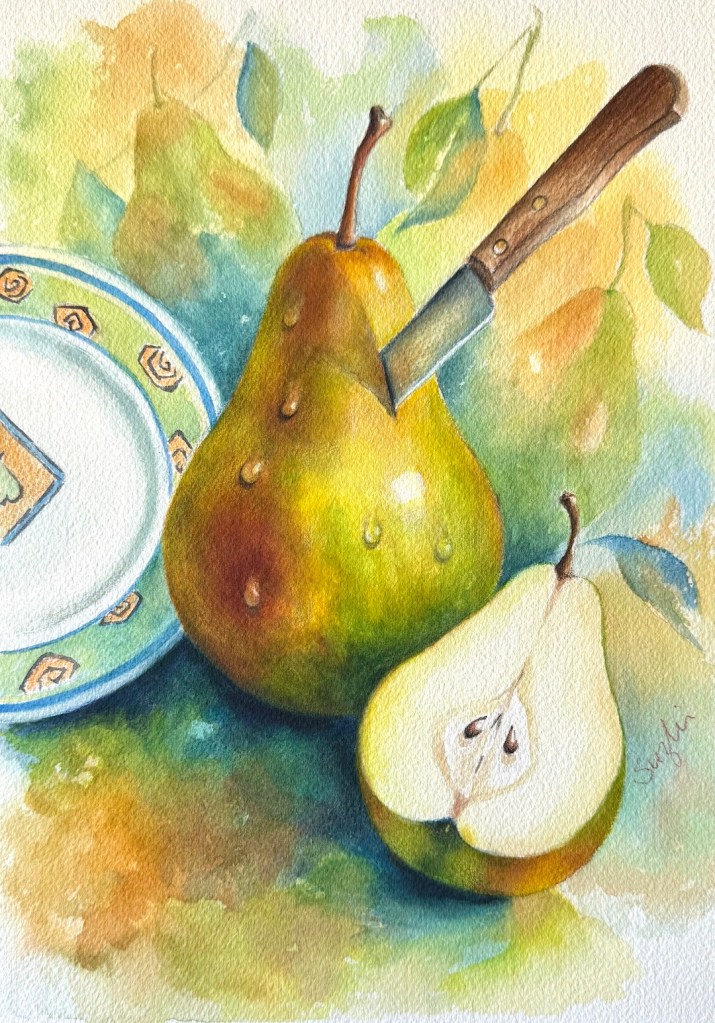
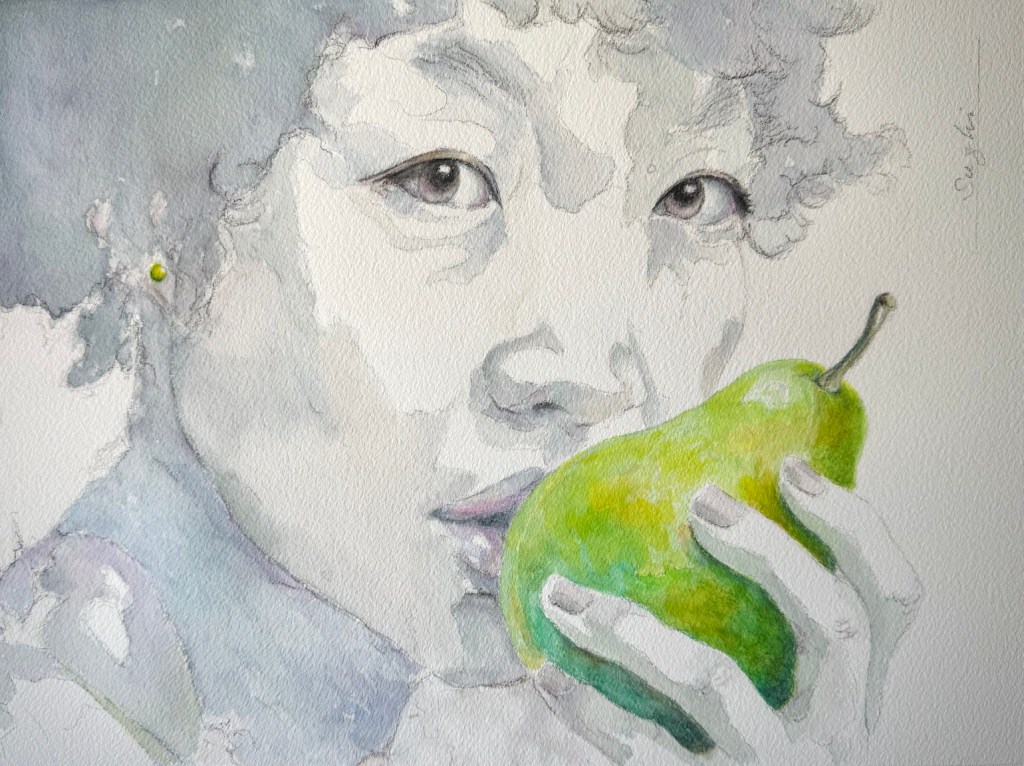
While juggling all these paintings with their mixed goals, I spent quite a bit of time designing the last two watercolors, both centered on our favorite theme. One is a still life with abstract patterns in the background, and the other is a semi self-portrait.
Golden Bow, oil on paper, 9 x 12, March 2026
My original vision for the still life was actually a painting with much more elaborate, sharply defined patterns in the spirit of Klimt, in oil on canvas or watercolor on hot-press paper. Either way, it would have been a much more time-consuming project. I’m still holding onto that thought. This simpler cold-press version became more of a test of the main composition. I may come back and develop the idea further in the future.
Knife and Plate: watercolor on paper, 10 x 14, March 2026
The final piece is, in my opinion, the best design of the month. I wanted a flat, almost monochromatic self-portrait (of course it’s a younger and prettier version of me), paired with one very saturated, juicy pear. In my original sketch, the head was meant to stay much flatter and more abstract. But as I painted, I couldn’t resist sharpening the features, especially around the eyes. I’m still not sure whether that was an improvement or a distraction. I had to drag myself away from the piece so I wouldn’t overwork it into a full realist portrait.
Kiss or Bite, watercolor on paper, 10 x 13, March 2026
Overall, I love the design, the visible pencil marks, and that satisfying feeling of something unfinished yet strangely complete.
March turned out to be a fruitful month. Am I done with pears? Check back in a month.
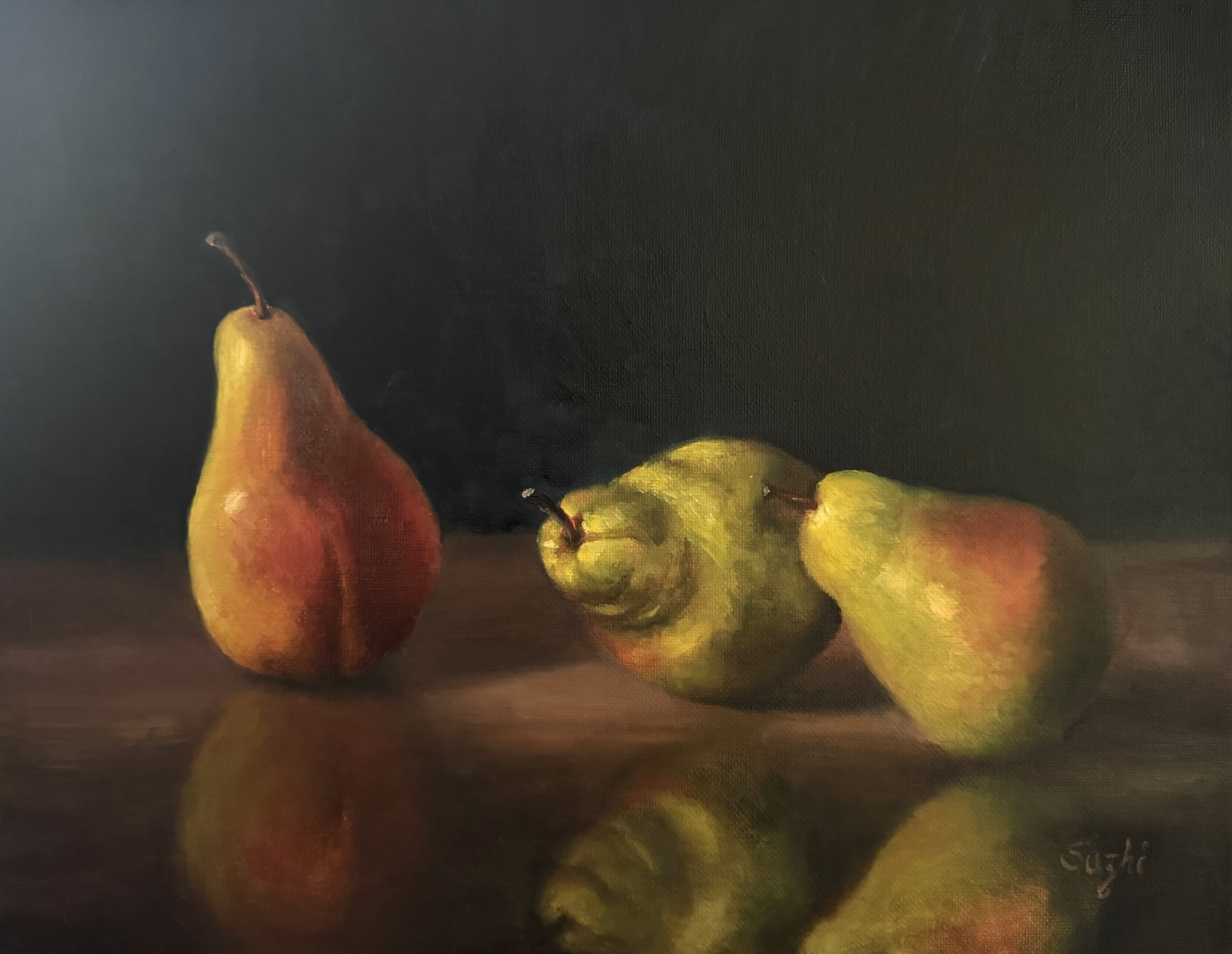
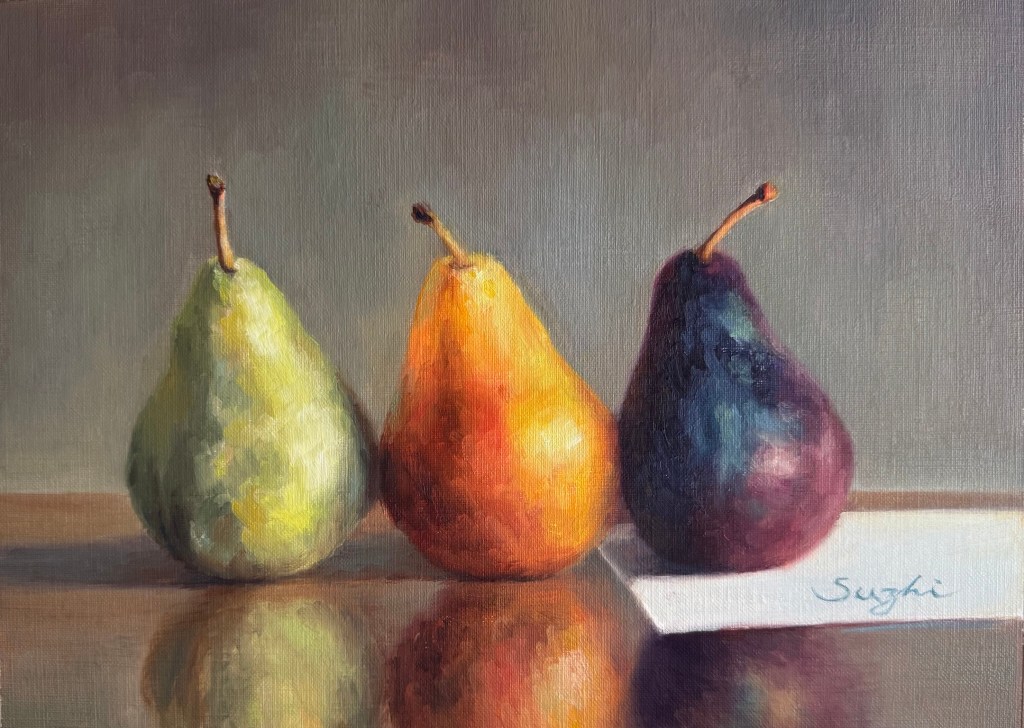
February slipped by faster than I expected. I had some ideas about “strategizing” for 2026 (see previous post), but the month didn’t cooperate with any real planning. When I’ve been away from oils for a stretch, I usually warm up with quick portrait sketches. This time I happened to watch a live sketching session centered on pears at the beginning of the month, and so I thought, why not try pear portraits instead? I picked up three from the local grocer, arranged them simply, and set off quickly.
Midway through though, I lost interest in the setup. The lighting was too conventional, the composition flat, and the whole thing uninspiring. I decided to add reflections on the surface to give it more life. Mostly I just added frustration. As the paint thickened and got tacky, I gave up. Here’s the oil painting I set aside:
Three Pears, oil on canvas board, 11×14, Feb. 2026
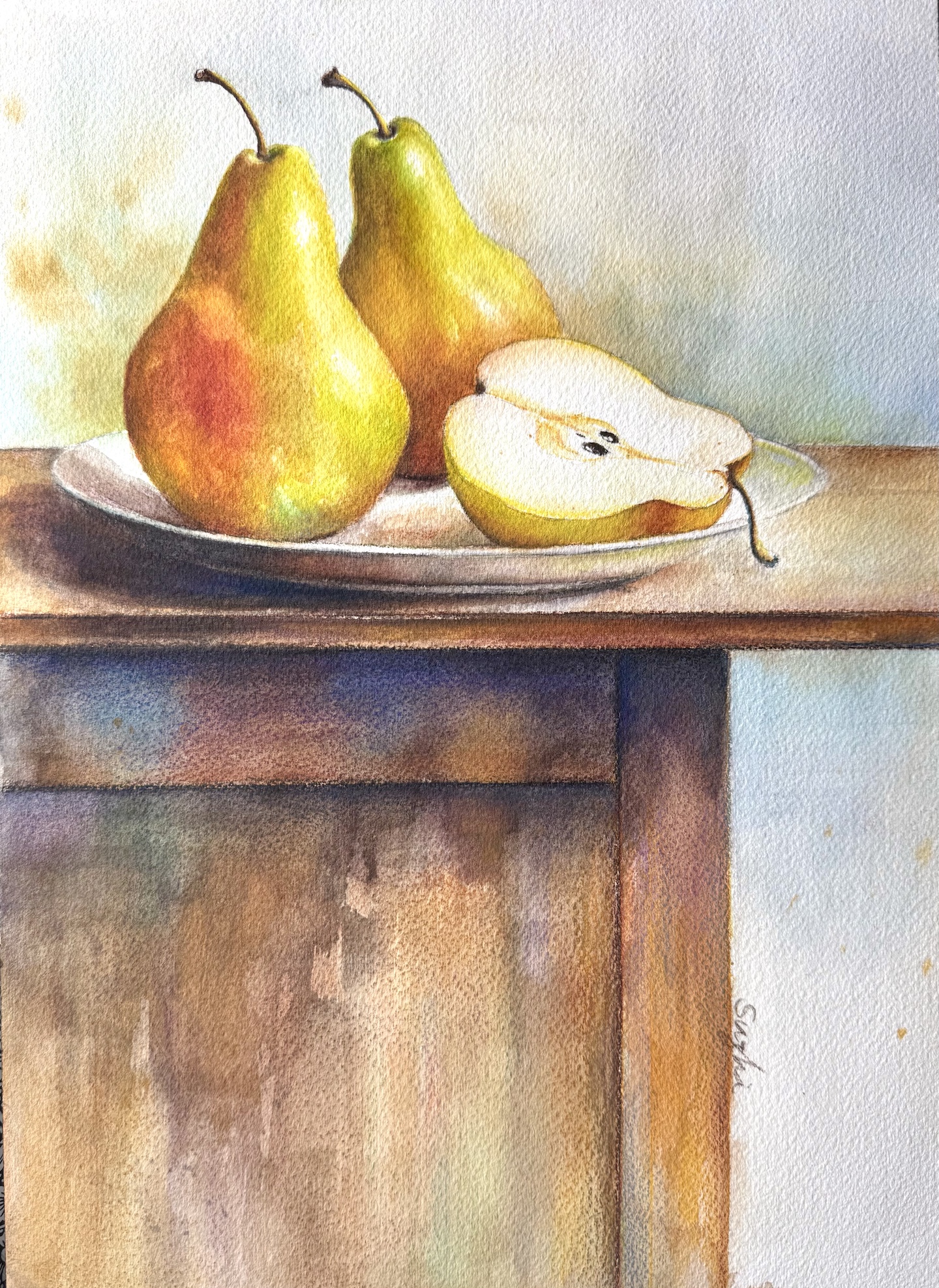
I switched to watercolor instead. In a recent cleanup effort, I found some unused Arches blocks. I’ve done a little watercolor in recent months, but only small sketches on inexpensive paper. I couldn’t wait to see what good quality paper could deliver after these practices. By then the pears were starting to rot, so I worked without a reference. Here’s the first attempt:
Two and Half, watercolor on paper, 10 x 14, Feb. 2026
As expected, the paper could hold much more water than the cheap alternatives, but the texture was rougher than I remembered, which affected only the initial pencil drawing so far. The painting turned out muddier than intended, and that’s what happens without a clear plan. I originally wanted almost no background. just white space to frame the pears. Once I considered it finished, though, the large white areas felt too empty and didn’t support the cut pear properly. I began adding background colors, changed direction a few times, and a couple of unintended mixes later, everything neutralized into gray. The forms of the whole pears suffered too. With everything around muddied, I didn’t want to kill the fresher red-orange even though it was supposed to be in the shadow. I felt like choosing between two wrongs. You can mix colors on paper, of course, but it helps to know exactly how you want to approach it. This piece isn’t abandoned, but it feels unresolved.
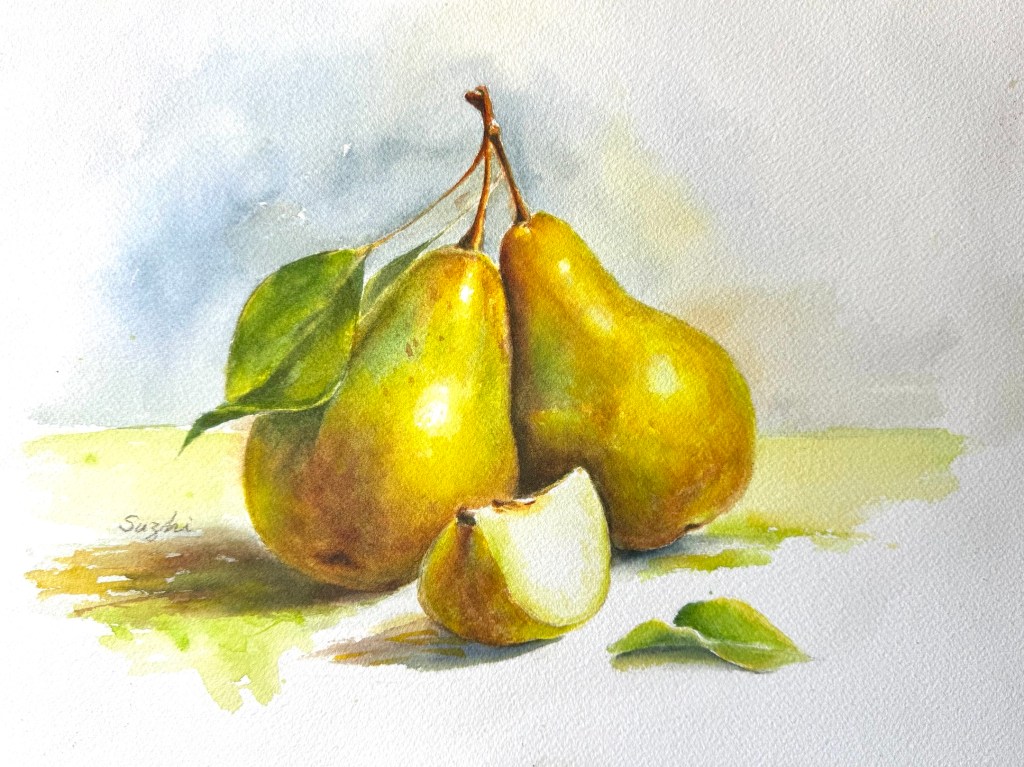
For the next one I made a conscious effort to avoid overworking the background. I still adjusted the pears more than I should have, but the result has better volume and value range, even if the colors lost a bit of their brightness. Pears do come in rustier, subdued tones, so I’ll take that as a feature rather than a flaw. This piece was also done without a reference.
Huddling, watercolor on paper, 11 x 14, Feb 2026
That gave me enough confidence to keep going. I returned to oil and worked on two different compositions at the same time, both on paper. One focused on color and a re-attempt at reflections, on Canson XL Oil and Acrylic paper; the other, on texture, on Canson Acrylic paper.
Display, oil on paper, 9 x 11, Feb. 2026
I have used the XL oil and acrylic paper before with a thin layer of shellac, but I found it was unnecessary. The paper handles paint very well and feels forgiving. Of all the paintings surfaces I’ve tried, this is the easiest to use and I like it more each time. The plain acrylic paper has a coarser surface that makes blending trickier, but it worked nicely for suggesting the wood grain of the table and backboard. It also encouraged (or forced) me to keep the pear colors varied and abstract rather than uniform. I may try a layer of shellac on it next time to see if it improves flow.
On the table, oil on paper, 11 x 15, Feb, 2026
February passed in a mix of small frustrations and a few satisfying moments. I’m glad I moved between watercolor and oil. It kept the process interesting. I hope to maintain the momentum.
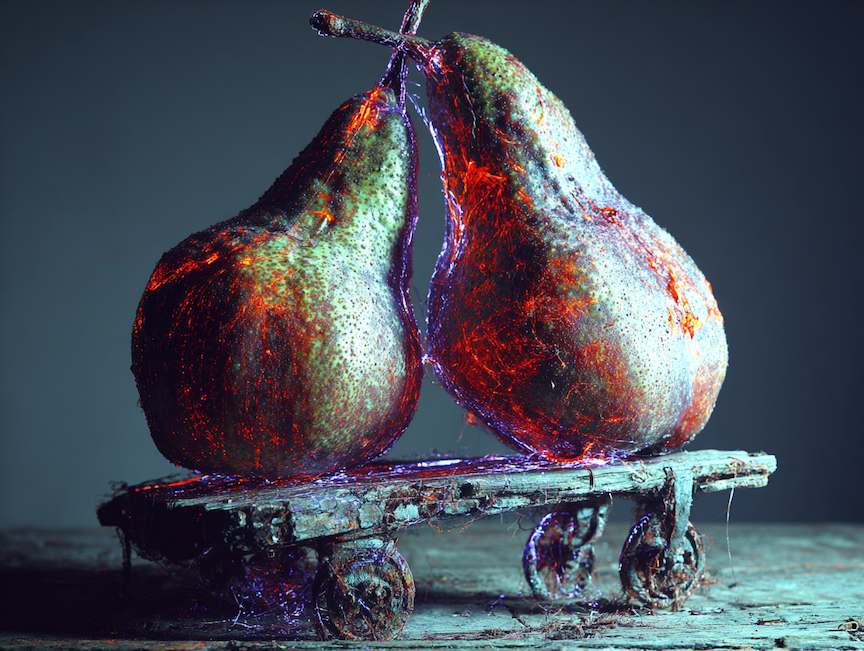
And just for fun, here’s a MidJourney piece on the same subject that I really like. The colorful glow and the roller-skate-like cart give it an eerie and playful feeling, quite beyond my imagination.
January brought me home after a long stretch away, and for the first time in months I finally had time to just zone out, daydream, and do some belated New Year planning.
As someone who’s deeply introverted and home-loving, I actually spent quite some part of last year outside my comfort zone. I visited many exhibitions, immersed myself in incredible paintings by other artists, and played extensively with AI image generation. Those experiences were thrilling in their own ways. I’m still in awe of what AI can conjure in seconds, and I still find it genuinely useful as a brainstorming and reference tool. Yet all of it, the shows, the scrolling, the endless prompting, only made my hands itch to pick up a brush. Nothing digital or vicarious can match the slow, stubborn satisfaction of standing at the easel for three or four hours, building something stroke by stroke, decision by decision, until it finally exists.
In parallel, I’ve been revisiting watercolor through basic exercises focused on values, color relationships, temperature, and edge quality. These aren’t flashy pieces; they’re deliberate drills. But every time I return to them, I’m reminded how deceptively simple the core theories of painting really are and how easy it is to overlook one of them the moment I get excited about a subject. When a painting fails (or just falls flat), it’s almost always because I ignored or half-applied one of those fundamentals.
While reorganizing my studio recently, I pulled out a few unposted oil still life paintings from last year. Seeing them with fresher eyes—after months of looking at masterworks and grinding through exercises, I can now spot exactly where I leaned too heavily on “copying what I saw” instead of using what I know.
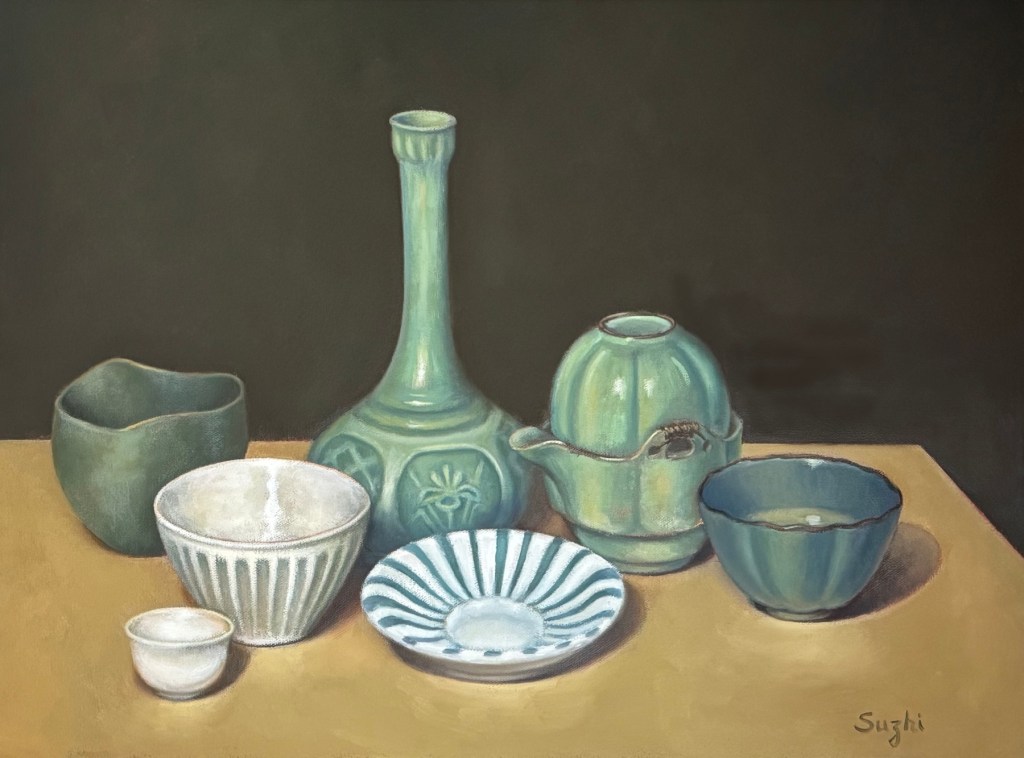
Group Portrait 1, oil on canvas, 18 x 24in, 2025
My shapes and overall compositions still hold up; I’m happy with those choices. But the values? In several passages I could have orchestrated them more deliberately to create stronger focus, depth, and mood. For instance, “Group Portrait 1”, for the small white cup and the dish in the center, the reflective surface and the blue strips makes the lighting not as informative as on others. I wrestled with those forms for hours. Now I realize I could have analyzed and designed the value patterns based on my knowledge (where the lightest light, darkest dark and mid-tones should be given the light source and the object’s shape), and considered their roles in the whole picture. With more intentional grouping and subordination, those objects could have popped or tucked in with far less effort.
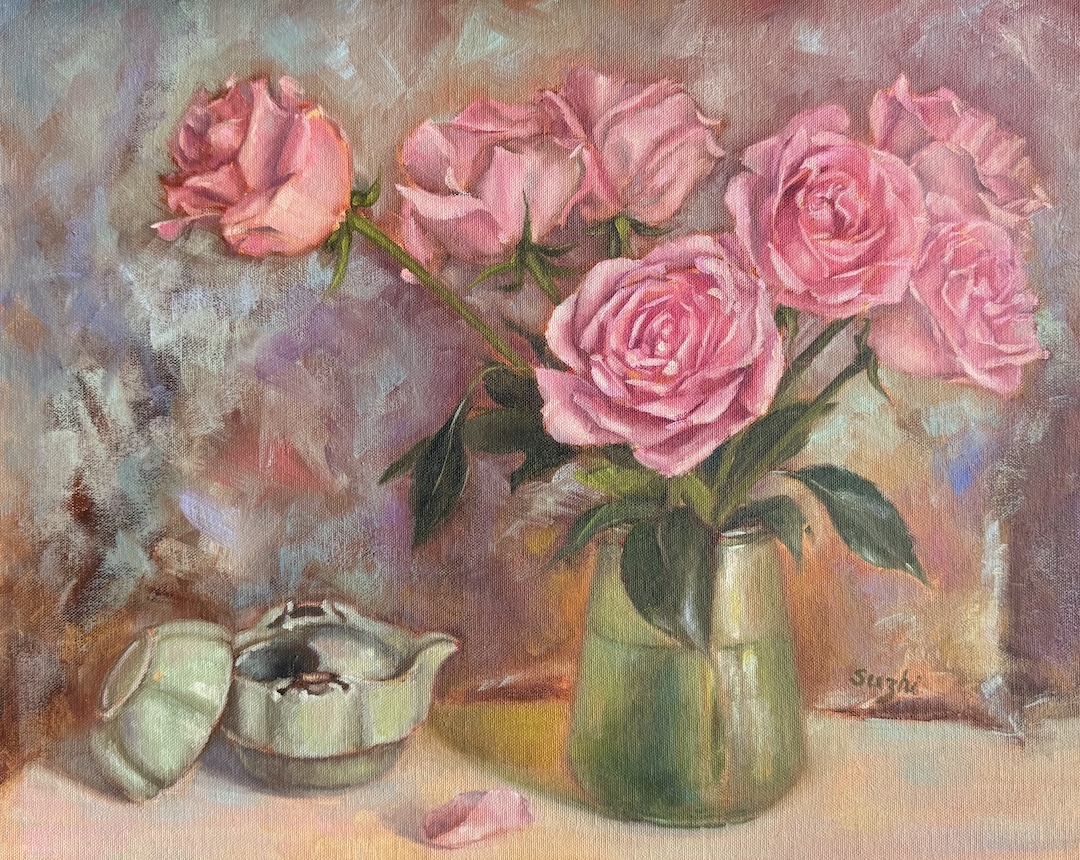
Pink Roses, oil on canvas board, 16 x 20in, 2025
The roses suffered from a similar issue. I got lost in distinguishing individual petals too soon, instead of first establishing the big value structure across the entire bouquet, then each rose. Had I done that, the flowers would feel more alive and integrated.
Color-wise, I still like the overall harmony in these pieces. The palettes feel cohesive and quiet, which suits my taste. But there’s room to push sophistication further. In the roses, I could have borrowed subtle echoes of the background tones into the petals themselves to make the roses more atmospheric. In the “Group Portrait 2”, I could have let the objects’ colors bounce into the paper underneath, unifying the scene better.
Group Portrait 2, oil on canvas board, 12 x 16in, 2025
These aren’t harsh self-criticisms: they’re just clearer observations now that I’ve had distance and review. The artists whose work I admire most probably didn’t arrive at their mastery through secret techniques; they simply became relentlessly consistent at remembering and applying the fundamentals while they painted.
So for 2026, I’m keeping the plan very simple (and hopefully realistic): I want to strategize how to apply what I know and constantly remind myself of the fundamentals during the process, making every session an effective practice. Who knows? By the end of the year, these conscious efforts might turn into subconscious habits, and I might finally make the progress I’m looking for.
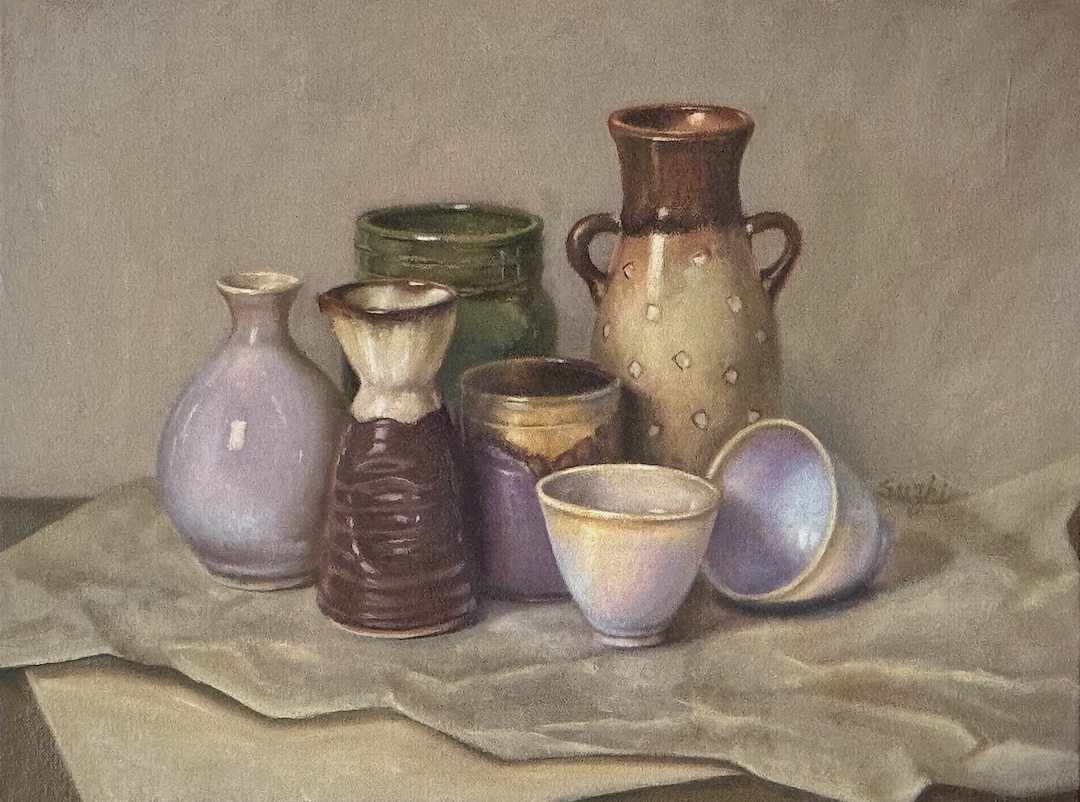
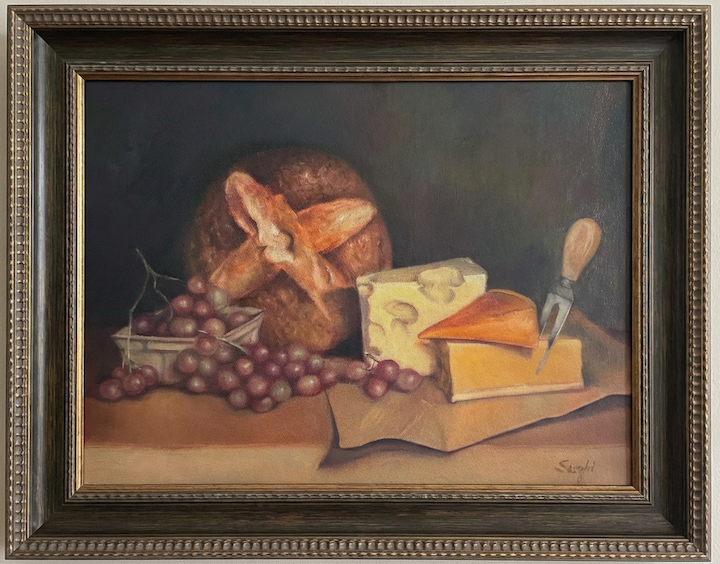
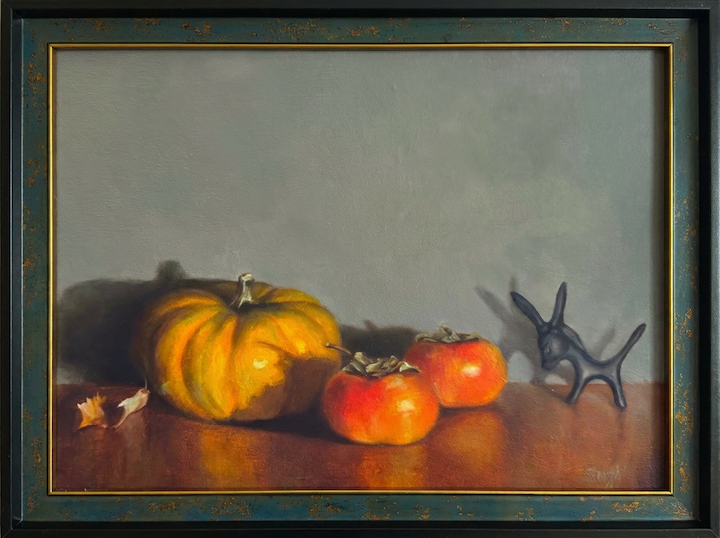
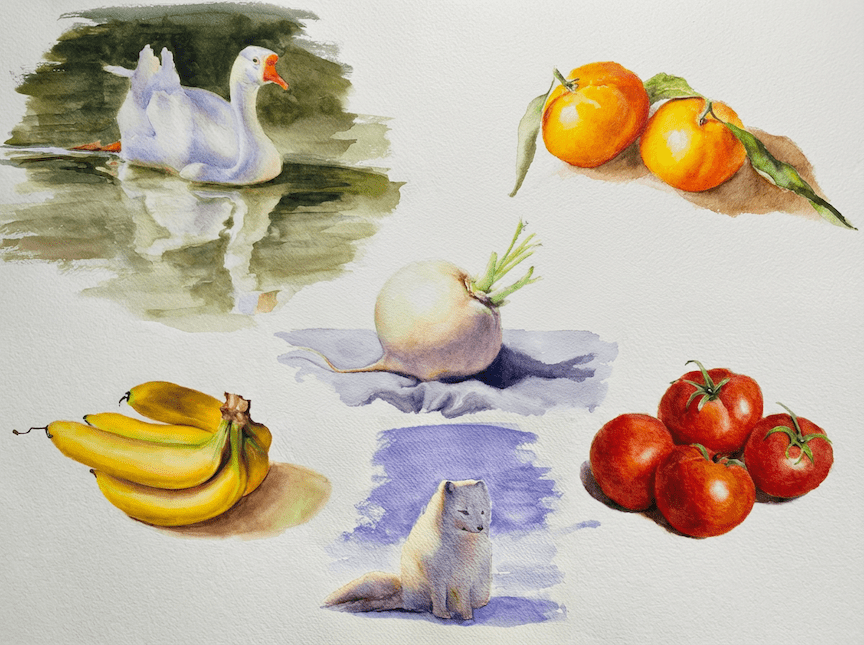
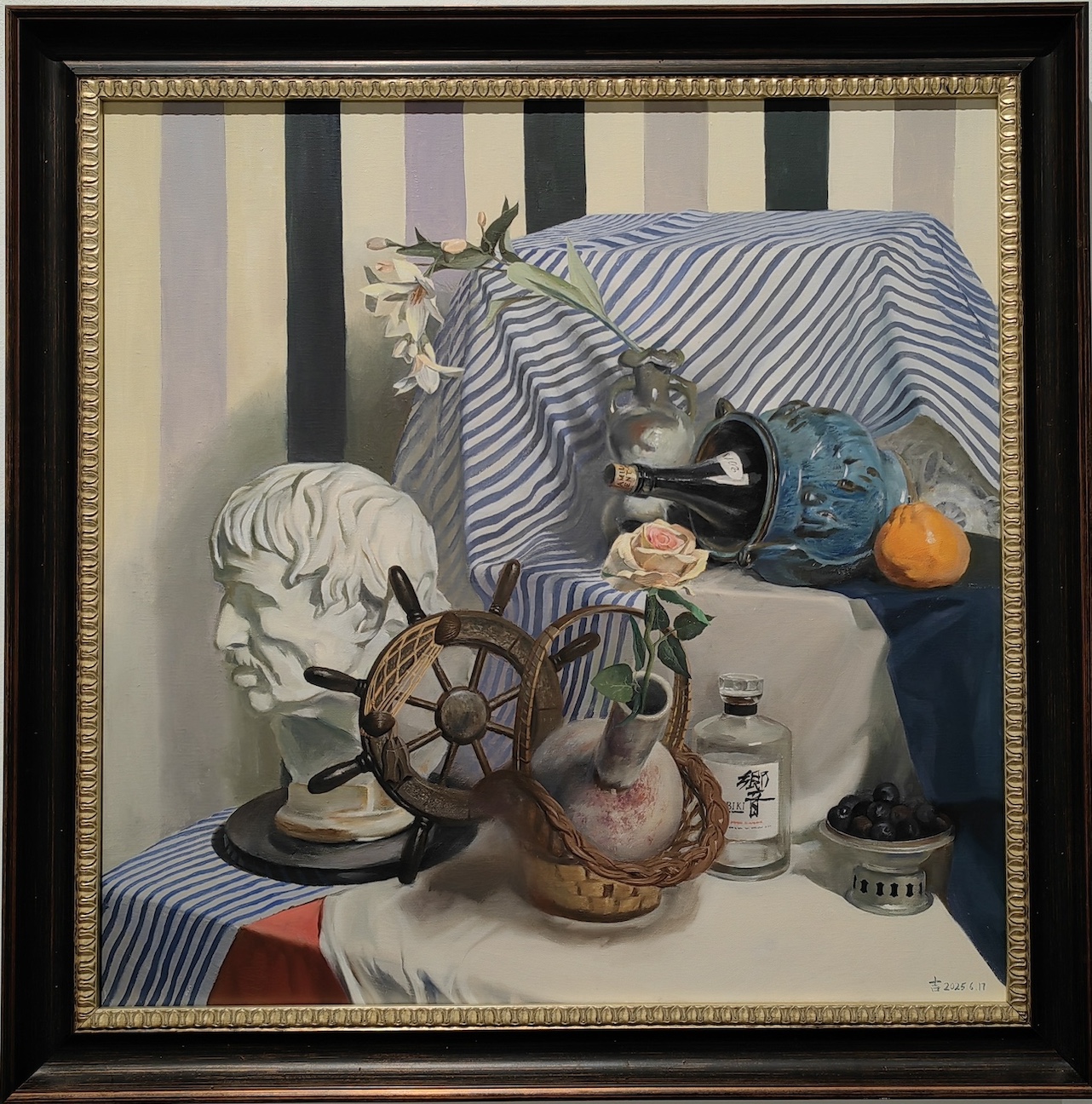
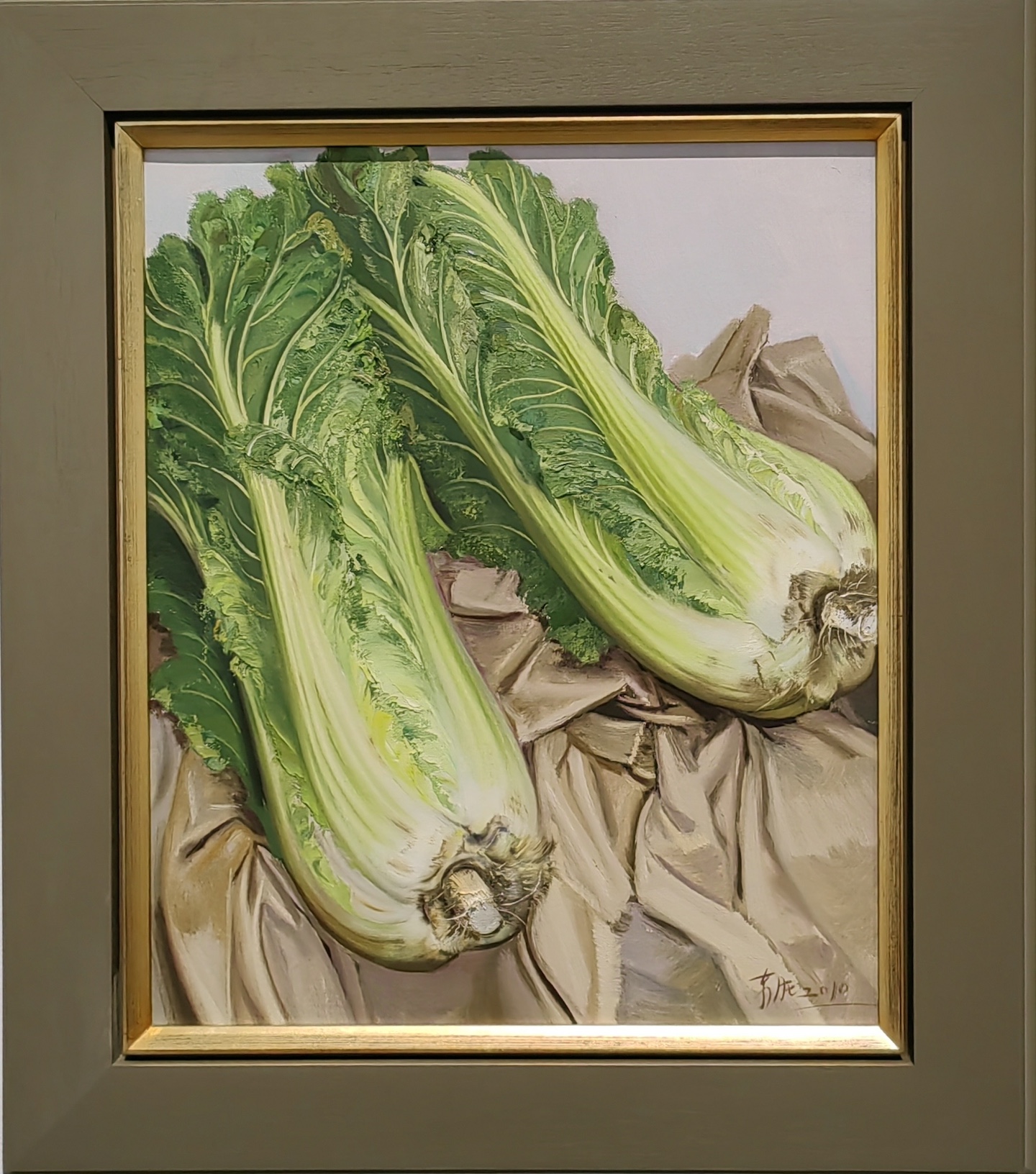
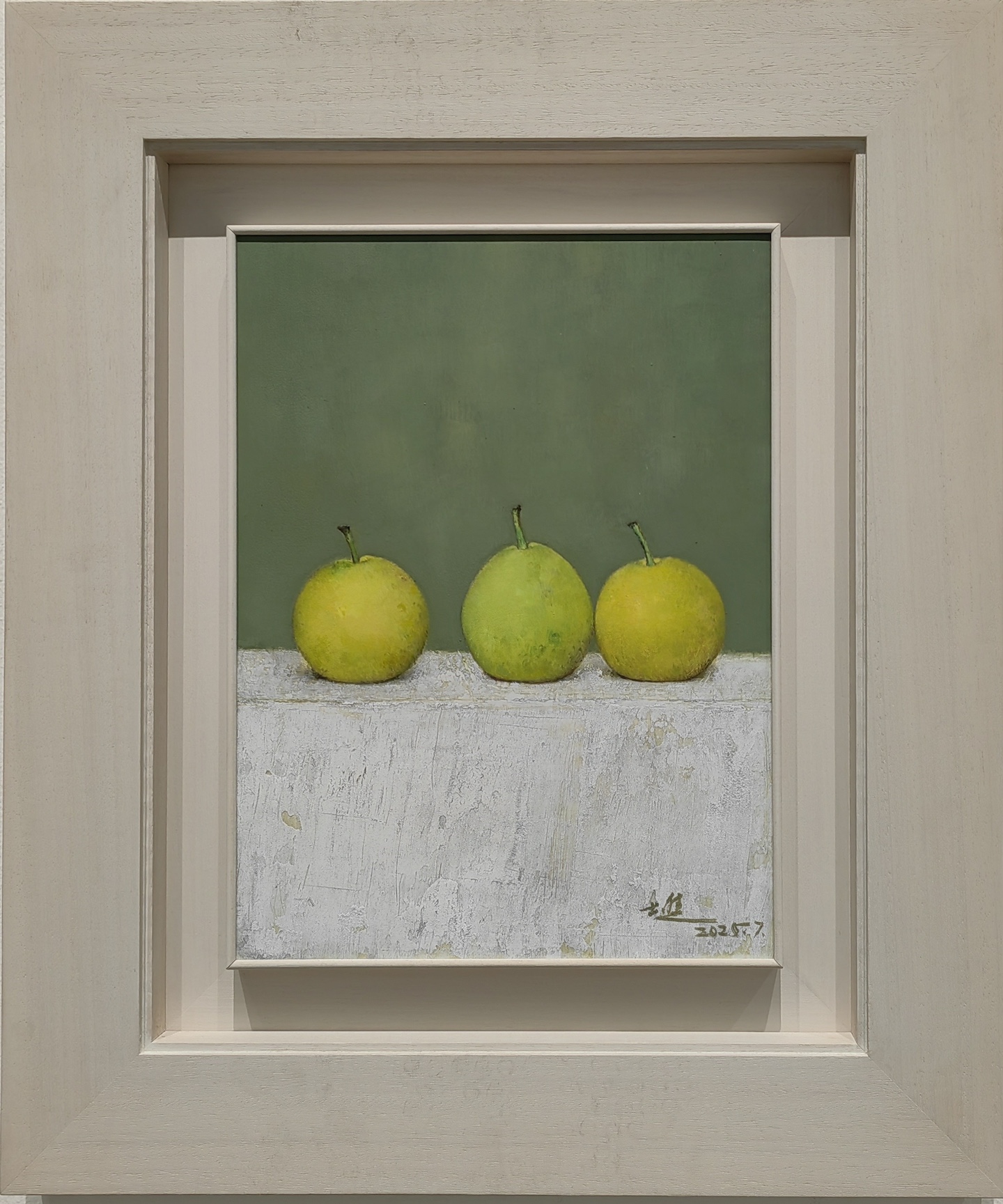
November had me on the other side of the globe again. This time I packed a couple of recent paintings to give as gifts for family. Lucky for me, framing in Beijing is much cheaper than in the States. I can afford to elevate my paintings a bit, which definitely makes the presentation better and adds to my confidence. Here are some of the paintings I gifted:
During my last long stay in Beijing, I decided to make the most of the situation by practicing watercolor. Oil wasn’t an option and watercolor stuff barely takes up any room. I am happy to report that I’ve actually stuck with the plan. My current goal in practice is trying to keep the colors clean. Small steps, but still moving forward.
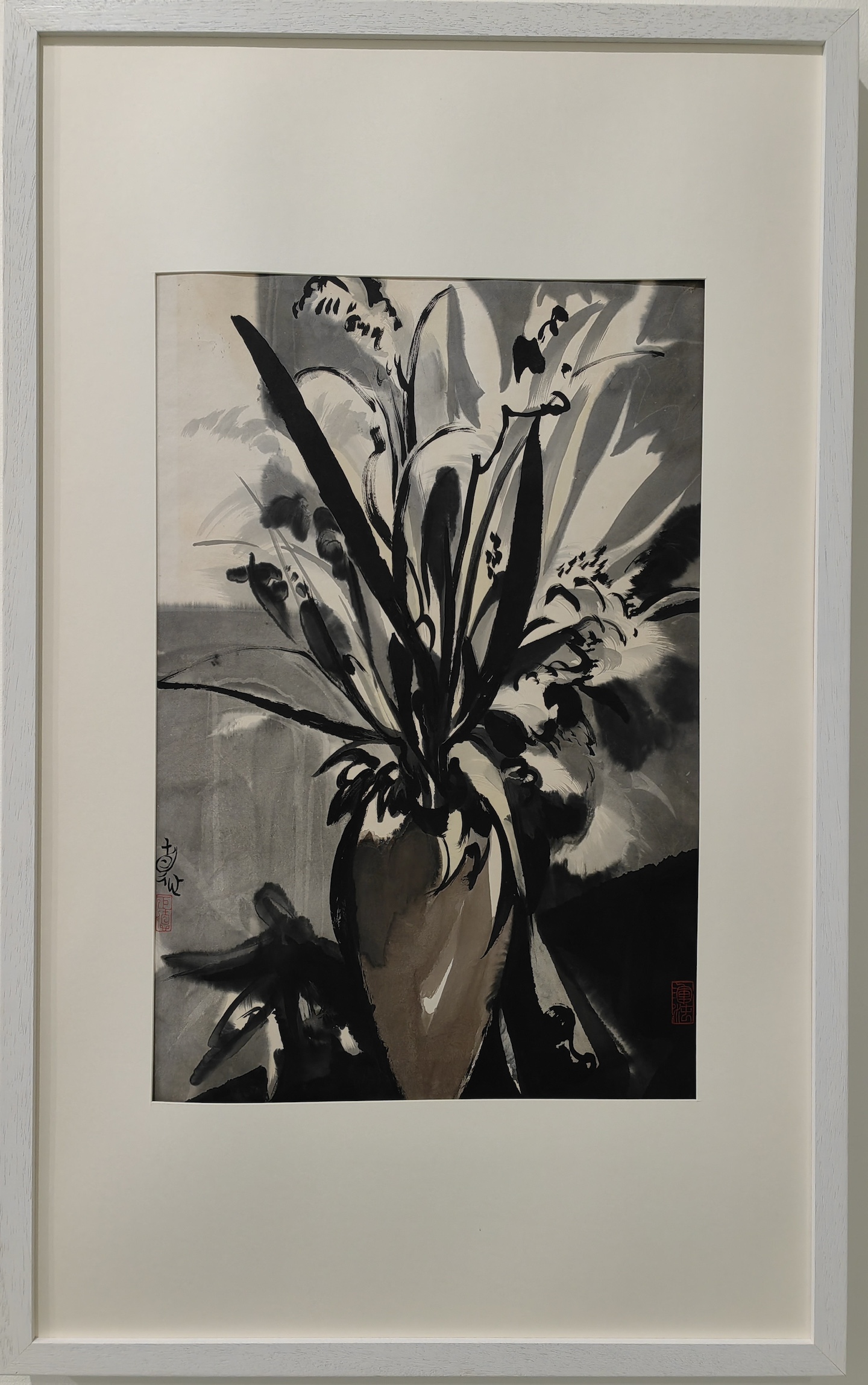
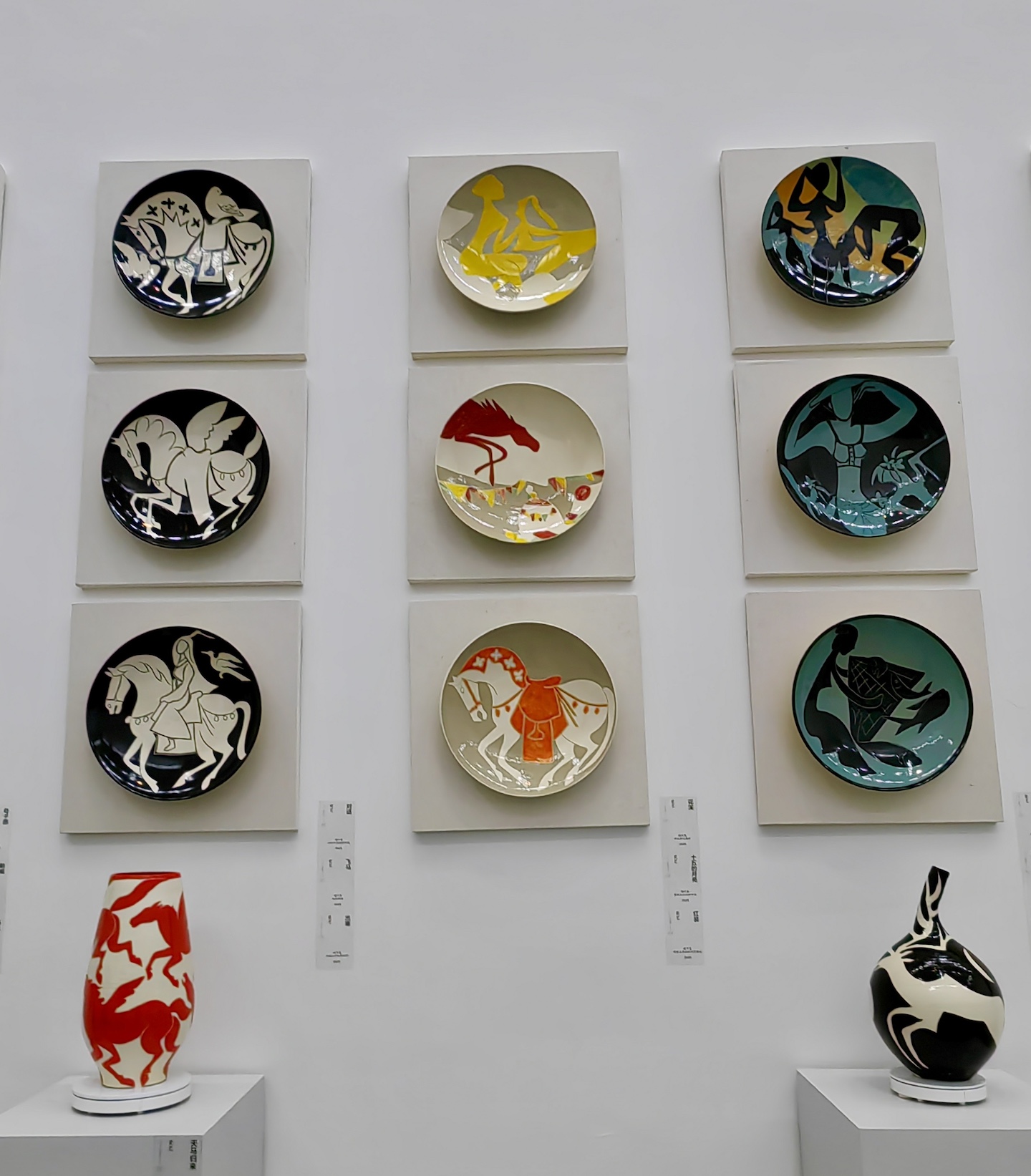
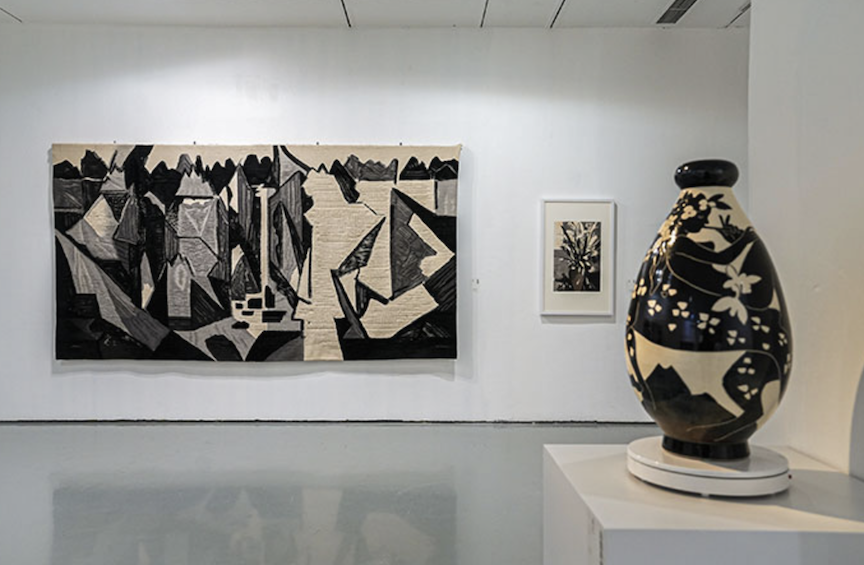
Gallery-wise, I saw Liu Jude’s 刘巨德 solo show at the Today Art Museum: Hearts Aflame for the Firmament. Liu studied at the Central Academy of Craft Art in 1965 and later worked under Pang Xunqin 庞薰琹 (1906 – 1985) in 1978, researching the comparison between traditional Chinese decorative art and Western modern art. He believes that painting should imitate the Tao that births all things: using the invisible Tao to paint visible objects, and using visible objects to paint the invisible Tao. His art isn’t constrained by the classification of genre or technique; he adheres to the traditions of Chinese decorative art but modernizes that formal beauty, making him unique in the Chinese art world. The exhibition featured over 200 new pieces by Liu and more than 100 ceramic debuts. Divided into “Ode to Peace” and “Ode to Hometown,” the show presented a kind of “chaotic beauty” and deep emotions for his roots.
In his artist statement, Liu mentioned: “Every time I paint, on the clean Xuan paper, I always put down thick black ink first, trying to occupy, grasp, and stabilize the whole space. As for what object that ink block, dot, or line represents, it is ambiguous, and I am not entirely clear. It is precisely this uncertain relationship of abstract points and lines that triggers me, pulling me to wander with it.”
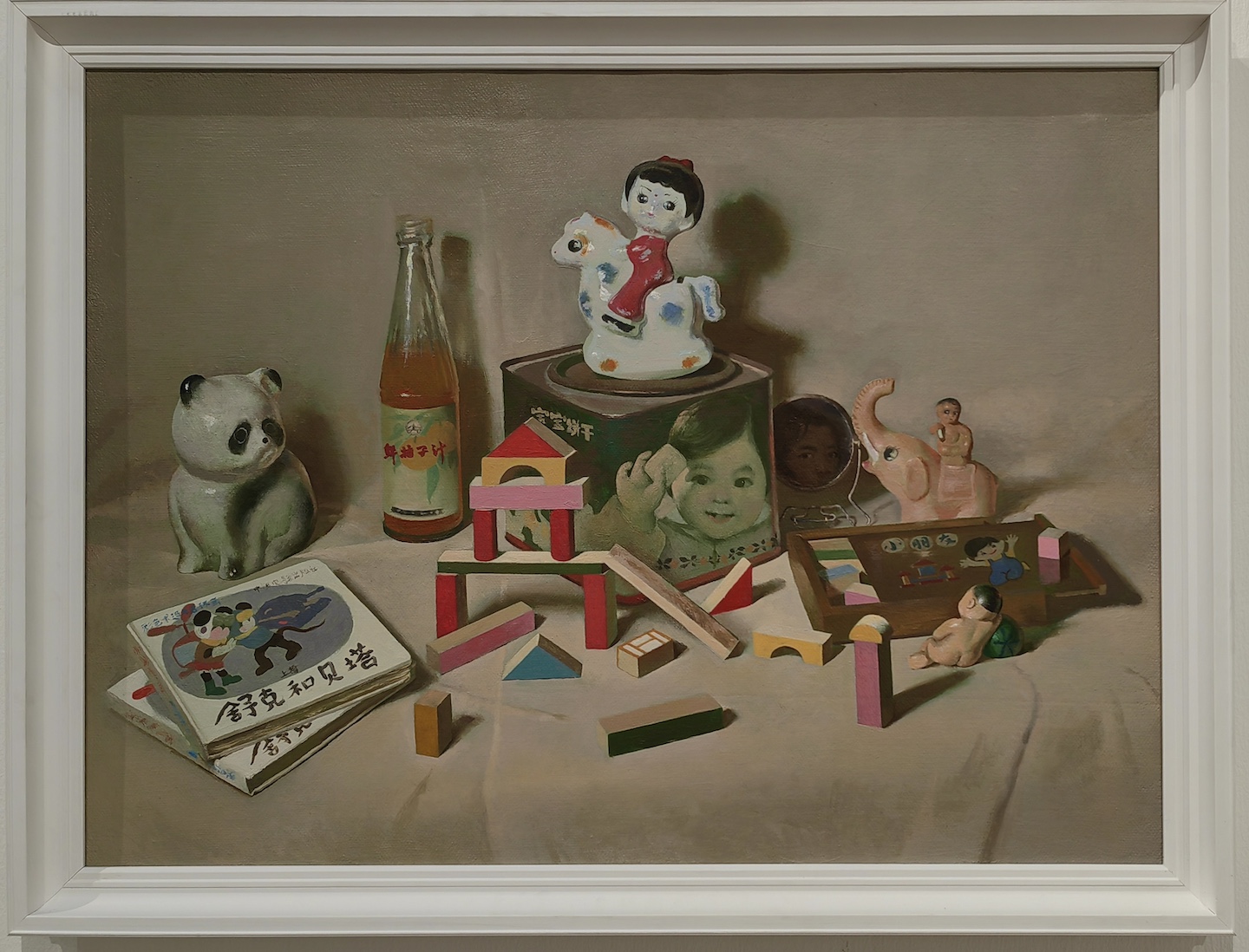
In comparison, the National Still Life Exhibition hosted by the Chinese Academy of Oil Painting felt … fine. Technically solid, just not particularly exciting.
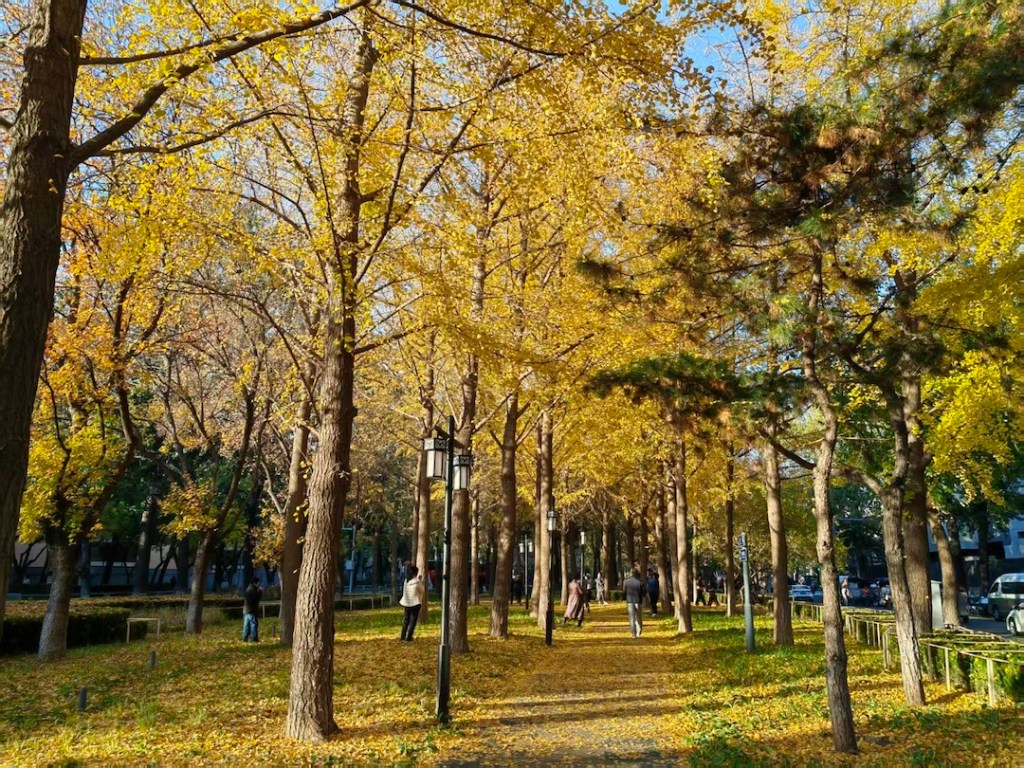
Finally, on one perfectly sunny mid-November day, I took this photo of a path covered in golden ginkgo leaves, a staple scene in Beijing’s autumn. Doubao, ByteDance’s (owner of TikTok) AI app, turned it into a watercolor painting. Love it or hate it, AI art will be a staple of the art world.
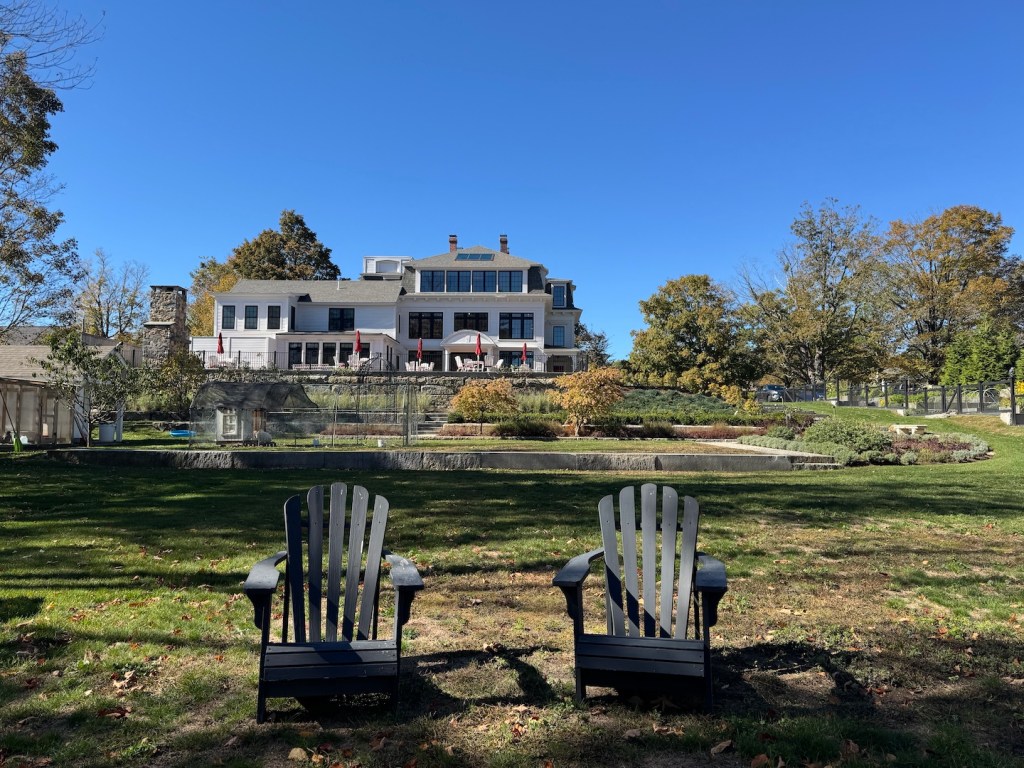
If you’re driving from Boston westward—say, toward Ithaca like I was—take a detour to New Salem, Massachusetts. Nestled in the vibrant fall foliage of a classic New England town, the New Salem Museum and Academy of Fine Art (NSMA) is a treat for anyone who loves realist art.
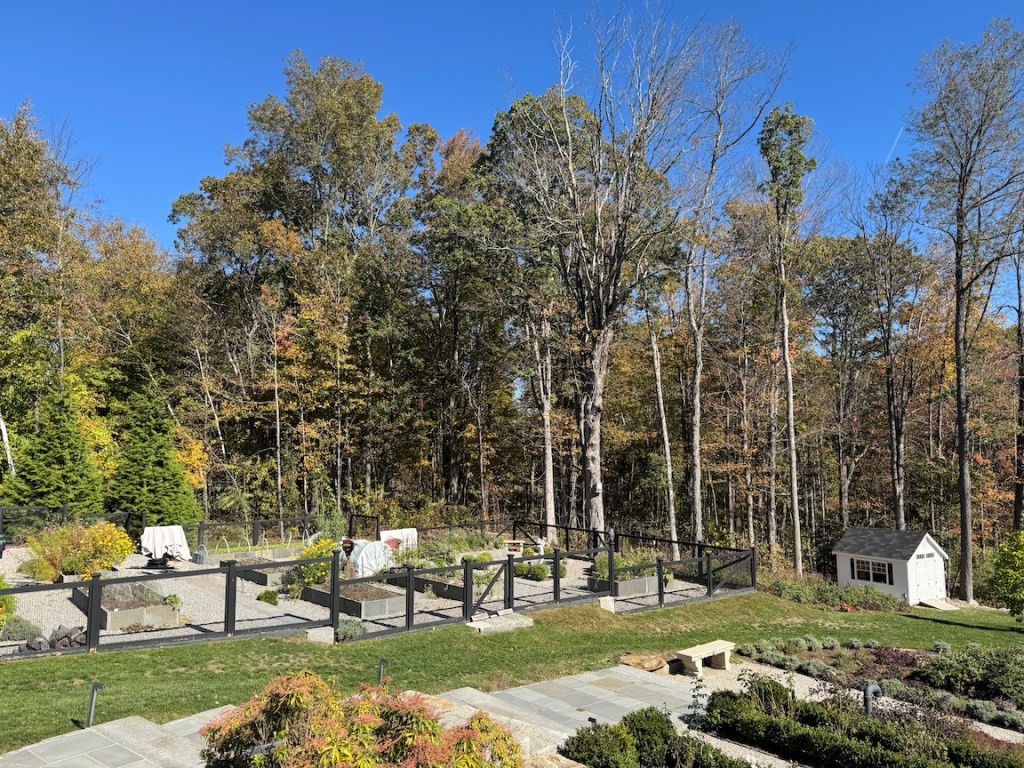
The NSMA sits on 2 acres, surrounded by a vegetable and rose garden and a serene pond. The three-story 19th-century building was once part of the New Salem Academy. In 2023, Laura and Vincent Barletta purchased it, turning their passion for art into a public treasure. Their journey as collectors began 20 years ago when they fell in love with Michael Klein’s painting “Leaving Home” in a New York gallery. Two decades later, Klein, a leading artist in the revival of representational painting in America, was enlisted to curate and direct the museum and its academy. Their mission is to create a stronghold for contemporary realist art.
The museum, housed on the first two floors, showcases a collection of contemporary realist masterpieces, primarily from living artists, such as Jeffrey T. Larson, Jordan Sokol, Jeremy Lipking, Colleen Barry, Michael Klein, Kate Lehman, Oliver Czarnetta, Daniel Sprick and more. It also features historical gems by John Singer Sargent and Andrew Wyeth, connecting the past and present. The Barlettas’ commitment to sharing their private collection with the public sets NSMA apart. Many artworks, once acquired by private collectors, end up hidden in storage. By opening their collection, the Barlettas ensure these works remain vibrant and accessible.
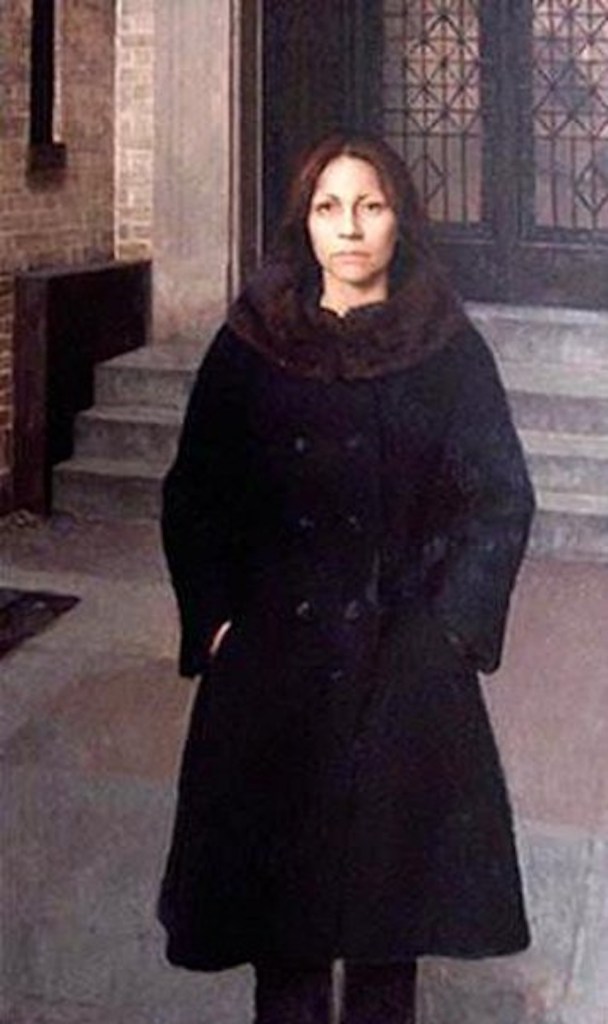
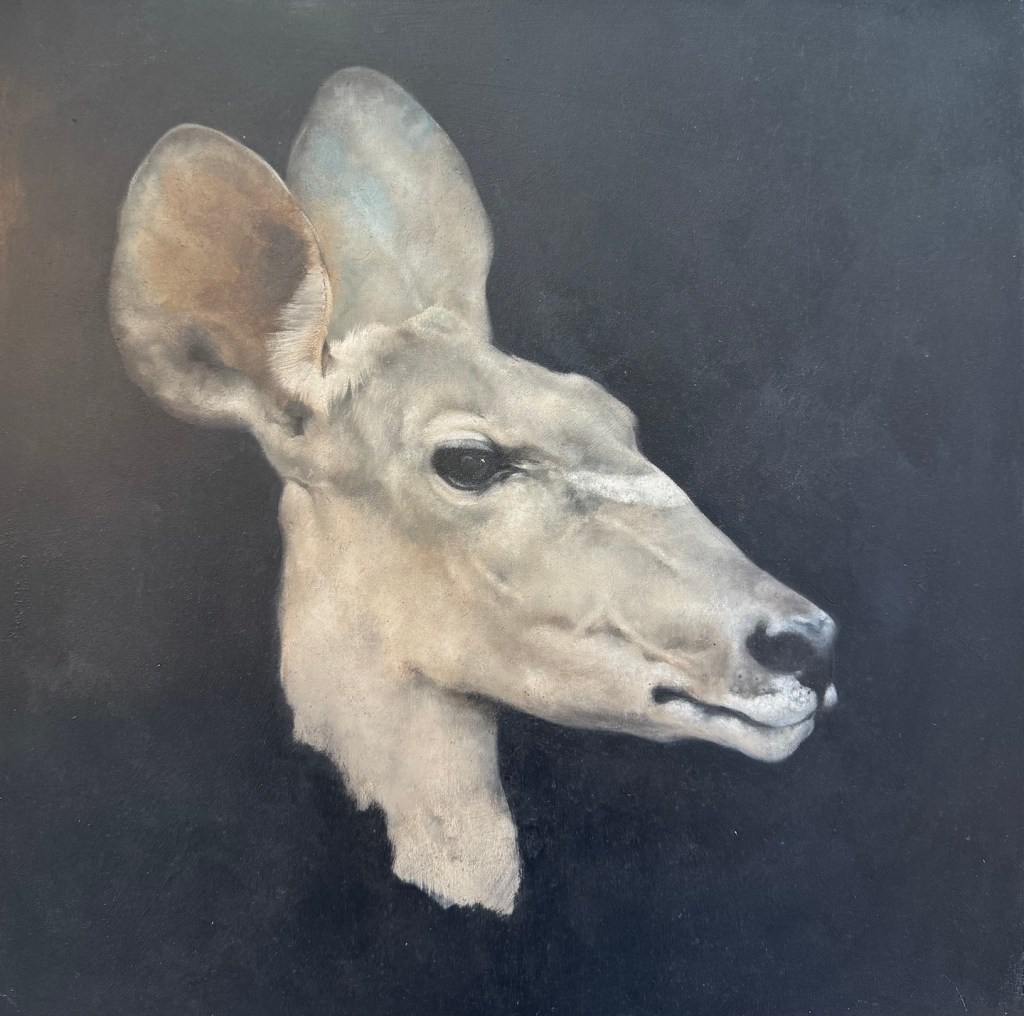
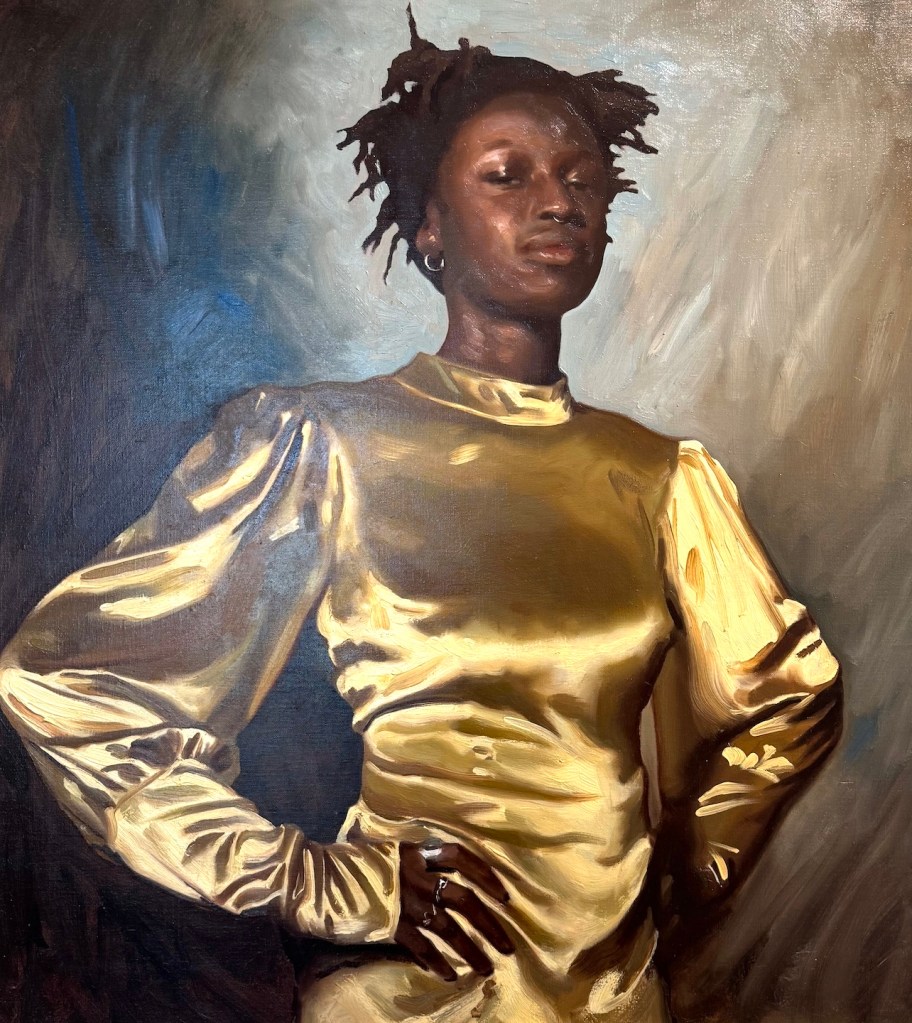
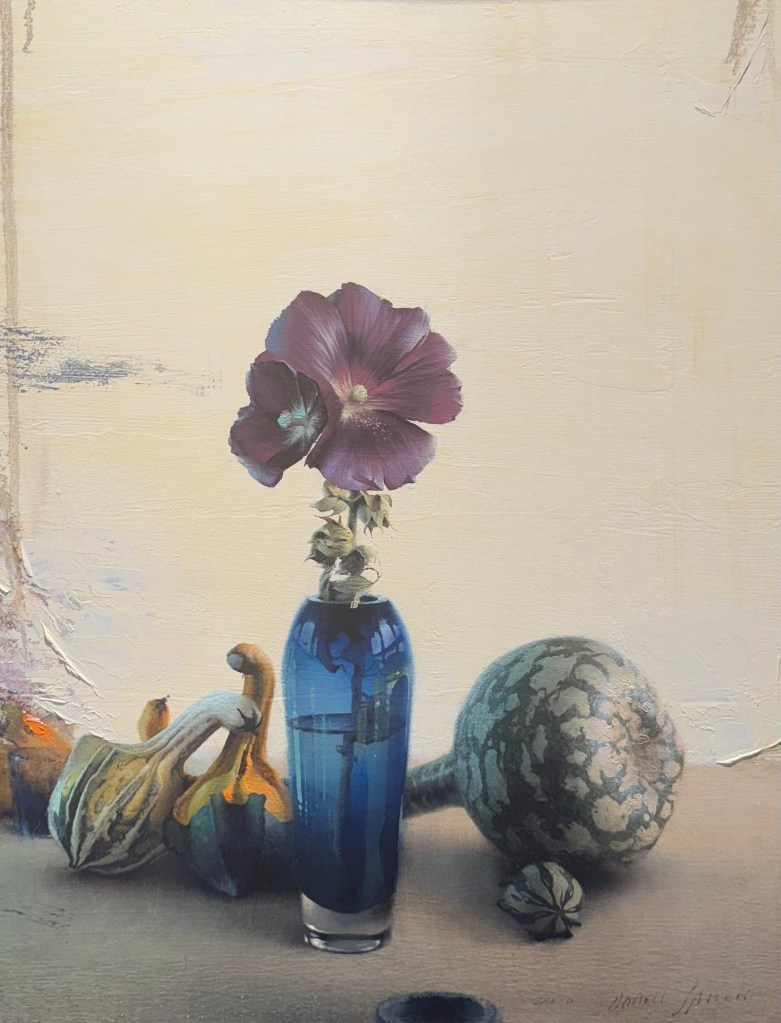
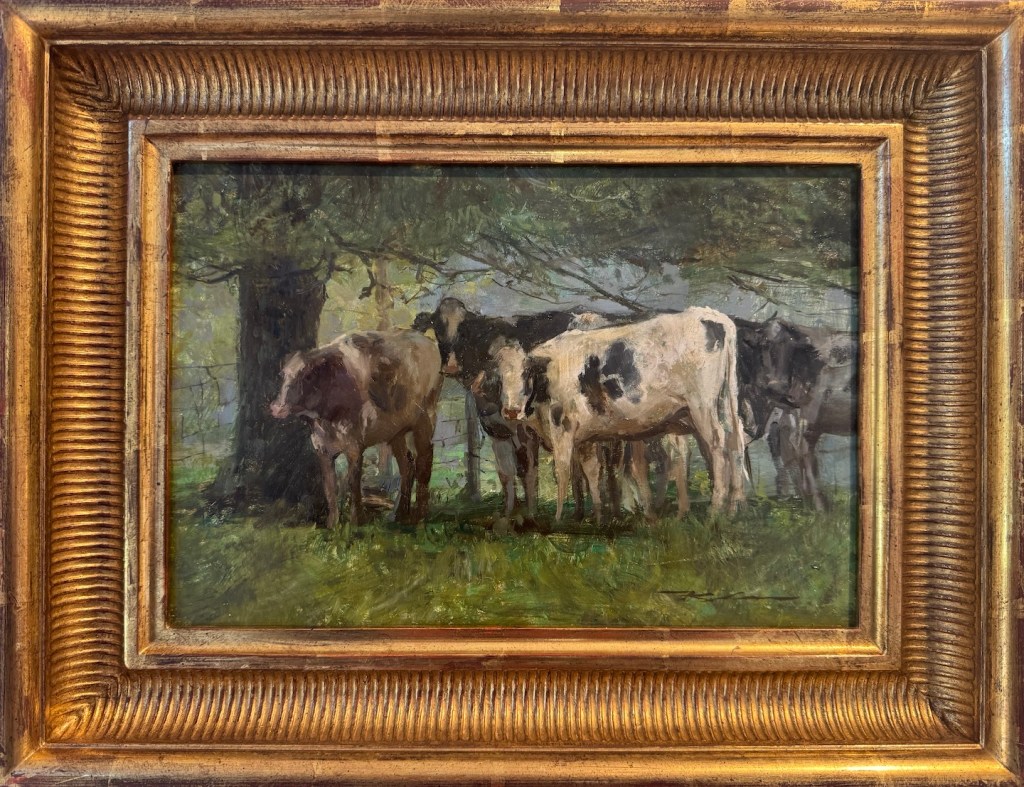
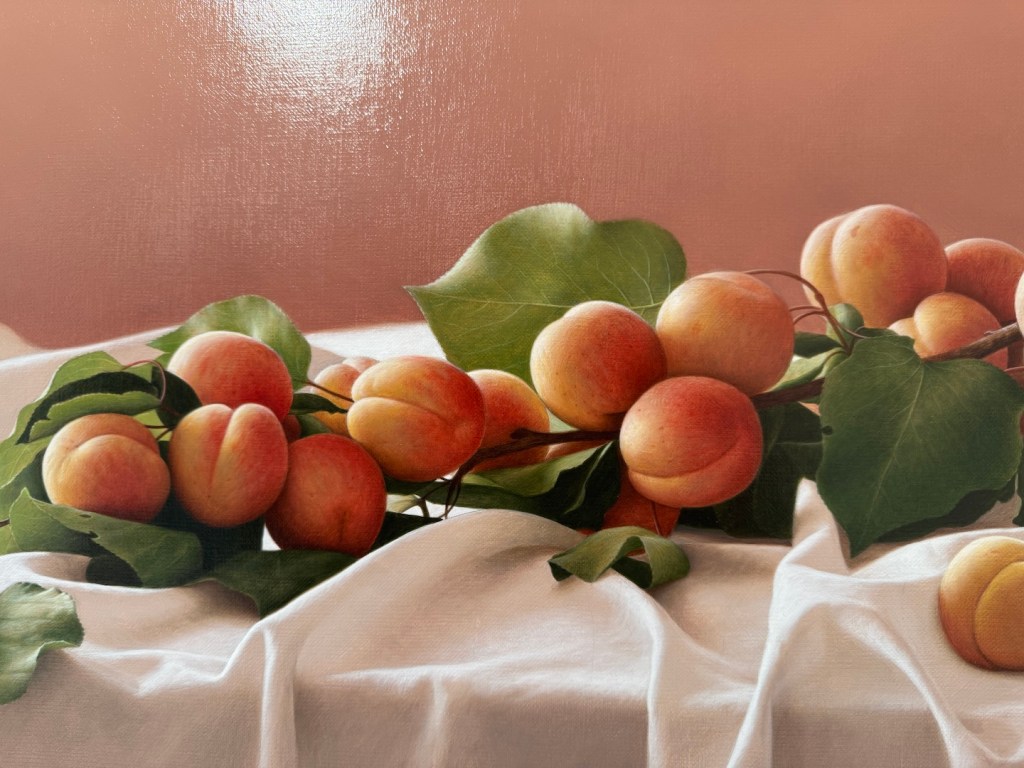
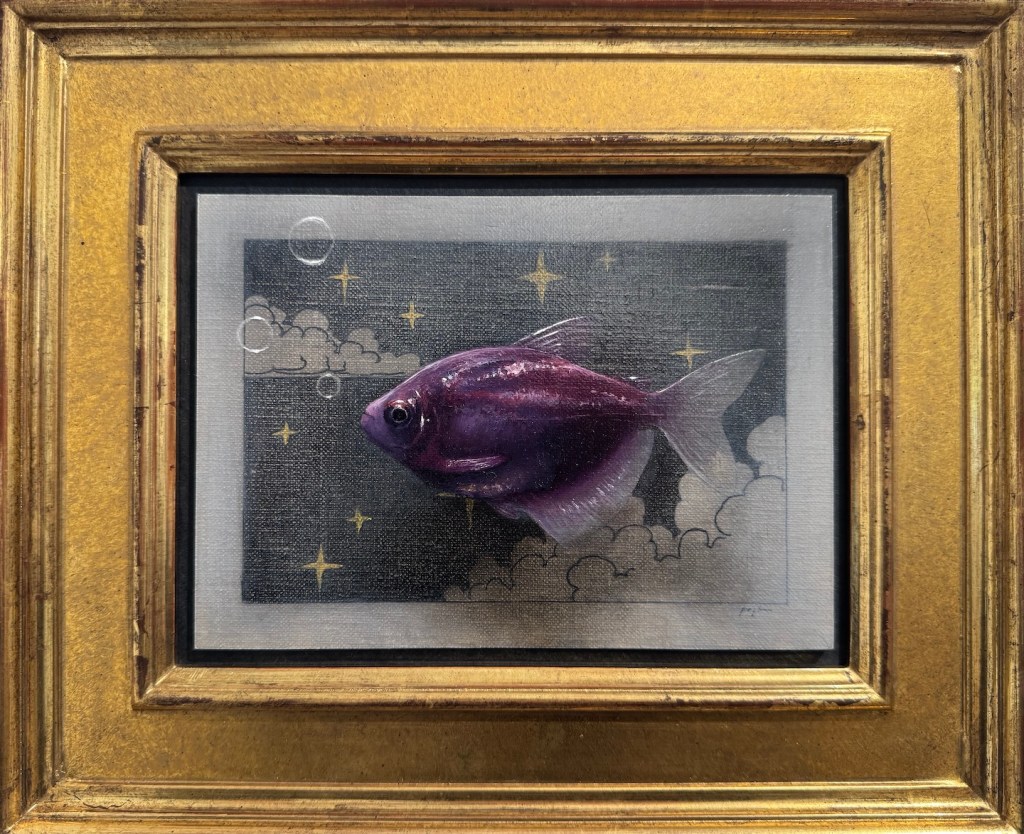
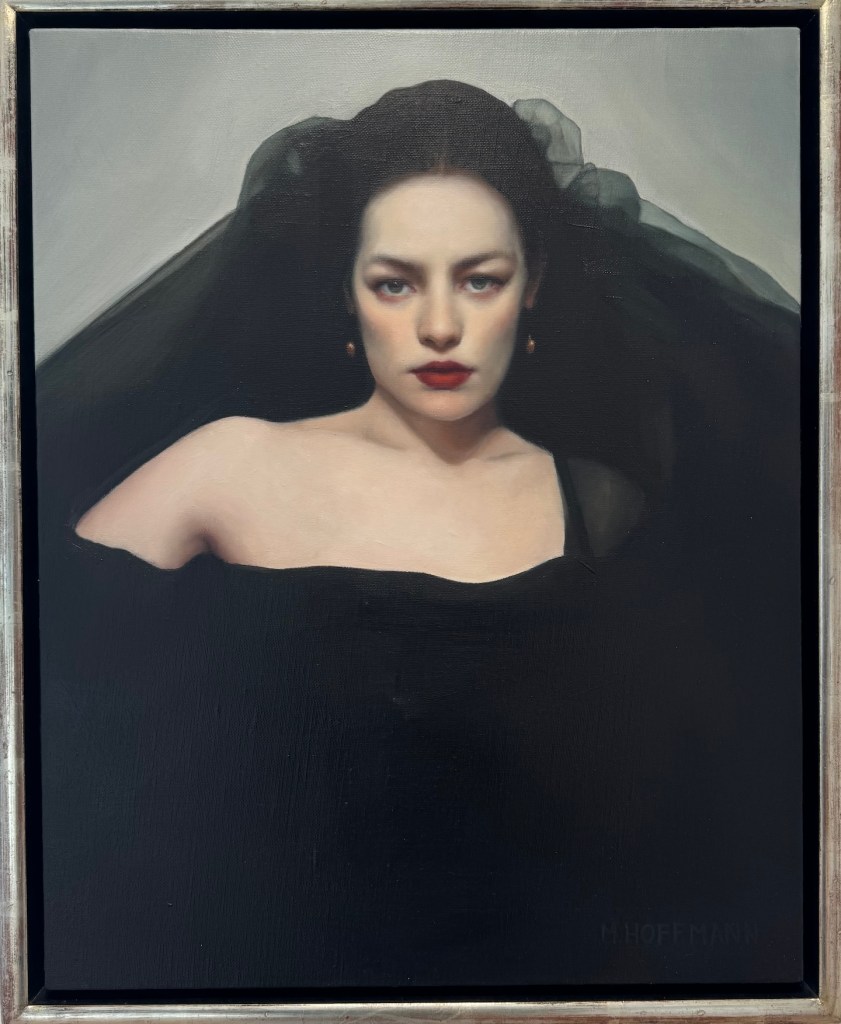
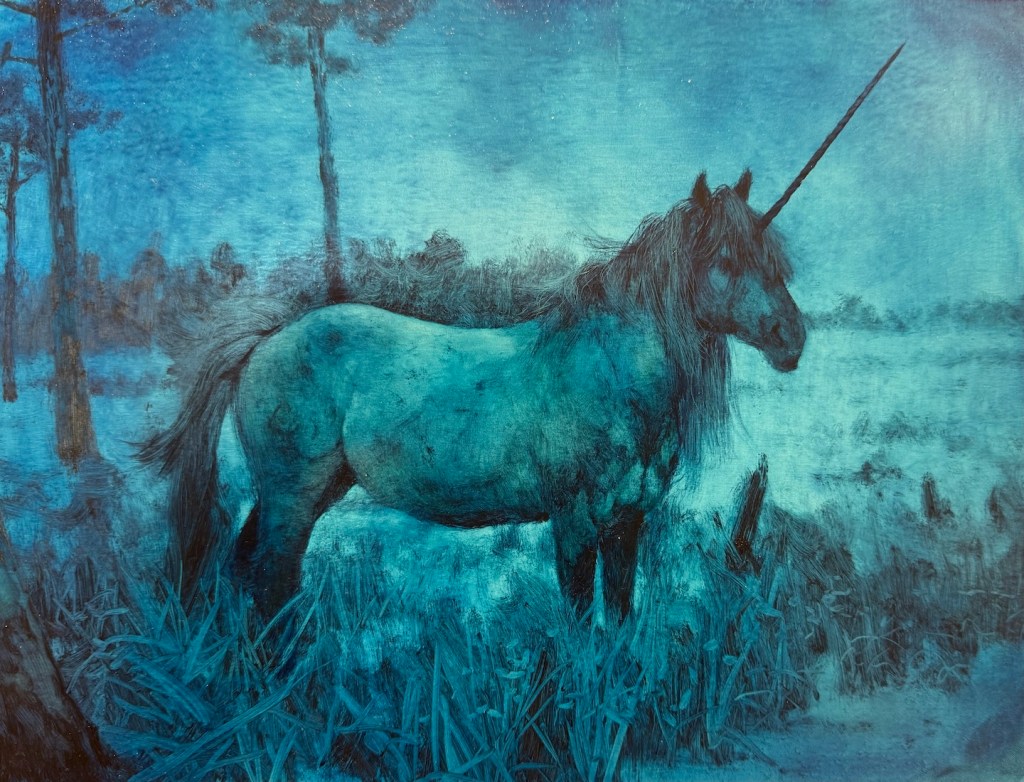
Justin CoburnJamie CorethDaniel SprickMichael Klein Antonio CazorlaMark PughMiriam HoffmanBrad KunkleCindy ProciousMichael Klein
The museum represent the Barlettas’, especially Laura’s taste in art, but it also embodies Michael Klein’s curatorial vision. Like his paintings, the display is a thoughtful and gentle invitation to experience truth and beauty. It is intimate but not small. Strolling from one gallery to another, you enjoy a natural flow of richness in substance and dynamic cohesion. The value of the art and the quality of the setting are in perfect harmony.
The collection is rotated and expanded regularly. I watched YouTube walkthroughs of past exhibitions, and the displays were different from what I saw, making NSMA a destination worth multiple trips.
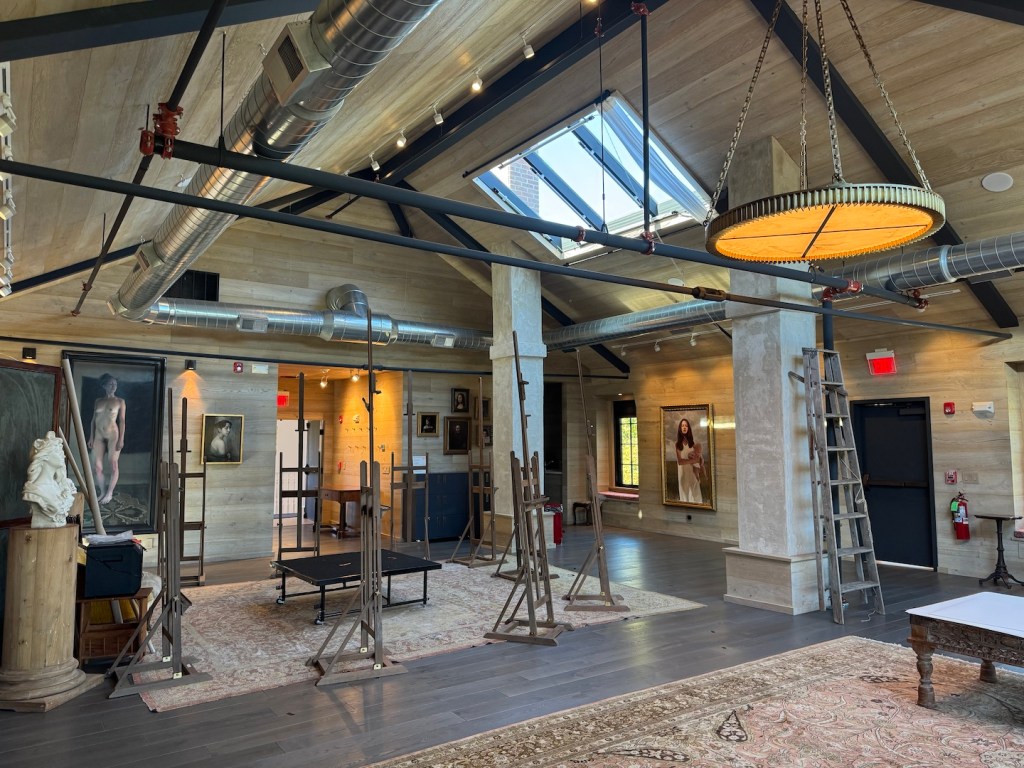
The third floor houses the NSMA Academy, a hub for aspiring artists. It offers workshops and classes led by professionals like Rachel Li for painting and Stephen Saxenian for sculpting. The academy fosters creativity and skill development, creating a space for artists to grow and connect. NSMA also hosts an annual International Painting Competition with a sizable award, welcoming all subject matters in representational art. You can view the 2025 finalists on their website or watch a video review by artist David Kassan.
AcademyVegetable Garden
Following a tip from NSMA’s website, I visited the nearby New Salem General Store, a charming spot that’s part convenience shop, post office, and bakery. I grabbed a couple of freshly baked energy cookies and a hot apple cider, then picnicked in NSMA’s back garden. The view of the pond, paired with the treats, was unforgettable, a perfect complement to the museum visit.
The Pond
Michael Klein once said, “Painting is a luxury that brings joy to our lives; it allows us time to sit in front of nature and be awed by the beauty that exists.” (“Art, God, and Beauty”, Realism Today) NSMA is the perfect manifestation of that. Whether you’re an art enthusiast or just looking for a unique stop, NSMA delivers inspiration and beauty.