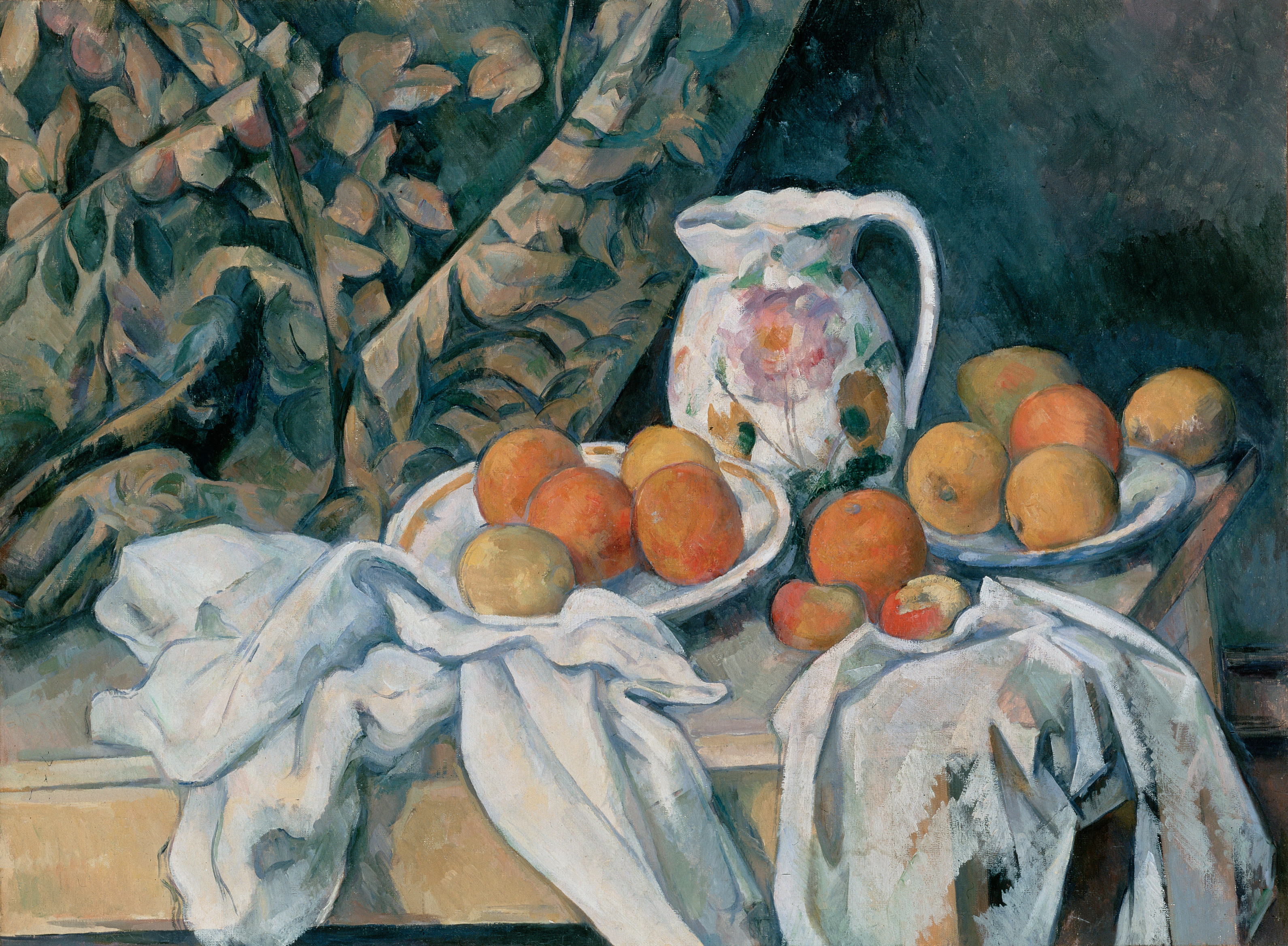
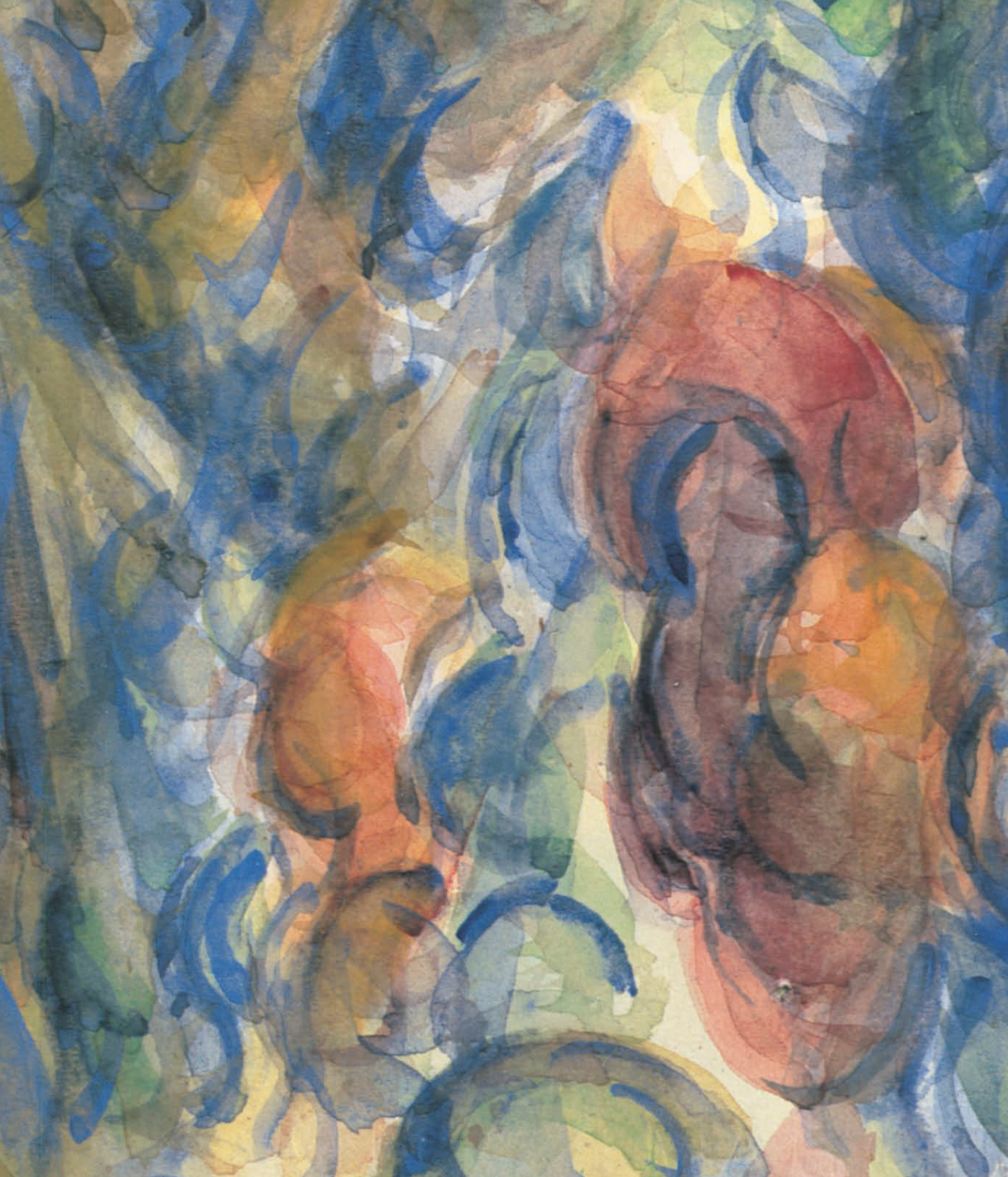
The two watercolor books are a rich collection of the artist’s sketches, finished and unfinished works in the medium. Watercolor and gouache were often used by old masters as studies for a bigger oil piece, and it seems to the be case for Cézanne early on. However, later in his life, when his reputation began to be established, he increasingly make watercolors as independent works of art.
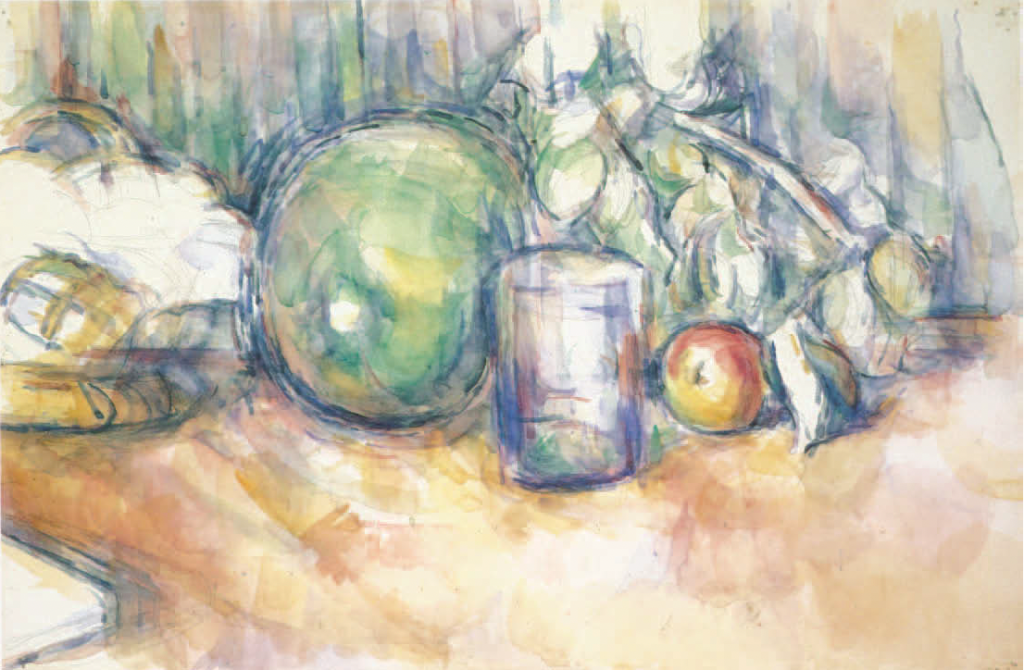
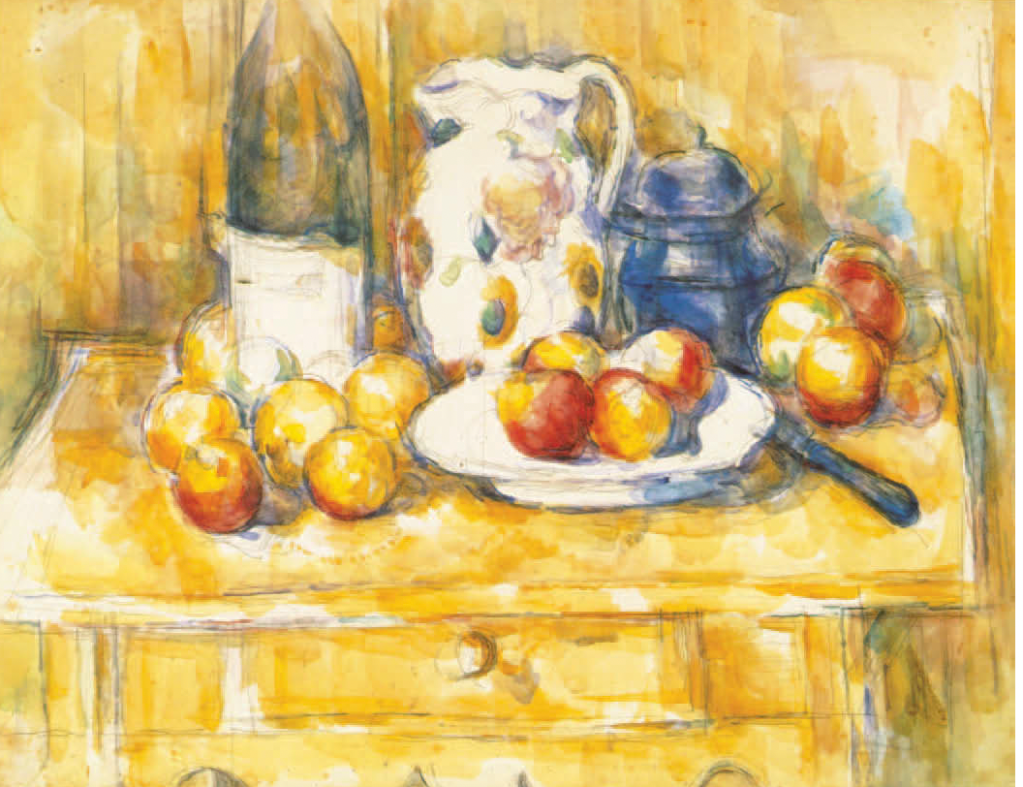
Cézanne’s watercolor is as unconventional as his oil paintings. The charcoal drawings, the white of the paper, and even the artist’s changing thought all become part of the composition. We see the draft, the negotiating and the final status on one page. This provides a unique window into the artist’s painting and the thinking process.
Still life with Green Melon, watercolor on paper, c.1906Still Life with Apples, a Bottle and a Milk Pot, watercolor on paper, c. 1904
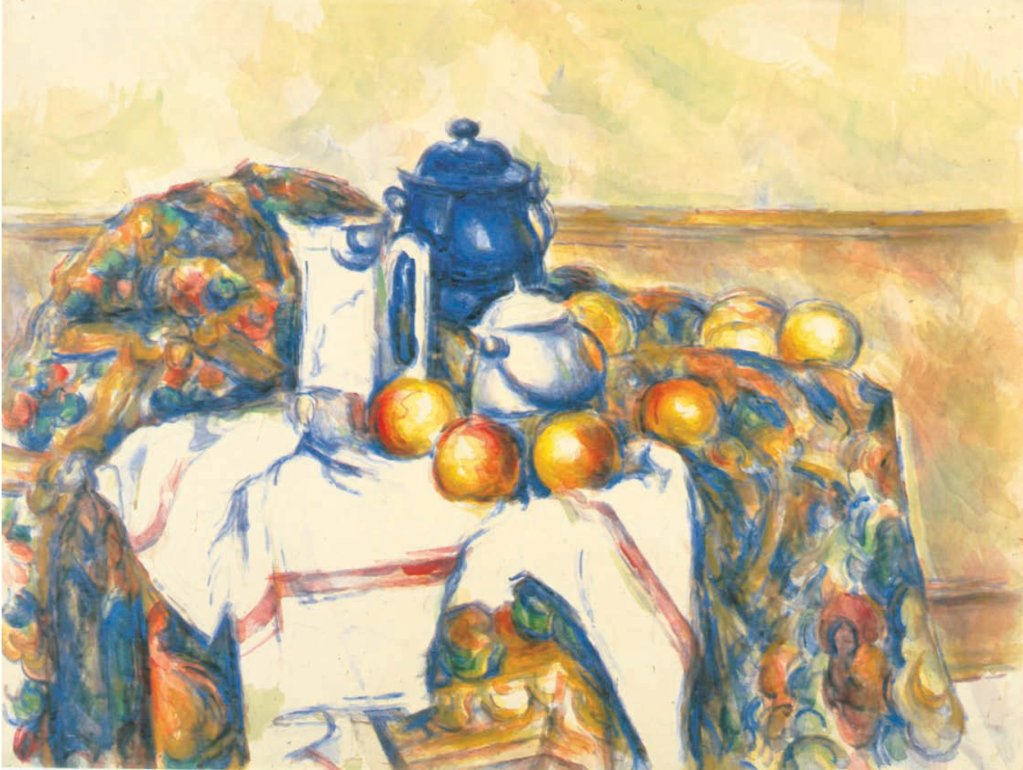
Unlike J. M. W. Turner (1775 – 1851) and other watercolorists, Cézanne adopts a touch by touch and color by color method. He layers translucent patches with gestural brushwork, resulting in a vibrant and casual overall appearance, with fragmentary and kaleidoscopic details. However, the actual process was deliberate and labor-intensive.
Still Life with Blue Pot, watercolor and graphite on paper, 48.1 x 632 cm, c 1900-1906
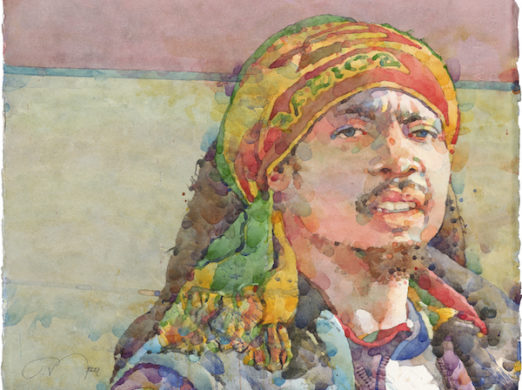
Contemporary figurative artist Ted Nuttall also employs transparent patches of colors to create energetic and vibrant paintings. While both artists are deliberate in their approach, Nuttall’s use of dots helps complete the painting, whereas Cézanne’s colors, used as lines, remain exploratory.
In an attempt to understand more about my “art parent,” (a term borrowed from the Draftsmen Podcast Season 1 Episode 5 YouTube), I recently did some some reading on Cézanne (1839 -1906). The two books by Alex Danchev, Cézanne : A Life, and The Letters of Paul Cézanne (edited and translated) are the most insightful to me.
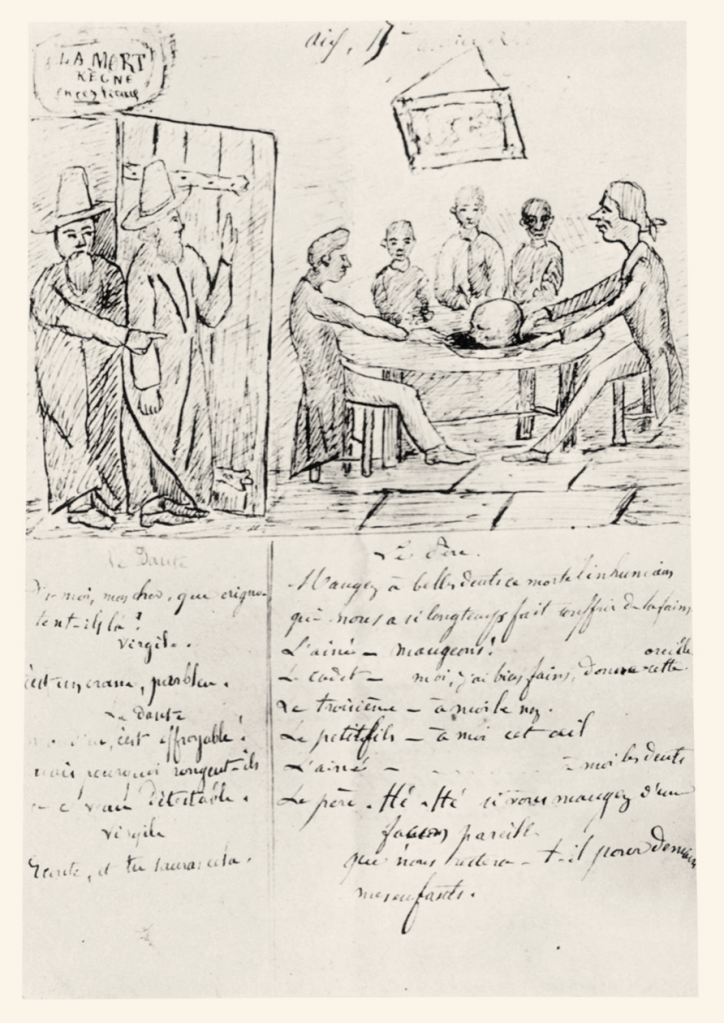
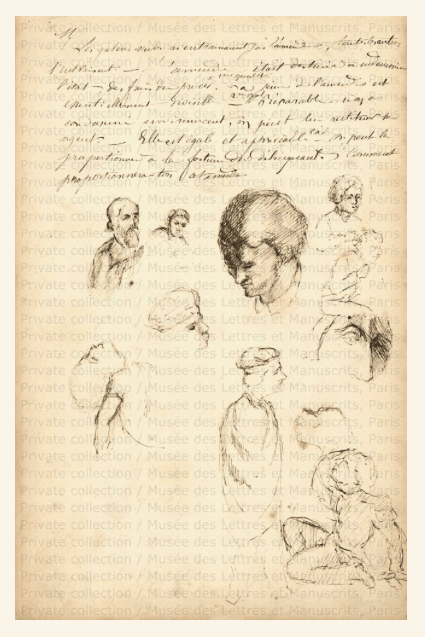
Instead of adhering to a chronological account of the artist’s life, Danchev seems more focused on contextualizing how Cézanne became the artist he was. The wealth of details in the book are well-constructed to provide a comprehensive understanding of the circumstances surrounding Cézanne, his self-perception, and the influence of the artistic community and environment on Cézanne’s paintings. The collection of letters not only serves as a valuable supplement to the biography, but also offers a glimpse into the artist’s penmanship doodles.
Two thoughts comes out of my reading:
First, Cézanne lived the ideal life of an artist. This is not to say he lived an ideal life, far from it, but the all the elements, good or bad, all line up working for him. Cézanne was from a wealthy middle-class background. Despite his family’s lack of support for his artistic pursuits, he was never deprived of financial resources, thanks in part to an inheritance from his father’s passing. Not formally trained as a draftsman, Cézanne was well-educated and immersed in a cultured and intellectual environment. He was a devotee of poetry, from Virgil to Baudelaire, and had a lifelong interest in writers such as Flaubert and Balzac. He may have been a loner in personality, but he managed a marriage and a son. He also was in close contact with devoted friends such as Zola and Pissarro. Despite lacking mainstream recognition for much of his life, Cezanne was always highly valued and admired by fellow artists like Renoir and Monet. Throughout his life, Cezanne faced enough challenges to maintain his edge, while being comfortable enough to never compromise his artistic beliefs and practices.
Secondly, Cézanne was a pure painter. A glance at his sketchbook and the doodles in his letters reveal that he was not an exceptional draftsman, mediocre at best. I once held the view that one must posses strong drawing skills to excel in painting. Cézanne did lament later in his life that he never “had a master” [meaning the traditional apprenticeship]. However, it seems this lack of training did not hinder him from cultivating sophisticated painting skills. Perhaps this was achieved through diligent and mindful practice, or perhaps it even shaped his unique style.
“Taste is the best judge. It is rare. Art speaks only to an excessively small group of people. The artist should scorn all opinion not based on the intelligent observation of character. He should be wary of the mind of the litterateur, who so often diverts the painter from his true path, the concrete study of nature, to waste too much time in abstract speculation. The Louvre is a good book to consult , but it should be only a means. The real, prodigious study to undertake is the diversity of the scene offered by nature.” – Cezanne (Letter to Emil Bernard, 12 May 1904)
I don’t know what to say with these “findings,” especially if they are applicable to us mortals in any sense. After all, as Danchev put it, “He is painting. This is it.” (Cézanne : A Life, p337)
Apart from studies, Emile Zola’s fiction The Masterpiece is both an interesting and relevant reading about Cézanne. The main character Claude Lantier, a revolutionary but ultimately failed artist, is based on Cézanne, while his writer friend, Sandoz, is Zola himself. In the story, the artist lost his son, and eventually hangs himself. Many details about the two friends are believed to be biographical, and the portrayal of the Parisian cultural scene is also quite accurate. However, the novel seems to end the long standing friendship between Zola and Cézanne. No more communication was found between the two ever after.
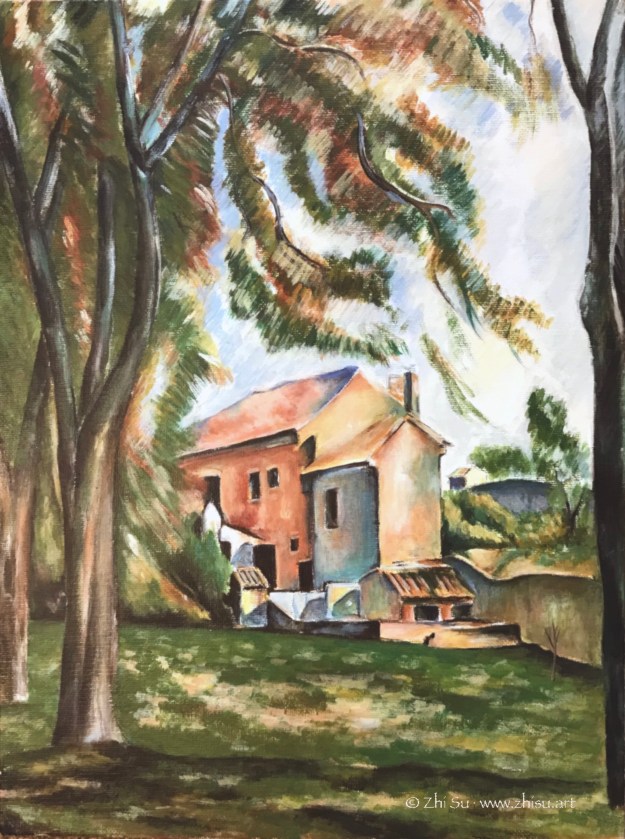
Cézanne’s original is packed with details, there’s subtle changes of color and value on every plane of the house. The trees are built with expressive but economic strokes. I got lost among the leaves.
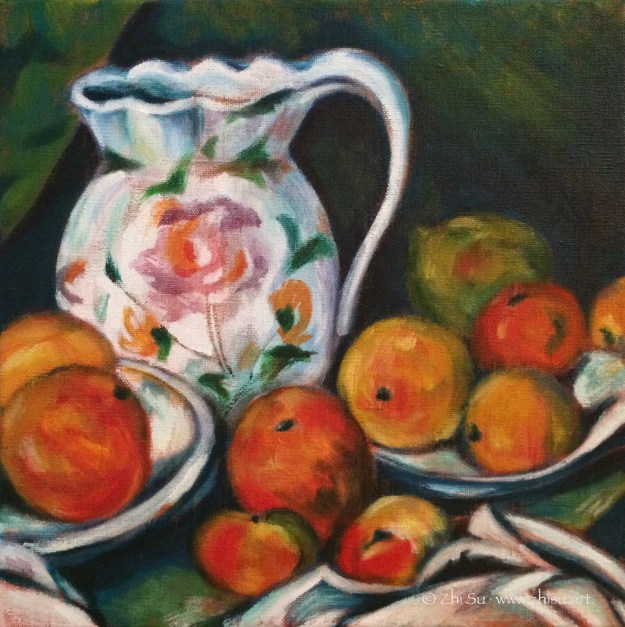
Paul Cézanne (1839–1906) is probably the most influential Post-Impressionist artist, and definitely the most inspiring for me. His colors are layered and strokes deliberate. It takes a lot more work than it seems. In this study I copied only a small section of the original painting.



 ZHI SU